
Why AI for Brand Building Is Rewriting the Rules of Growth
AI for brand building is no longer a future-state experiment — it is the operational infrastructure that separates high-velocity enterprise brands from those losing ground to slower execution, inconsistent messaging, and fragmented creative output.
Here is what enterprise marketing and growth leaders need to know:
| What AI Does for Brand Building | Business Impact |
|---|---|
| Converts brand guidelines into machine-readable intelligence | Every team, tool, and AI agent stays on-brand at scale |
| Automates multilingual content localization | Up to 30% reduction in adaptation time across markets |
| Accelerates global brand audits | 90% faster compliance reviews across thousands of assets |
| Generates personas, positioning, and campaign briefs | Weeks of strategy work compressed into hours |
| Enables hyper-personalized media at scale | Higher acquisition efficiency and lower cost per conversion |
| Reduces legal review cycles | 50% less time spent on compliance bottlenecks |
The shift is structural, not cosmetic. Brands that once managed identity through static PDFs and tribal knowledge are now building living intelligence systems — ones that feed every creative workflow, media buy, and regional deployment with consistent strategic context.
The stakes are high. Coca-Cola’s AI-driven campaign for Y3000 Zero generated 5.2 billion media impressions. Pedigree used geotargeted AI creative to drive six times more shelter visits, with half of those dogs adopted within two weeks. These are not outlier experiments — they are early signals of what systematic AI adoption looks like at scale.
The gap between brands with structured AI infrastructure and those without is widening fast.
I’m Renzo Proano, founder of Berelvant AI, and I have spent my career designing performance marketing systems and AI automation infrastructure for brands managing complex, multi-market operations — including work with Microsoft, Cartier, and StoneX, with over $300 million in digital ad spend under management. My work at the intersection of AI systems and brand performance gives me a direct operational view of what it actually takes to deploy AI for brand building at enterprise scale. In this guide, I will walk you through the frameworks, tools, and strategic decisions that matter most for VP and Director-level leaders who need to move faster, execute cleaner, and build brand equity that compounds.
AI for brand building vocabulary:
From Static Guidelines to Machine-Readable Brand Intelligence
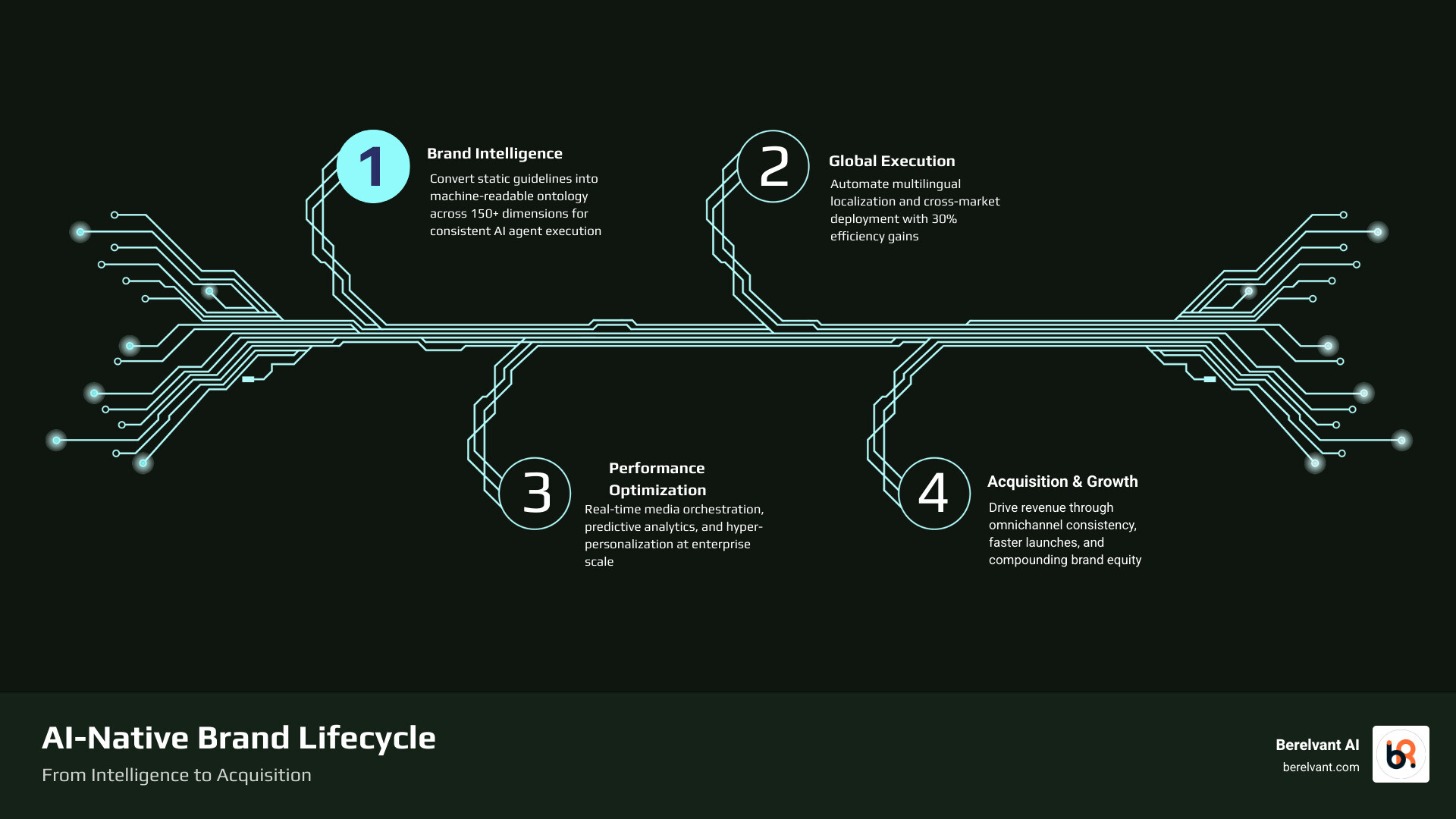
For decades, brand management was a manual, defensive exercise. We created massive PDFs called “Brand Guidelines,” distributed them to agencies, and hoped for the best. In the age of AI for brand building, this approach is a liability. Modern brand work requires a “Brand OS”—a structured intelligence layer that transforms tribal knowledge into machine-readable data.
By mapping a brand across 150+ dimensions—including verbal identity, visual systems, and competitive positioning—we create a Brand Ontology. This isn’t just a digital version of a style guide; it is a live architecture that allows AI to understand why a brand makes certain choices. This structured intelligence ensures that whether a piece of content is generated by a human designer in Connecticut or an AI agent in a regional office, the output remains strategically aligned.
To explore how these systems integrate with broader growth goals, see our insights on AI marketing strategies.
Transitioning from PDFs to Living Brand Systems
The primary bottleneck in enterprise branding is the “search and rescue” mission for assets and guidelines. Integrated brand intelligence platforms solve this by using semantic search. Instead of tagging files with keywords, these systems understand the context of your request.
When your brand intelligence is “living,” it ingests daily signals from the market—social sentiment, competitor moves, and cultural trends. This allows for rapid asset discovery and ensures that the brand doesn’t just sit on a shelf but evolves in real-time. For enterprise leaders, this means moving from a reactive posture to a proactive one where the system suggests strategic opportunities based on current market data.
The Role of AI Agents in Maintaining Brand Context
As AI agents proliferate across marketing, sales, and customer service, they all need one thing: brand context. Without a machine-readable foundation, these agents produce “generic AI slop” that dilutes brand equity.
By implementing AI-driven brand identity systems, we provide these agents with automated guardrails. These systems act as a “Brand Check,” providing risk scores and alignment audits before any asset goes live. This allows for consistency at a scale that was previously impossible, ensuring that every touchpoint—from a chatbot interaction to a global ad campaign—sounds and looks like the brand.
Scaling Global Execution with AI for Brand Building
For enterprise brands operating across the Americas, the challenge isn’t just creating content; it’s localizing it without losing the soul of the brand. Traditional localization is slow and expensive. However, leading brands are now seeing a 30% reduction in the time needed to adapt and localize ads by using AI-native workflows.
According to the 2024 State of Marketing AI Report, adoption is accelerating because marketers realize they “couldn’t live without” these efficiencies.
| Feature | Traditional Manual Localization | AI-Accelerated Global Deployment |
|---|---|---|
| Turnaround Time | 4-6 Weeks | 2-3 Days |
| Consistency | Subjective / High Variance | Algorithmic / High Precision |
| Cost Structure | Linear (Per Asset) | Exponential (Platform Scaled) |
| Compliance | Manual Review Cycles | Automated Guardrails |
Leveraging AI for Brand Building in Market Research
Strategic brand building starts with deep intelligence. AI now allows us to conduct market research at the speed of culture. We use AI agents to perform real-time trend analysis and competitive intelligence, processing thousands of data points from social media, industry reports, and customer feedback.
This data feeds directly into persona development. Instead of static “Marketing Mary” sketches, we build rich, data-driven buyer personas with journey mapping and specific objection-handling strategies. This ensures that the brand’s positioning is rooted in actual customer “pain and gain” points, not just creative intuition.
Optimizing the Content Lifecycle with AI for Brand Building
The modern content lifecycle is no longer a linear path from brief to publish. It is a closed loop. We use generative workflows to launch campaigns 60% faster, but the real value lies in performance-driven iteration.
AI doesn’t just help create the first version of a campaign; it analyzes real-time performance data to suggest optimizations. This “AI-native content lifecycle” means your brand assets are constantly learning and adapting to what drives the most revenue. For more on this, read about generative AI in marketing.
High-Performance Applications: Innovation and Media Orchestration
Enterprise growth requires more than just better ads; it requires better products and smarter resource allocation. AI is now being used for advanced product formulation and innovation. For example, some brands have reduced product development cycles from years to months by using AI to analyze social media recipes and consumer trends.
In media, the shift is toward omnichannel orchestration. We no longer manage channels in silos. Instead, we use a unified engine to ensure that the brand experience is seamless across every touchpoint.
Learn more about how we manage these complex systems in our guide to AI campaign management.
Real-Time Media Optimization and Predictive Analytics
The goal of AI for brand building is to move from looking at what happened (descriptive) to predicting what will happen (predictive). We use predictive modeling to score leads and optimize media spend in real-time.
Tools like LIFT ROI allow us to test and validate ad creative in minutes rather than weeks. This ensures that every dollar of your media budget is backed by data-driven confidence. By using dynamic creative optimization, we can serve thousands of variations of an ad, each tailored to the specific context of the user, while maintaining strict brand alignment.
Hyper-Personalization at Enterprise Scale
Hyper-personalization is the new standard. Customers expect interactions that reflect their specific needs and behaviors. AI allows us to tailor user journeys at scale, triggering personalized offers or content based on predicted churn or purchase intent.
This extends to search. With the rise of AI Overviews, which now appear in over 13% of queries, brands must optimize for “Answer Engines.” Answer Engine Optimization (AEO) focuses on making your brand’s intelligence easily digestible for AI models so that your brand is the one cited in zero-click searches. For the latest data on this shift, check out the latest research on AI Overviews.
Governance, Ethics, and the Human-in-the-Loop Framework
As we integrate AI for brand building, governance becomes the top priority for VP-level leaders. Operating across the Americas means navigating a complex web of data privacy laws, including GDPR and CCPA.
Ethical considerations—such as algorithmic bias and data transparency—are not just “nice-to-haves”; they are essential for brand trust. This is why tools like Typeface Arc, recognized as a TIME Best Invention of 2024, focus on enterprise-grade security and brand safety.
Ensuring Authenticity in AI-Generated Outputs
The biggest risk of AI is “sameness.” If every brand uses the same foundational models, every brand starts to sound the same. To prevent this, we maintain a “human-in-the-loop” framework.
AI is the speed and scale layer, but humans provide the strategic curation and creative integrity. We use AI to generate the “how,” but leaders must define the “what” and “why.” This ensures that the brand voice remains unique and authentic, even when produced at a massive scale.
Managing Compliance in Regulated Industries
For brands in finance, healthcare, or other highly regulated sectors, the legal review process is often where innovation goes to die. AI changes this by automating the compliance check.
By building automated guardrails into the Brand OS, we can reduce legal review and compliance cycles by 50%. The system can flag non-compliant language or visual elements in real-time, providing a full audit trail for every asset created. This allows enterprise brands to move at the speed of a startup without the regulatory risk.
The Future of Brand Leadership: The CMO as Change Management Officer
The role of the CMO is evolving. In the age of AI, the CMO must act as a Change Management Officer. It’s no longer just about the “big idea”; it’s about the systems that allow those ideas to scale.
Strategic vision now includes organizational readiness—ensuring that the team has the skills to manage AI agents and structured data. For more on the evolution of these roles, see our guide on AI digital marketing.
Shifting Value from Execution to Strategic Direction
The value in branding is shifting from “craft” (the execution of a single asset) to “curation” (the strategic direction of a system). When AI handles the repetitive execution tasks, brand leaders are freed to focus on system-level thinking and revenue-driven branding.
This requires a commitment to continuous learning. The brands that win will be those that view AI not as a replacement for designers or strategists, but as a multiplier for their impact.
Frequently Asked Questions about AI for Brand Building
How does AI ensure brand consistency across fragmented global markets?
AI ensures consistency by using a centralized “Brand OS” that serves as the single source of truth. Every AI agent or human creator draws from the same machine-readable rules, ensuring that visual and verbal identity remains uniform across different languages and regions.
What are the primary ethical risks for enterprise brands using generative AI?
The primary risks include data privacy violations, algorithmic bias (where AI reflects unfair stereotypes), and the potential for copyright infringement if models are trained on unlicensed data. Enterprise brands must use tools with built-in compliance and maintain human oversight to mitigate these risks.
How can brands maintain uniqueness when using foundational AI models?
Uniqueness is maintained by feeding the AI specific, proprietary brand context—your Brand Ontology. By layering your unique strategy, voice, and values on top of the foundational model, you ensure the output is distinctively yours rather than a generic average of the internet.
Conclusion
At Berelvant, we believe that AI for brand building is the ultimate performance multiplier. We don’t just use AI to make content; we use it to build end-to-end acquisition systems that drive measurable revenue growth.
By integrating performance media, multilingual creative, and AI automation into a unified engine, we help enterprise brands solve their most complex challenges—from multi-country execution to compliance in regulated industries. The future of branding is intelligent, automated, and relentlessly focused on growth.
To learn how to transform your creative infrastructure, explore our AI digital marketing agency ultimate guide.