
Why the Use of AI in Digital Marketing Is Now an Execution Problem, Not a Strategy Problem
The use of AI in digital marketing has moved well past the experimentation phase. Here is what it covers at the enterprise level:
| AI Application | What It Does | Business Impact |
|---|---|---|
| Content generation | Drafts copy, blogs, ads at scale | Faster creative cycles, lower production cost |
| Predictive analytics | Scores leads, forecasts LTV, flags churn | Higher acquisition efficiency |
| Programmatic advertising | Automates bids, targeting, and creative rotation | Reduced wasted spend, better ROAS |
| Personalization engines | Adapts messaging to behavior and context | Higher engagement and conversion rates |
| SEO automation | Maps intent, audits pages, optimizes metadata | Compounding organic growth |
| CRM and email automation | Triggers personalized sequences in real time | Improved retention and pipeline velocity |
| AI chatbots and agents | Handles queries, qualifies leads, books meetings | 24/7 coverage without headcount growth |
Marketing used to rely heavily on guesswork. You built a campaign, launched it, and waited to see if the numbers moved. AI changes that loop entirely. It processes data faster than any team can, adapts in real time, and removes the manual bottlenecks that slow execution across channels, regions, and languages.
The numbers reflect this shift. In a 2024 PwC survey, 51% of CMOs said they plan to invest in and implement generative AI technologies to enhance performance. Separately, 93% of CMOs report that generative AI is already delivering measurable ROI. And 88% of digital marketers have integrated AI into their workflows in some capacity.
But adoption alone is not the advantage. How you architect and deploy AI inside your growth operation is what separates the leaders from the laugards.
I’m Renzo Proano, founder of Berelvant AI, and I’ve managed over $300 million in digital ad spend across regulated and high-growth markets where the use of AI in digital marketing is not optional — it is the operational backbone. What follows is the framework I use to build these systems for enterprise and mid-market brands that need speed, precision, and accountability at scale.
Discover more about use of ai in digital marketing:
The Architecture of Modern Intelligence: LLMs and the Use of AI in Digital Marketing
To understand the current state of play, we must look under the hood of Large Language Models (LLMs). Models like GPT-4 and Claude 3 are not just “smart search engines.” They are built on transformer architecture, a type of neural network that excels at processing sequential data. This allows the model to understand the context of a sentence, not just the individual words, leading to context-aware outputs that feel increasingly human.
In an enterprise setting, we don’t just use these models to “write a poem.” We use them as the logic layer for complex marketing systems. For example, Generative AI Marketing allows us to synthesize vast amounts of brand guidelines and historical performance data to generate thousands of ad variations that remain strictly on-message.
Furthermore, scientific research on AI for data analysis confirms that AI can process information at speeds and quantities that lead to more accurate business insights than human analysts alone. This is the difference between looking at a spreadsheet and having a system that tells you why a specific cohort is converting.
Decoding the “Generative” in the Use of AI in Digital Marketing
The “Generative” in GenAI refers to the ability to create new content—text, images, video, or code—based on patterns learned during training. These pre-trained models have essentially “read” the internet, learning the statistical relationships between concepts. When we deploy Generative AI in Marketing, we are leveraging pattern recognition to produce content synthesis that would take a human creative team weeks to draft. It is the “speed and scale layer” that turns a single creative brief into a multi-market campaign in hours.
Beyond Chatbots: Agentic Systems and Autonomous Execution
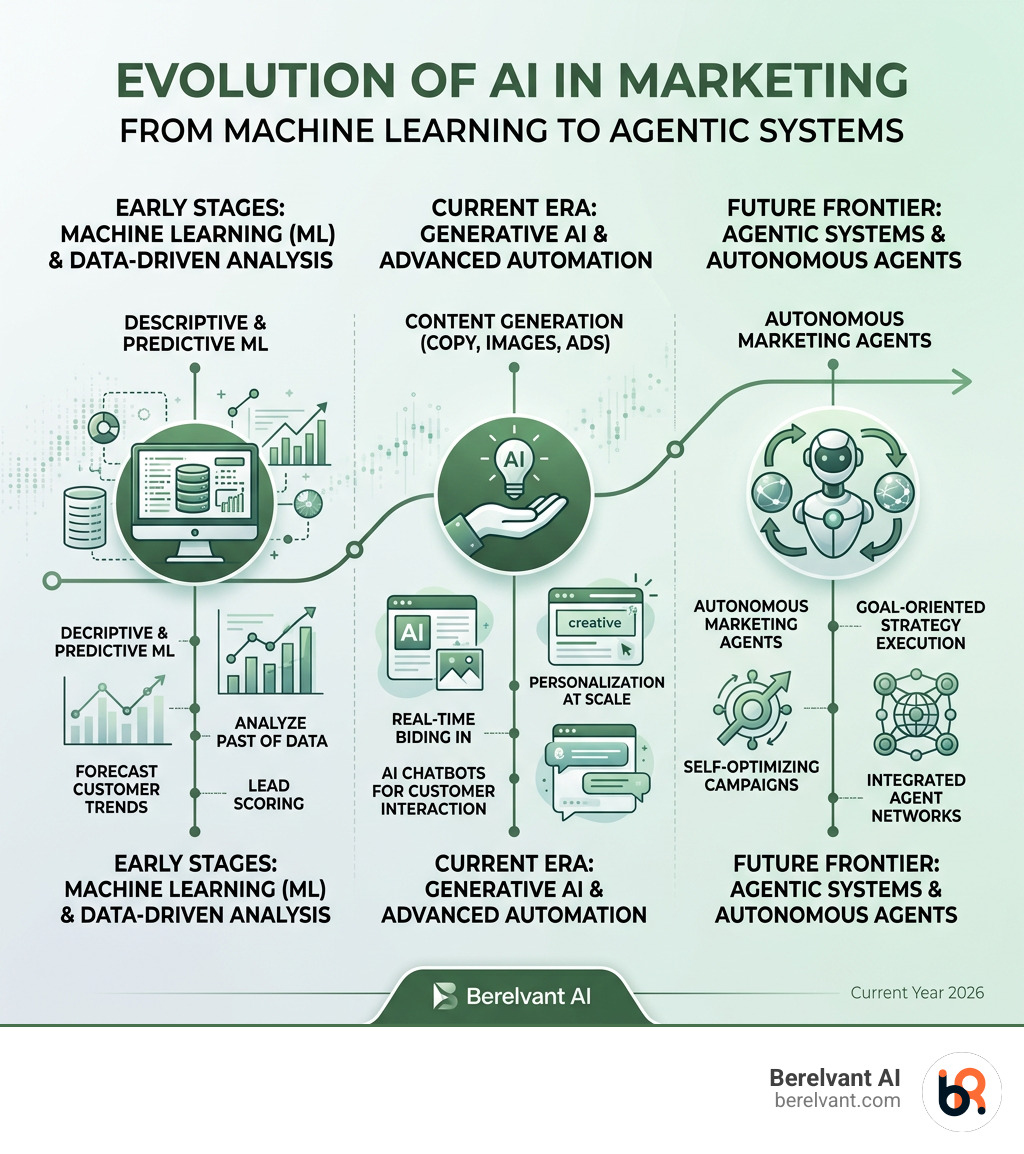
We are moving past the era of “assistive” AI—where you ask a bot a question—into the era of “Agentic” AI. AI Digital Marketing is evolving into autonomous systems. These task-specific agents don’t just suggest a headline; they can be programmed to monitor a campaign, identify a drop in performance, and autonomously swap out a creative asset or adjust a bid to maintain ROI. Gartner projects that by 2028, 33% of enterprise software applications will include agentic AI, enabling more autonomous day-to-day decisions.
Strategic Advantages: Efficiency, Personalization, and Predictive ROI
The shift toward AI is driven by a simple reality: it works. According to a 2024 survey by PwC, more than half of CMOs are already implementing these tools. The efficiency gains are staggering—marketers are reclaiming an average of 13 hours weekly by automating routine tasks.
When we develop AI Marketing Strategies, we focus on three core pillars:
- Efficiency: Removing the “grunt work” of data entry and basic drafting.
- Hyper-personalization: Moving beyond “Hi [First Name]” to messaging that adapts to a user’s real-time behavior and psychographics.
- Predictive ROI: Using historical data to forecast which leads are actually worth the spend.
A Fortune/Deloitte survey on GenAI efficiency found that 79% of CEOs believe generative AI will increase efficiencies, while 52% see it as a primary driver for growth opportunities.
Scaling Creative Infrastructure with the Use of AI in Digital Marketing
For companies operating across the Americas, scaling creative is a nightmare of translation and cultural nuance. AI allows us to build a creative infrastructure that handles multilingual creative and asset variation without losing brand integrity. Generative AI Advertising ensures that a campaign launched in Connecticut can be rapidly adapted for a multicultural audience in Miami or a Spanish-speaking market in Mexico, with brand-safe generation that adheres to local regulations.
Predictive Analytics and High-Intent Lead Scoring
In the mid-market and enterprise space, lead volume isn’t the problem—lead quality is. AI-driven propensity modeling allows us to score leads based on their likelihood to convert, their predicted Lifetime Value (LTV), and even their churn risk. As noted in our AI Digital Marketing Agency Ultimate Guide, this shifts the focus from “how many clicks did we get?” to “how much revenue did we generate?”
Deploying the Enterprise AI Stack Across the Marketing Lifecycle

A true enterprise AI stack is not a collection of separate tools; it is a unified engine. This includes everything from your content infrastructure to your CRM orchestration. By integrating AI Campaign Management, we create a closed-loop system where data from media buying feeds directly into creative optimization.
Optimizing Search Visibility and Technical SEO
SEO is no longer just about keywords; it’s about intent mapping and entity relevance. AI tools now perform automated audits and on-page scoring with a level of detail that manual teams can’t match. Importantly, we follow Google’s guidance on AI-generated content, which rewards high-quality, helpful content regardless of how it was produced, provided it meets the E-E-A-T (Experience, Expertise, Authoritativeness, and Trustworthiness) standards.
Performance Media and Automated Ad Orchestration
In programmatic media, milliseconds matter. We use AI for bid shading and win-rate prediction to ensure we aren’t overpaying for impressions. AI-driven bid management research shows that these systems can reduce wasted ad spend by up to 37%. By using dynamic creative optimization, we can serve the perfect ad to the perfect user at the perfect time, automatically.
Navigating Governance: Ethics, Privacy, and Risk Management
With great power comes significant responsibility. The use of AI in digital marketing introduces risks like algorithmic bias and data privacy concerns. Enterprise leaders must be vigilant. Scientific research on AI bias and inaccuracy highlights that if a model is trained on skewed data, it will produce skewed results. This is why a “human-in-the-loop” approach is non-negotiable for brand safety.
Mitigating Bias in Automated Decision Systems
To prevent unfair results, we must use diverse datasets and conduct regular auditing of our AI systems. This requires cross-functional oversight—marketing, legal, and data science teams working together to ensure that our automated decisions don’t inadvertently discriminate or violate ethical standards.
Data Sovereignty and Enterprise Security
For our clients in Fairfield and Westport, CT, data protection is paramount. Adhering to GDPR compliance and CCPA regulations is the baseline. We prioritize data sovereignty, often using secure, private LLM instances that ensure first-party data is never used to train public models. Anonymization and strict encryption protocols are built into every acquisition system we manage.
Future-Proofing the Growth Engine: 2026 and Beyond
Looking toward 2026, the trend is clear: more autonomy and more “Agentic Commerce.” Gartner projects on autonomous agents suggest that AI will soon handle end-to-end transactions without human intervention. We are also seeing a massive shift in how users find information. Google’s data on visual search trends shows that billions of searches are now happening via Lens, and voice-activated queries are becoming a primary interface.
As McKinsey’s 2025 update on personalization notes, 71% of consumers now expect tailored interactions. To meet this demand, businesses must build for real-time responsiveness and massive scalability. The goal isn’t just to keep up; it’s to build a growth engine that learns and improves every single day.
Frequently Asked Questions about AI in Marketing
How does AI provide a competitive advantage in regulated industries?
In industries with heavy compliance requirements, AI acts as a sophisticated “compliance filter.” It can scan thousands of assets in seconds to ensure every word meets regulatory standards, allowing for faster execution in environments where manual legal review traditionally creates months of delay.
What are the primary risks of using AI for content generation?
The biggest risks are “hallucinations” (the AI confidently stating false information), lack of unique brand voice, and potential copyright issues. This is why we treat AI as a “speed layer” for first drafts, but always require human experts to verify, edit, and inject the “heart” into the final output.
How can enterprise leaders measure the ROI of AI implementation?
ROI should be measured through three lenses: Cost Savings (hours reclaimed and reduced production costs), Efficiency Gains (faster time-to-market for campaigns), and Revenue Growth (lift in conversion rates and LTV due to better targeting and personalization).
Conclusion
At Berelvant, we don’t view AI as a replacement for human ingenuity; we view it as a multiplier. We are an enterprise growth and performance partner that builds end-to-end acquisition systems designed for the complexities of the modern market. Whether it’s managing performance media across the Americas, executing multilingual creative, or navigating compliance-heavy environments in Fairfield County, Connecticut, we integrate AI as the unified engine that drives measurable revenue.
The use of AI in digital marketing is the bridge between traditional strategy and future-proof execution. If you are ready to move from “using pencils” to deploying a high-speed, autonomous growth engine, we are here to build it with you.