
Why Online Sales Growth Is the Most Important Metric You’re Not Measuring Precisely Enough
Online sales growth is accelerating faster than most enterprise teams can track — and the gap between leaders and laggards is widening.
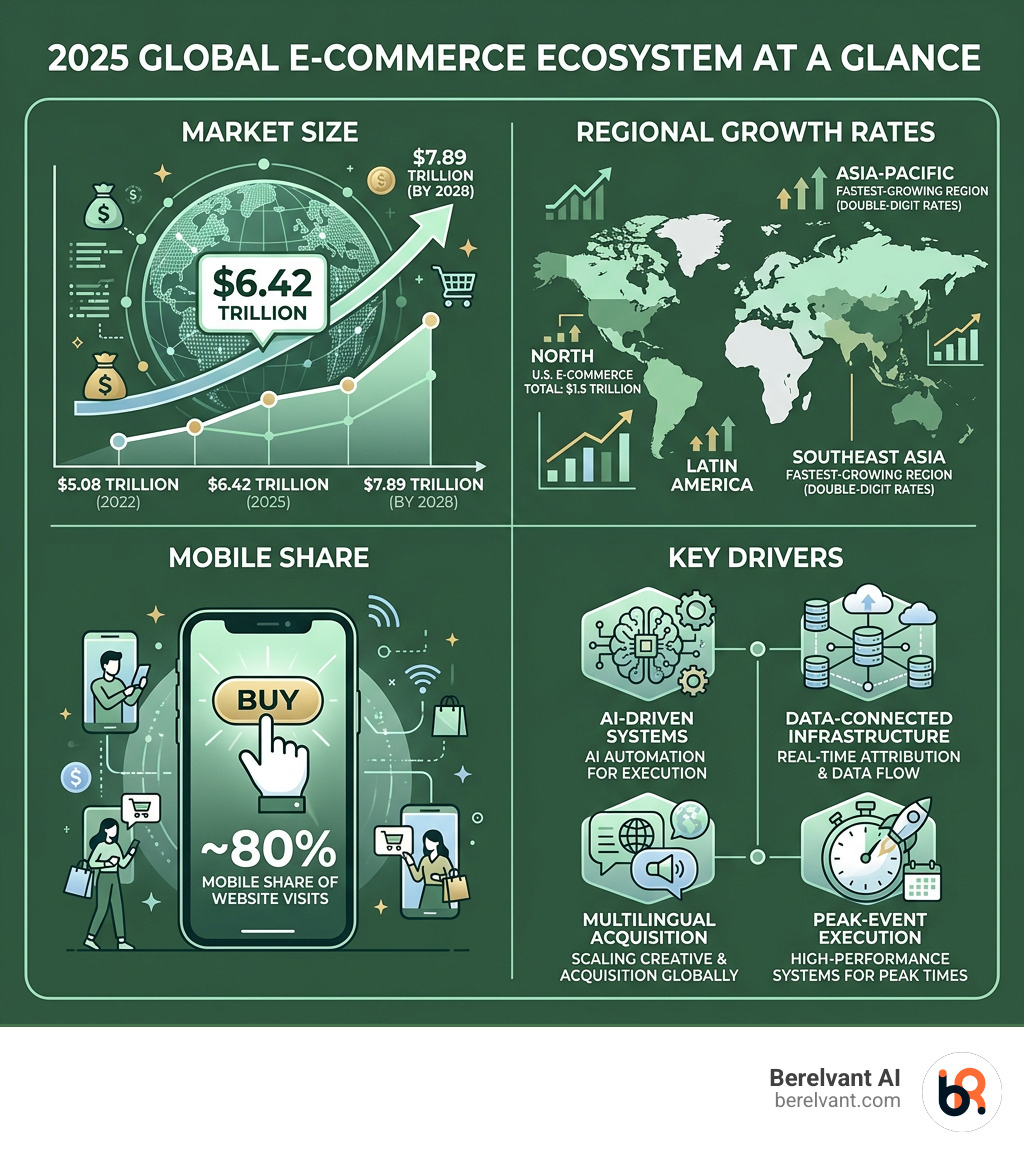
Here is a quick snapshot of where things stand in 2025:
| Metric | 2025 Figure |
|---|---|
| Global e-commerce market size | $6.42 trillion |
| U.S. e-commerce total | $1.5 trillion (first time ever) |
| U.S. e-commerce penetration | 22.7% of total retail |
| Year-over-year U.S. growth | 9.24% |
| Mobile share of website visits | ~80% |
| Projected global market by 2028 | $7.89 trillion |
| Fastest-growing region | Asia-Pacific (double-digit rates) |
The numbers are not the problem. Most VP and Director-level leaders already know the market is growing. The real challenge is execution — moving fast enough to capture share, attributing performance across fragmented channels, and scaling creative and acquisition systems across regions without losing control.
Global e-commerce grew from $5.08 trillion in 2022 to $6.42 trillion in 2025. That is a compounding structural shift, not a trend. And it is happening simultaneously across North America, Southeast Asia, and Latin America — each market with its own payment infrastructure, regulatory environment, and consumer behavior.
The teams winning right now are not just spending more. They are building systems — AI-driven, data-connected, multilingual acquisition engines that operate faster than internal teams can move manually.
I’m Renzo Proano, founder of Berelvant AI, and I’ve managed over $300 million in digital ad spend while driving online sales growth for enterprise and high-growth brands across e-commerce, financial services, SaaS, and regulated markets. In this guide, I’ll show you exactly how to architect those systems — from infrastructure and AI automation to cross-market expansion and peak-event execution.
Online sales growth terms at a glance:
The Global Landscape of Online Sales Growth in 2025
As we navigate the mid-2020s, the scale of digital commerce has reached a point of absolute ubiquity. According to U.S. Census Bureau data, the definition of e-commerce has expanded to include any transaction where terms are negotiated or orders are placed via internet, mobile, extranet, or EDI systems. This broad definition reflects a reality where digital is no longer a “channel” but the primary nervous system of global trade.
The global market is currently valued at approximately $6.42 trillion. While mature markets like the U.S. continue to post record-breaking numbers, the center of gravity is shifting. We are seeing Statista E-commerce reports that highlight a 21.1% global retail share for e-commerce, a figure projected to climb toward 25% by 2027.
Asia-Pacific remains the undisputed heavyweight in this arena. China alone controls nearly 40% of the global market, but emerging players in Southeast Asia (Philippines, Thailand, Malaysia) and Latin America (Mexico, Ecuador) are seeing growth rates between 14% and 23%. For enterprise leaders, this means online sales growth is no longer just about optimizing a domestic storefront; it is about managing a complex, multi-currency, and multilingual ecosystem.
Benchmarking U.S. Online Sales Growth Against Global Trends
In the United States, the story is one of sustained, high-volume expansion. U.S. e-commerce sales exceeded $1.5 trillion in 2025—a staggering figure that is more than double the $717 billion recorded in 2019. This 9.24% year-over-year increase demonstrates that even as the initial pandemic-era surge subsides, the structural shift toward digital remains permanent.
U.S. e-commerce penetration reached a record 22.7% of total retail sales in 2024. Projections from eMarketer and other industry analysts suggest that if current trends hold, digital commerce will represent 30% of all U.S. retail by 2030. For VPs of Growth, this means that captured market share is increasingly coming from digital-first competitors who can operate with lower overhead and higher speed.
Sector-Specific Performance and B2B GMV
While B2C gets the most headlines, the real sleeping giant is B2B e-commerce. Projections indicate that global B2B e-commerce GMV could reach a massive $62.2 trillion by 2030. This growth is driven by a generational shift in procurement: B2B buyers now expect the same seamless, omnichannel experience they get as individual consumers.
In the B2C sector, fashion and consumer electronics remain the dominant verticals. However, groceries and consumer packaged goods (CPG) are seeing the fastest adoption curves in emerging markets. This shift requires a rethink of logistics and fulfillment—moving from centralized hubs to hyper-local “quick-commerce” models that promise delivery in under 30 minutes.
Architecting High-Performance Infrastructure for Scalability
To sustain double-digit online sales growth, your technical infrastructure must be more than just “functional”—it must be an acquisition engine. We see too many enterprises struggling with legacy stacks that cannot handle the demands of modern, multi-country execution.

The shift to mobile is no longer a “trend”—it is the baseline. In 2025, smartphones accounted for nearly 80% of all retail website visits worldwide. If your mobile experience is a downgraded version of your desktop site, you are effectively turning away 80% of your potential revenue. High-performance infrastructure today requires a mobile-first, app-like experience that integrates seamlessly with omnichannel operations.
Optimizing the Checkout and Conversion Funnel
The single biggest bottleneck to online sales growth remains the checkout process. Global cart abandonment rates hover around 70%, and on mobile, that figure can spike to 84%. Most of this friction is self-inflicted: unexpected shipping costs, forced account creation, and limited payment options.
Enterprise leaders must prioritize:
- One-Click Checkout: Reducing the steps from “cart” to “complete” is the fastest way to boost ROI.
- Digital Wallet Integration: Digital wallets are projected to account for 65% of global e-commerce payments by 2030. If you aren’t supporting Apple Pay, Google Pay, and regional leaders like AliPay or Mercado Pago, you are losing conversions.
- Buy Now, Pay Later (BNPL): During peak periods like November 2025, BNPL usage grew by 9%, reflecting a consumer demand for flexible financing at the point of sale.
Fulfillment Systems and Quick-Commerce Integration
Logistics is now a marketing tool. Customer expectations have evolved from “free shipping” to “immediate delivery.” To compete, we are seeing a massive trend toward outsourced fulfillment and warehouse automation. Roughly 60% of retailers now outsource at least a portion of their fulfillment to specialized partners to maintain speed without the capital expenditure of building their own global networks.
Automation in omnichannel warehouses has reached a productivity tipping point. By integrating AI-driven inventory management, enterprises can predict demand spikes before they happen, ensuring that the right products are in the right regional hubs before the customer even clicks “buy.”
Deploying AI and Automation Systems for Revenue Acceleration
At Berelvant, we view AI as the “speed and scale” layer of modern commerce. It is the only way to manage the sheer volume of data and creative permutations required for global acquisition systems. In 2025, generative AI traffic to e-commerce sites increased by a staggering 758% year-over-year, as consumers began using AI agents to research and curate their shopping lists.
Driving Online Sales Growth Through AI-Powered Personalization
Personalization is no longer about putting a customer’s name in an email. It is about dynamic, real-time adjustments to the entire shopping experience. AI-driven personalization can boost e-commerce revenues by up to 40% through:
- Predictive Product Recommendations: Analyzing historical data to suggest the next logical purchase.
- Dynamic Pricing: Adjusting prices in real-time based on demand, inventory levels, and competitor activity.
- Tailored Messaging: Using LLMs to generate multilingual creative that resonates with specific multicultural audiences in their native nuances.
By leveraging ZyGro and similar AI-powered insights, retailers can move from reactive marketing to proactive revenue generation.
Unified Data Integration and Performance Analytics
Data fragmentation is the enemy of online sales growth. When your Facebook ads data, Google Analytics, and ERP information live in separate silos, you cannot see the true path to conversion. This is why we emphasize unified data integration.
Using tools like TROCCO, businesses can integrate disparate data streams into a single source of truth. This allows for:
- Accurate Attribution: Knowing exactly which touchpoint in a multi-country campaign drove the final sale.
- SMART Goal Tracking: Monitoring real-time progress against KPIs like a 20% traffic increase or a 5% conversion boost.
- Real-Time PPC Optimization: Using machine learning to adjust bids across thousands of keywords every minute, ensuring you never overpay for a lead.
Strategic Expansion into Emerging and Regulated Markets
For enterprise growth, the “Americas” isn’t a single market—it’s a collection of distinct regulatory and cultural environments. Success in Westport, CT, looks very different from success in Mexico City or São Paulo. We specialize in navigating these compliance-heavy and multicultural environments.
Navigating the Americas and Asia-Pacific Corridors
The fastest-growing sources of e-commerce sales are currently in Southeast Asia and Latin America. However, these regions present unique challenges:
- Payment Fragmentation: High reliance on cash-based digital payments (like OXXO in Mexico).
- Logistics Hurdles: “Last-mile” delivery in high-density urban areas or remote regions.
- Regulatory Compliance: Strict data privacy and consumer protection laws that vary by country.
To win here, enterprise brands must adopt an “online-first” playbook that prioritizes localized creative and regional payment infrastructure.
Leveraging Peak Shopping Events for Record Growth
Shopping events like Black Friday, Cyber Monday, and Singles’ Day (11.11) are no longer just “busy days”—they are massive stress tests for your acquisition systems. In November 2025, U.S. e-commerce sales hit $130.12 billion, with Cyber Monday alone accounting for $14.25 billion.
Winning these events requires:
- Capacity Planning: Ensuring your site and app can handle 10x normal traffic.
- Peak Logistics: Pre-positioning inventory based on predictive analytics.
- Remarketing Systems: Deploying automated remarketing campaigns to capture the 70% of shoppers who abandon their carts during the holiday rush.
Frequently Asked Questions about Online Sales Performance
What is the projected size of the global e-commerce market by 2030?
The global e-commerce market is expected to reach approximately $8.91 trillion by 2030. This growth represents a steady climb to a 30% share of total retail. The primary drivers will be the continued digitalization of emerging markets and the maturation of AI-driven “unified commerce” where the lines between online and offline shopping disappear entirely.
How does mobile commerce impact enterprise sales performance?
Mobile commerce (m-commerce) now accounts for 59% of total online sales, representing over $4 trillion in global revenue. For enterprise leaders, this means that mobile-optimized checkout and app-based retention strategies are the most critical factors in maintaining a competitive conversion rate. Mobile isn’t just a discovery tool; it is where the transaction happens.
What are the primary drivers of B2B e-commerce growth?
The B2B sector is being transformed by digital procurement and hybrid sales models. With a projected GMV of $62.2 trillion by 2030, the drivers include:
- Self-Service Portals: B2B buyers increasingly prefer to research and order without speaking to a rep.
- Marketplace Dominance: Platforms like Amazon Business and Alibaba are capturing massive shares of the tail-end spend.
- Data-Driven Personalization: Using historical purchase data to automate re-orders and suggest relevant upsells.
Conclusion
Achieving sustainable online sales growth in 2025 and beyond requires more than just a better ad campaign. It requires a fundamental shift toward system-level thinking. You need an infrastructure that scales, an AI layer that accelerates, and a data strategy that unifies your global operations.
At Berelvant, we don’t just “run ads.” We build the end-to-end acquisition systems that allow enterprise brands to dominate across the Americas and beyond. By integrating performance media, multilingual creative, and AI automation into one unified engine, we remove the bottlenecks that hold back your revenue.
If you are ready to stop managing tactics and start scaling a system, let’s talk. We help VP and Director-level leaders solve the complex challenges of regulated industries, multicultural audiences, and multi-country execution.
Explore more of our insights on unique ways to increase sales or connect with us at Berelvant AI to see how we can accelerate your growth engine.