Why Enterprise Leaders Are Betting on AI to Transform Marketing Operations
Artificial intelligence in digital marketing examples are no longer experimental—they’re driving measurable revenue growth, operational efficiency, and competitive advantage for organizations that execute at scale. From Netflix’s $1 billion recommendation engine to Google’s autonomous Performance Max campaigns delivering 18% more conversions, AI has shifted from marketing automation to strategic infrastructure. The technology now powers predictive analytics, multilingual creative production, real-time audience discovery, and compliance-ready execution across regulated markets.
Top artificial intelligence in digital marketing examples include:
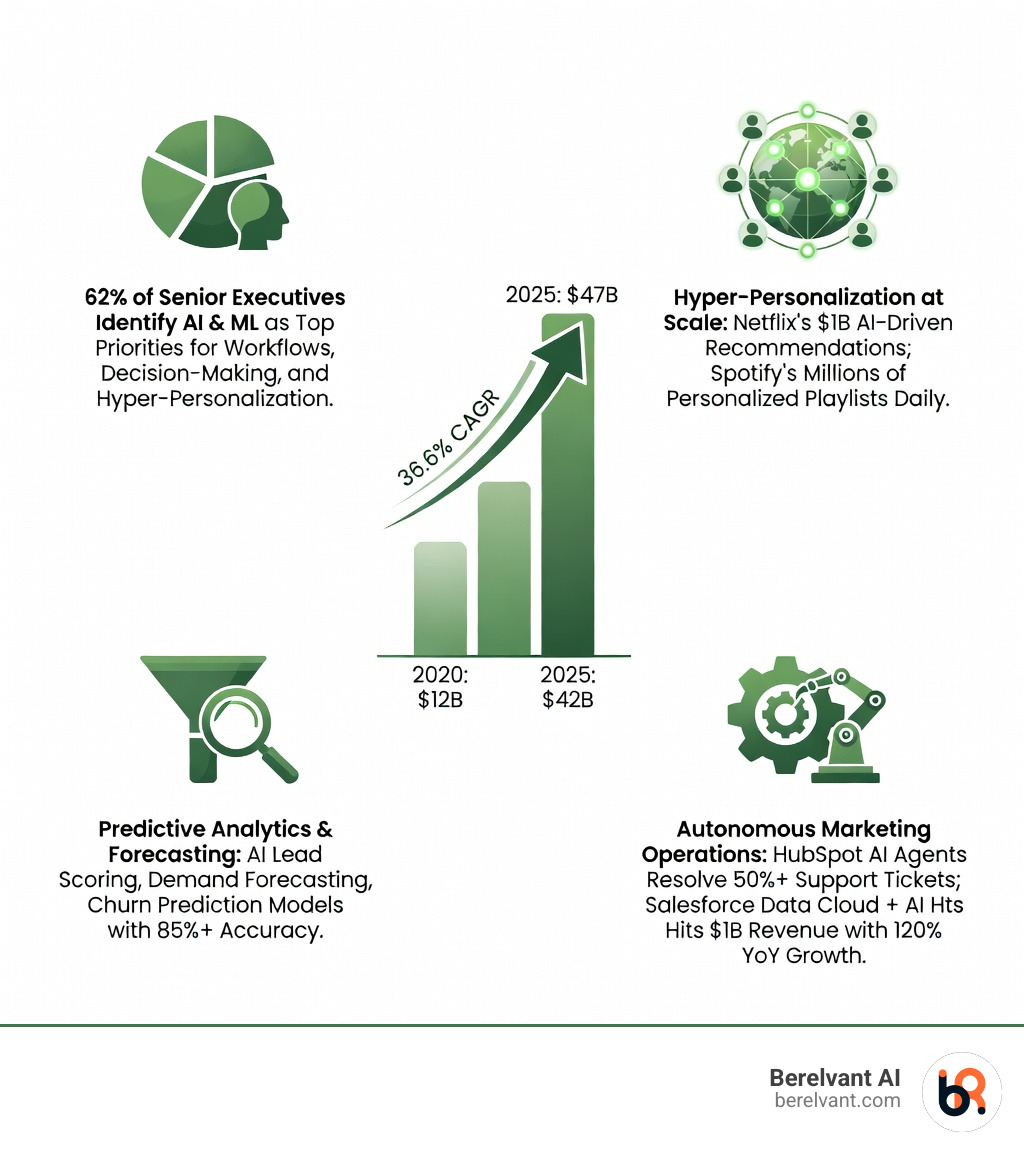
- Hyper-personalization at scale: Netflix generates $1B annually from AI-driven content recommendations; Spotify curates millions of personalized playlists daily
- Predictive analytics and forecasting: AI lead scoring, demand forecasting, and churn prediction models with 85%+ accuracy; closed-loop LTV attribution
- Generative AI for creative production: 50% faster campaign development; automated video remixing; multilingual asset generation at studio quality
- Autonomous marketing operations: HubSpot’s AI agents resolve 50%+ of support tickets; Salesforce Data Cloud + AI hit $1B revenue with 120% YoY growth
- Performance media optimization: Google Ads’ broad match delivers 35% more conversions; Performance Max finds new customers across inventory with 18% lift
- Enterprise SEO automation: Real-time content optimization; intent-based keyword mapping; 20x organic traffic growth through AI-powered workflows
- Fraud detection and compliance: 90% reduction in fraudulent payouts; GDPR and CCPA-compliant data handling in regulated industries
The global AI in marketing market is projected to reach $47 billion by 2025, up from $12 billion in 2020—a 36.6% compound annual growth rate. Meanwhile, 62% of senior executives identify AI and machine learning as top priorities for workflows, decision-making, and hyper-personalization. Organizations not building AI capabilities today are falling behind competitors who are already scaling execution, reducing acquisition costs, and delivering compounding growth through intelligent systems.
I’m Renzo Proano, and I’ve architected AI-driven acquisition systems and performance marketing infrastructure for brands across financial services, SaaS, and e-commerce, managing over $300 million in digital ad spend. Through building artificial intelligence in digital marketing examples for enterprise clients and developing AI infrastructure for CVRedi—my career platform serving thousands across LATAM—I’ve deployed speech-to-text, natural-language evaluation, agent orchestration, and cross-platform automation at scale.
Know your artificial intelligence in digital marketing examples terms:
The Strategic Impact of Artificial Intelligence in Digital Marketing Examples
The shift from “gut instinct” to data-driven precision is the hallmark of the current AI revolution. For enterprise leaders in Westport and across the Americas, the conversation has moved past simple chatbots. We are now seeing the rise of the “AI for Marketing Engine”—a unified system where measurement, media, and creative work in a continuous feedback loop.
The 2024 State of Marketing AI Report highlights that adoption is accelerating because AI “couldn’t be lived without” in daily workflows. It’s not just about doing things faster; it’s about doing things that were previously impossible. For example, processing billions of behavioral data points to predict which customer in a multi-country rollout is most likely to convert today is a task only AI can handle.
At Berelvant, we view AI digital marketing as the speed and scale layer. While the strategy remains human-led, the execution is superhuman. This is particularly critical in mid-market and enterprise organizations where the complexity of managing multiple languages, regulatory environments, and high-volume media spend can create significant bottlenecks.
Hyper-Personalization in Digital Marketing Examples
Hyper-personalization is the practice of using AI and real-time data to provide products or services that are specifically tailored to each individual. This goes far beyond “Hello [First Name]” in an email. It involves predictive artwork, dynamic content, and behavioral triggers that adapt as a user interacts with your brand.
Netflix is the gold standard here. Their AI doesn’t just recommend movies; it personalizes the artwork you see. If you tend to watch romances, the thumbnail for a movie might show the lead couple. If you prefer action, it might show a car chase. This Netflix personalization research shows that this engine is estimated to be worth $1 billion annually because it drastically reduces churn.
| Feature | Traditional Personalization | AI-Driven Hyper-Personalization |
|---|---|---|
| Data Source | Static demographics (age, location) | Real-time behavioral streams |
| Content | Rule-based segments (Group A gets X) | Individualized (User 1 gets Y) |
| Timing | Scheduled/Batch | Instantaneous/Predictive |
| Scale | Limited by manual effort | Virtually infinite |
Similarly, Amazon has leveraged AI for over 20 years to drive its recommendation systems. By processing behavioral data, they create real-time user profiles that suggest products before the user even knows they want them. This level of AI marketing strategies is what allows e-commerce giants to maintain dominance in a crowded market.
Predictive Modeling for Revenue Growth
Predictive modeling uses historical data, machine learning, and statistical algorithms to identify the likelihood of future outcomes. In an enterprise context, this is the difference between reacting to last month’s sales and shaping next month’s revenue.
A powerful example comes from Kantar Group predictive analytics, where they achieved 85%+ precision in predicting which subscribers were likely to cancel (churn). For a global streaming service, knowing who is about to leave allows for targeted retention campaigns that save millions in recurring revenue.
In the realm of AI campaign management, predictive modeling facilitates:
- Lead Scoring: Identifying high-propensity prospects across social media, web, and events.
- Demand Forecasting: Integrating sales trends and external data to manage inventory and ad spend.
- LTV Attribution: Tying media spend to long-term customer value rather than just the first click.
Formula 1® is another standout, using Salesforce’s Data Cloud to unify fan data from over 100 sources. This allows them to create comprehensive, real-time profiles for 24 million fans, driving deeper engagement and increasing return on investment through precisely timed offers.
Generative AI and Multilingual Creative Infrastructure
The era of waiting three weeks for a creative refresh is over. Generative AI in marketing has moved from “writing funny poems” to becoming a robust creative infrastructure. McKinsey research on generative AI value estimates that GenAI could add up to $4.4 trillion in annual value to the global economy, with a massive chunk of that coming from marketing and sales.
For organizations operating across the Americas, the challenge is often maintaining brand voice consistency while executing in multiple languages (English, Spanish, Portuguese). We use AI as a translation and localization layer that doesn’t just swap words but adapts tone and cultural context. This removes the “bottleneck” of traditional creative production, allowing for a 50% reduction in campaign time-to-market.
Scaling Content with Generative AI in Digital Marketing Examples
When we talk about scaling, we mean moving from 10 ad variations to 1,000 without a 100x increase in cost. This is achieved through Dynamic Creative Optimization (DCO).
Generative AI advertising allows us to:
- Automate Video Remixing: HubSpot’s “Content Remix for Video” can turn a single long-form video into a full campaign of clips, audio, and social posts.
- Studio-Quality Production: Tools like Synthesia or HeyGen convert blog posts into studio-quality videos with AI avatars, eliminating the need for expensive shoots for every update.
- Cross-Market Operations: Brands like Coca-Cola have used GenAI to engage digital artists globally, creating original artwork that stays true to iconic brand assets while feeling locally relevant.
VertoDigital, for instance, integrated AI into their workflow and accelerated time-to-market by 50%, producing 3x more content for their clients. This is the “speed and scale” layer in action—allowing creative teams to focus on the “big idea” while AI handles the high-volume variations.
Advanced Data Analytics and Insights
Enterprise marketing generates an ocean of unstructured data—customer reviews, call transcripts, social mentions, and competitor moves. AI is the only way to turn this noise into a signal.
Google’s AI principles for marketing emphasize using these models to understand human language 50% better than just a few years ago. This enables:
- Sentiment Analysis: Understanding the “vibe” of your brand across thousands of social media comments instantly.
- Competitor Intelligence: Scraping and analyzing competitor pricing or content shifts in real-time.
- Marketing Mix Modeling (MMM): Using open-source models like Google’s Meridian to measure the impact of every dollar spent across every channel, including offline.
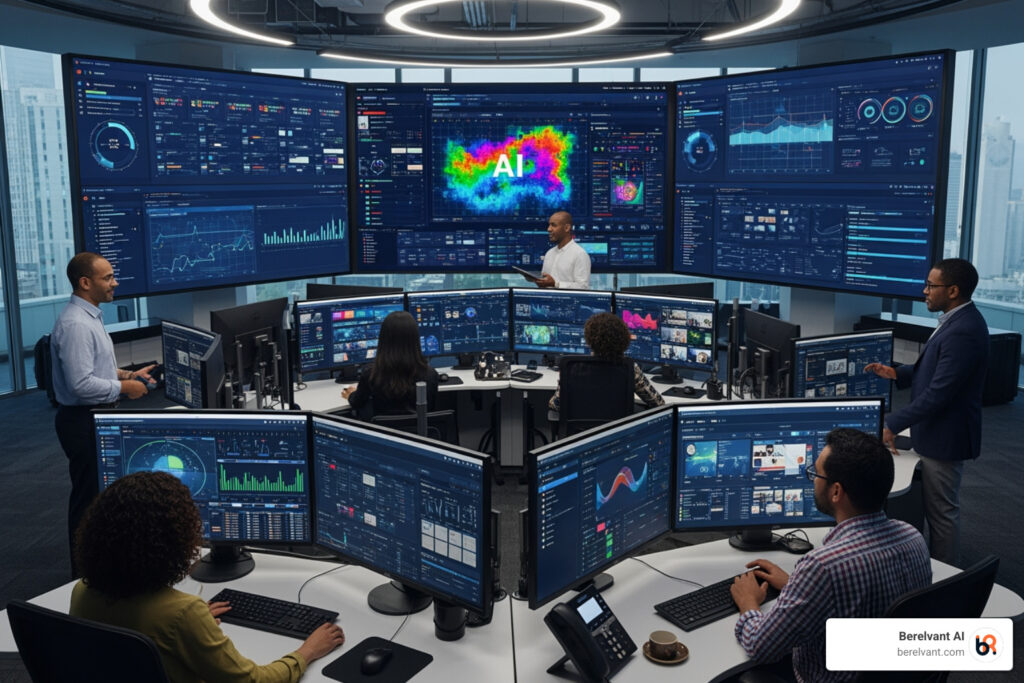
For a Westport-based AI digital agency, this means providing clients with a “command center” view of their operations. We no longer guess why a campaign is working; the data patterns tell us exactly where to double down.
Operational Efficiency through AI Automation and SEO
Efficiency isn’t just about saving money; it’s about reallocating your most valuable resource—human talent—to high-leverage tasks. HubSpot research on AI agent efficiency shows that their AI agents now resolve over 50% of support tickets, reducing closing times by 40%.
This “digital labor” works alongside your team 24/7. In complex, multi-country executions, AI calling agent automation can handle initial lead qualification in multiple languages, ensuring your sales team only speaks to high-intent prospects. This level of operational scaling is how mid-market companies compete with global giants.
Performance Media and Search Optimization
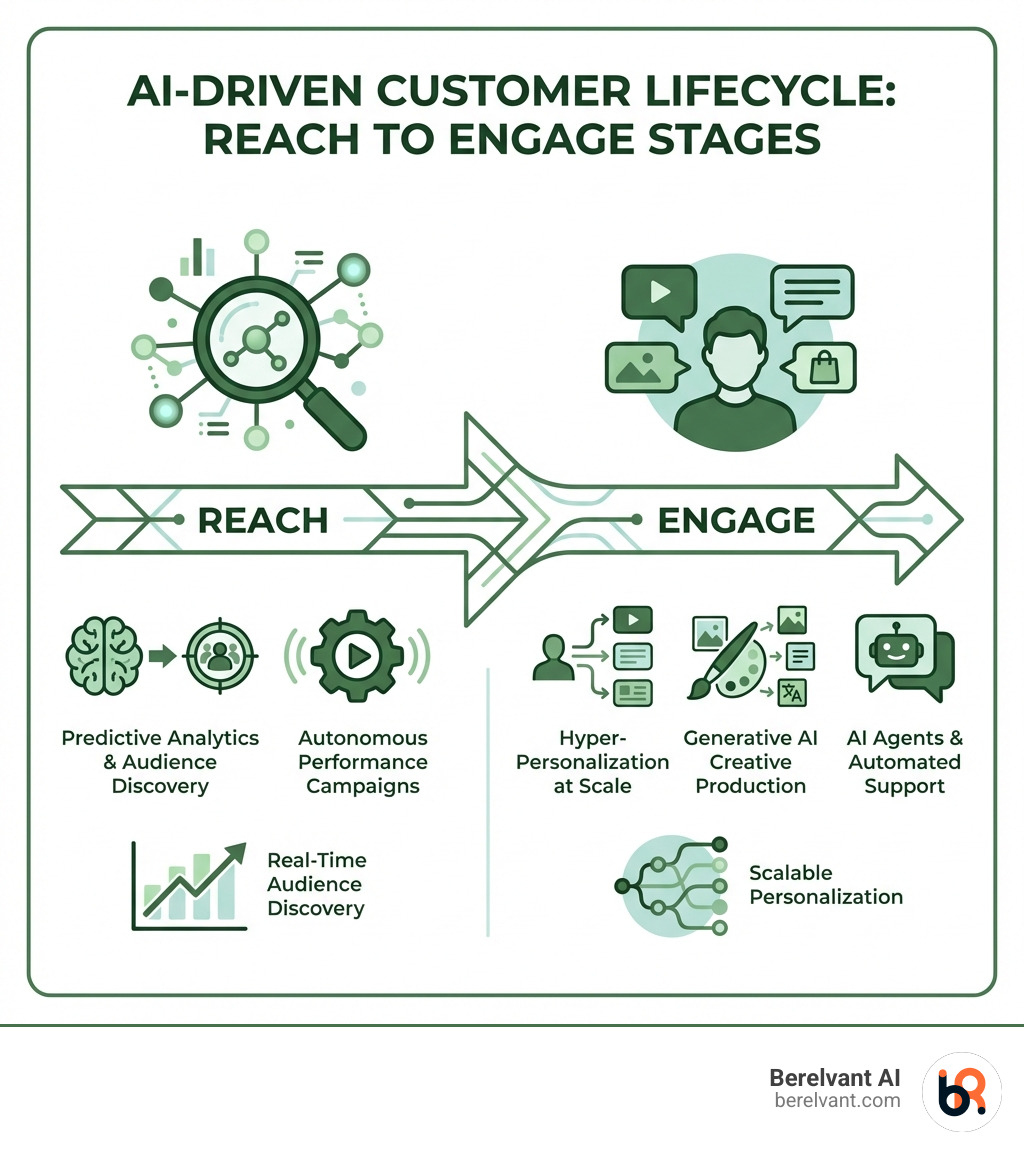
Google Ads has been at the forefront of this shift. Breakthroughs like Performance Max and Broad Match use AI to find valuable new customers across YouTube, Search, and Gmail. Advertisers who adopt Performance Max see an average of 18% more conversions at a similar cost-per-action.
The AI digital marketing agency ultimate guide highlights that the marketer’s role has evolved into “AI Orchestration.” We provide the inputs—budget, creative assets, and audience signals—and the AI optimizes the bidding and placement in real-time. This is particularly effective for “Search Generative Experience” (SGE), where AI-powered search results require a new approach to bidding and content relevance.
Enterprise SEO and Content Strategy
SEO is no longer just about keywords; it’s about intent. AI tools like BrightEdge AI insights act as personal data analysts, automating website improvement recommendations and competitor gap analysis.
For enterprise SEO, we leverage AI to:
- Map Intent: Grouping thousands of keywords into clusters that match the customer’s journey.
- Automate Technical SEO: Fixing broken links, optimizing meta tags, and improving site structure at scale.
- Real-Time Readability: Using tools like Grammarly or Hemingway to ensure content is accessible and on-brand before it goes live.
Wyndly, a telehealth provider, used AI-powered workflows to grow their organic traffic by 20x, outranking massive health sites for key terms. This shows that with the right AI strategy, even smaller players can win in highly competitive search environments.
Ethical Governance and Responsible AI Implementation
With great power comes great responsibility—and significant legal risk. In regulated industries like finance or healthcare, the “dark side” of AI includes data privacy violations and algorithmic bias. For example, Amazon’s AI recruiting tool famously had to be scrapped because it unfairly favored male candidates based on biased historical data.
Marketers must prioritize:
- Data Privacy: Strict adherence to GDPR and CCPA compliance standards.
- Transparency: Being open about when AI is being used, especially in customer interactions.
- Human-in-the-Loop: Ensuring every AI-generated output is reviewed by a human expert to prevent “hallucinations” or brand-damaging errors.
- IP Protection: Ensuring the data used to train your models doesn’t leak sensitive information or violate copyright.
At Berelvant, we specialize in these compliance-heavy environments. We build “guardrails” around AI usage, ensuring that while we move fast, we never compromise on safety or legal standing.
Frequently Asked Questions about AI in Marketing
What are the primary benefits of AI for enterprise marketing?
The primary benefits include measurable revenue growth, operational efficiency, and hyper-personalization. According to a McKinsey study on marketing ROI, personalization can lower acquisition costs by up to 50% and boost revenue by 5-15%. AI allows these results to be achieved at a scale that was previously impossible for human teams alone.
How does AI handle data privacy in regulated industries?
AI handles privacy through the use of first-party data, anonymization techniques, and privacy-safe environments like “Clean Rooms.” By using secure API integrations and adhering to frameworks like those discussed by Securiti.ai on privacy laws, enterprises can leverage AI insights without exposing sensitive customer information. We focus on building “privacy-first” AI systems that comply with GDPR, CCPA, and industry-specific regulations.
What is the future of generative AI in digital marketing?
The future lies in autonomous agents and multimodal reasoning. We are moving toward a world where AI doesn’t just write a blog post; it plans the strategy, creates the video, optimizes the ad spend, and reports on the ROI autonomously. The BCG blueprint for AI marketing suggests that the gap between “AI Leaders” (the top 20%) and laggards will become unbridgeable as leaders achieve 60% greater revenue growth through these integrated systems.
Conclusion
The artificial intelligence in digital marketing examples we’ve explored—from Netflix’s recommendation engine to Google’s Performance Max—demonstrate that AI is the definitive competitive frontier. For enterprise leaders, the goal isn’t just to “use AI,” but to integrate it into a unified acquisition engine.
At Berelvant, we help companies across the Americas bridge the gap between AI hype and business value. We integrate performance media, multilingual creative, and advanced automation into a single system that drives measurable revenue. Whether you are navigating a regulated industry in Connecticut or scaling a multi-country execution across Latin America, our AI marketing strategies are designed to remove bottlenecks and multiply your impact.
The technological revolution is here. Your job won’t be taken by AI, but it might be taken by someone who knows how to use it better than you. It’s time to build your AI for Marketing Engine.