
Why Growth Hacking Techniques Are Replacing Traditional Marketing Playbooks
Growth hacking techniques are a set of rapid, data-driven experiments designed to find the fastest, most cost-efficient path to scalable growth — across acquisition, activation, retention, referral, and revenue.
Here are the most effective growth hacking techniques used by high-growth organizations:
| Technique | What It Does | Best For |
|---|---|---|
| Referral programs | Turns users into acquisition channels | Activation, Referral |
| Viral loops | Creates self-feeding growth cycles | Acquisition, Referral |
| A/B testing at scale | Removes guesswork from optimization | All funnel stages |
| Onboarding gamification | Increases activation and retention | Activation, Retention |
| AI-driven creative automation | Scales content and personalization | Acquisition, Revenue |
| Strategic partnerships | Borrows existing audience distribution | Acquisition |
| Exit-intent and email capture | Recovers lost pipeline | Activation, Revenue |
| Freemium with social proof | Lowers friction, builds trust | Acquisition, Activation |
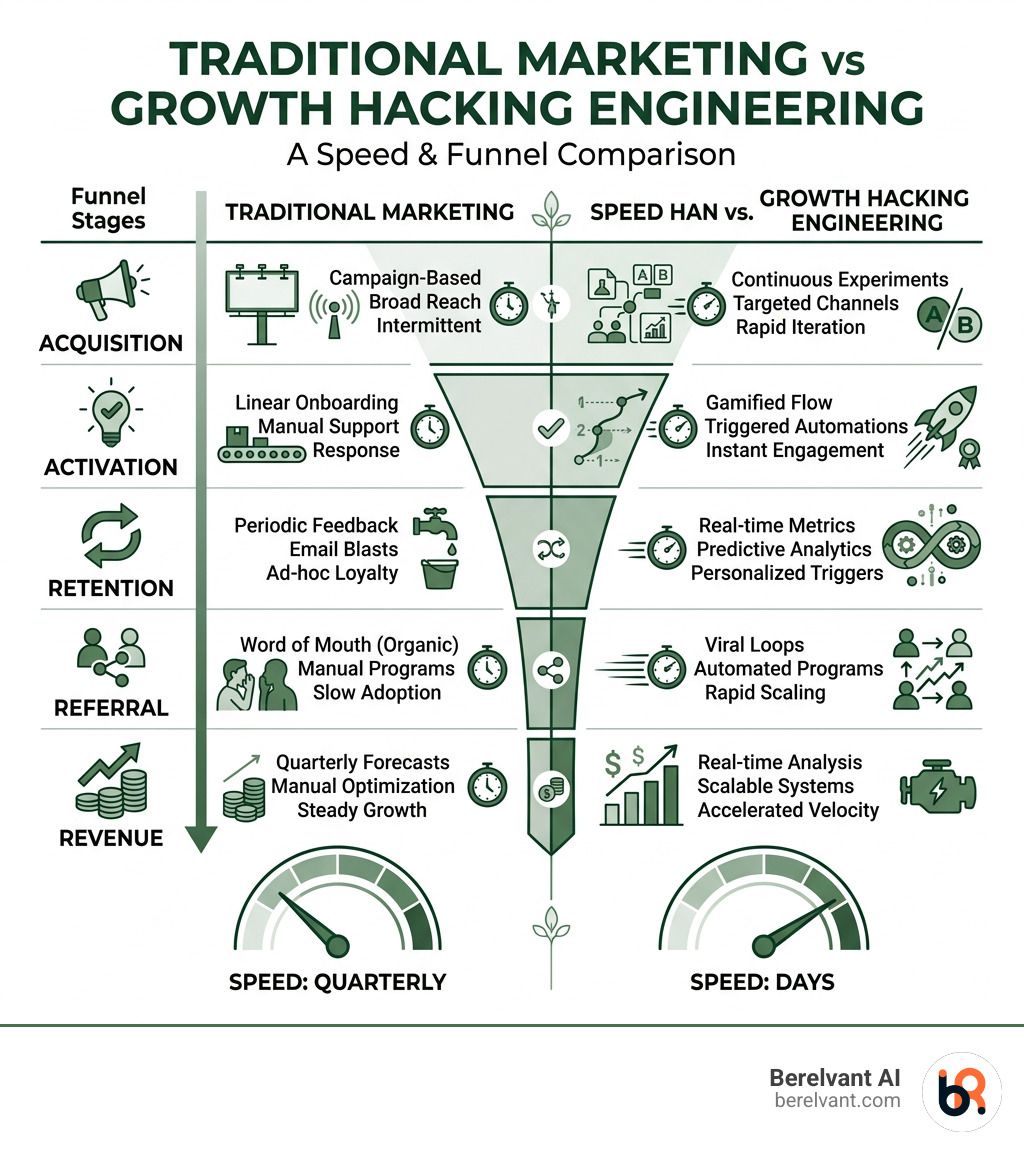
Traditional marketing moves in quarters. Growth hacking moves in days.
The difference is not creativity — it is system design. Growth hacking replaces slow, campaign-based thinking with a continuous engine of hypothesis, test, measure, and scale. Sean Ellis coined the term in 2010 to describe a marketer whose only goal is scalable growth. Since then, the discipline has expanded far beyond scrappy startups. Today it drives strategy inside regulated enterprises, global SaaS companies, and multi-market consumer brands that cannot afford to wait six months to learn what is working.
The numbers make the case clearly. Hotmail reached 12 million users in 18 months with a single email signature. Dropbox increased signups by 60% with a storage-based referral program. PayPal achieved a daily growth rate of 7 to 10% by paying users to refer friends. These were not lucky accidents. They were engineered outcomes built on clear incentive structures, tight feedback loops, and a relentless focus on one metric that mattered.
I’m Renzo Proano, founder of Berelvant AI, and I have managed over $300 million in digital ad spend deploying growth hacking techniques across financial services, SaaS, and e-commerce for brands featured in Vogue, Cosmopolitan, and BuzzFeed, and for clients including Microsoft, Cartier, and StoneX. In the sections below, I will walk you through the frameworks, execution systems, and advanced strategies that separate high-velocity growth programs from the ones that stall.
Quick look at Growth hacking techniques:
The Architecture of Rapid Expansion: Core Growth Hacking Techniques
For enterprise leaders, growth hacking is not about “tricks”; it is about building a scalable architecture. While traditional marketing often prioritizes vanity metrics like impressions or brand awareness, we focus on the entire customer lifecycle. This requires a shift from siloed departments to cross-functional “growth cells” that combine engineering, data science, and creative strategy.
The foundational framework we use is the AARRR Framework, often called “Pirate Metrics” (Acquisition, Activation, Retention, Referral, Revenue). Developed by Dave McClure, this model forces us to look at where the funnel is leaking. If we acquire 10,000 users but only 100 reach the “Aha!” moment of activation, our problem isn’t marketing—it’s product friction.
To decide which growth hacking techniques to deploy first, we utilize the ICE Prioritization model:
- Impact: How much will this project improve our North Star metric?
- Confidence: How sure are we that this will work based on existing data?
- Ease: How many resources (time, money, engineering) does it require?
This data-driven experimentation ensures we aren’t chasing every shiny object. Instead, we are running high-tempo tests to find the “unfair advantages” in your specific market. This approach is critical because, as A Nielsen report on trust in recommendations highlights, 88% of people trust recommendations from people they know over any other channel. If your growth engine doesn’t account for this psychological reality, you are overpaying for every lead.
For organizations looking to institutionalize this, more info about marketing operations consulting can help bridge the gap between high-level strategy and daily execution.
Engineering Viral Loops and Referral Systems
A viral loop is the ultimate “set it and forget it” growth engine. It occurs when a user’s natural interaction with your product leads to the acquisition of new users. The goal is to achieve a viral coefficient greater than 1.0, meaning every new customer brings in more than one additional customer.
In an enterprise context, this often involves sophisticated incentive structures. PayPal famously used a double-sided cash incentive ($10 for the referrer and $10 for the referee) to spark a 7-10% daily growth rate. Dropbox took a different path by aligning the incentive with their core value proposition: storage space. By offering free storage for referrals, they increased signups by 60%, turning their product into its own marketing channel.
To engineer these loops, we focus on:
- Network Effects: Ensuring the product becomes more valuable as more people join.
- Social Proof: Integrating user reviews, testimonials, and “powered by” links that act as passive endorsements.
- Frictionless Sharing: Making the referral process a one-click experience within the user’s existing workflow.
Leveraging AI-Driven Growth Hacking Techniques for Scale
At Berelvant, we view AI as the “speed layer” of growth. In the past, running 50 A/B tests on creative assets would take weeks of design and copy time. Today, we use generative AI and creative automation to produce thousands of variations in hours.
This isn’t just about volume; it’s about predictive analytics. We can now analyze vast datasets to identify which creative triggers resonate with specific multicultural audiences across the Americas. Whether it’s optimizing a PPC campaign or automating personalized email sequences, AI allows us to maintain a “high-tempo” testing cadence that was previously impossible.
For a deeper dive into how we automate these systems, see more info about AI campaign management.
From Acquisition to Retention: Holistic Funnel Optimization
The most common mistake in growth hacking is focusing exclusively on acquisition while ignoring the “leaky bucket” of retention. For mid-market and enterprise firms, the cost of acquiring a new customer is significantly higher than retaining an existing one. True growth hacking techniques must address the entire journey.
| Metric Type | Acquisition-Focused | Retention-Focused |
|---|---|---|
| Primary KPI | Cost Per Lead (CPL) | Customer Lifetime Value (LTV) |
| Success Signal | High Click-Through Rate | High Usage Frequency / Low Churn |
| Growth Lever | Ad Spend / SEO | Onboarding / Product Stickiness |
| Feedback Loop | Short-term (Campaign length) | Long-term (Cohort analysis) |
Advanced Growth Hacking Techniques for Multilingual Markets
Operating across the Americas—from our base in Westport, CT, to markets in Latin America—requires more than just translation. It requires cultural resonance. A growth hack that works in Connecticut might fail in Mexico City if the psychological triggers aren’t aligned.
Facebook reached 500 million users largely because they crowdsourced translations, allowing local users to adapt the platform to their own linguistic nuances. We apply similar logic by using generative AI marketing to create localized, high-performing content at scale. This allows us to test “hooks” and “offers” across different regions simultaneously, identifying which cultural nuances drive the highest conversion rates.
Strategic Partnerships and Distribution Hacks
Sometimes, the fastest way to grow is to “borrow” someone else’s audience. This is known as a distribution hack. Airbnb famously reverse-engineered an integration with Craigslist, allowing their users to cross-post listings to a massive, pre-existing audience. This provided them with free, high-quality traffic during their most critical growth phase.
For enterprise clients, this often looks like API-led growth or strategic channel integrations. By forming partnerships where your product solves a “tiny problem” for a massive partner’s user base, you can unlock growth that would take years to build manually. For instance, Spotify and Uber partnered to allow riders to choose the music for their ride, creating a unique experience that benefited both brands’ acquisition goals.
Explore more info about unique ways to increase sales to see how these partnerships fit into a broader revenue strategy.
Operationalizing the Growth Sprint in Enterprise Environments
In a large organization, the biggest barrier to growth isn’t a lack of ideas—it’s bureaucracy. To overcome this, we implement “Growth Sprints.” These are time-bound periods (usually 2 to 4 weeks) where a cross-functional team focuses on a single objective, such as “Reduce Onboarding Churn by 15%.”
This high-tempo testing requires a cultural shift. You must be willing to “fail fast” and move on. In compliance-heavy or regulated environments, this process includes a legal “guardrail” system where pre-approved frameworks allow the growth team to iterate without waiting for a 30-day legal review for every minor copy change. As a specialized campaign operations agency, we help build these internal systems to ensure speed doesn’t compromise security.
Building a Tech Stack for Continuous Experimentation
You cannot hack what you cannot measure. A modern growth tech stack must be integrated and automated. This typically includes:
- Analytics Engines: Tools like Google Analytics or specialized product analytics (Mixpanel/Amplitude) to track user behavior.
- CRM Integration: Ensuring every experiment’s data flows back into a central source of truth (Salesforce/HubSpot).
- A/B Testing Tools: Platforms that allow for rapid UI and copy variations.
- Creative Workflow Automation: Using AI to bridge the gap between data insights and creative production.
By investing in creative workflow automation, enterprise teams can remove the manual bottlenecks that usually kill growth momentum.
Navigating Compliance and Regulated Growth
In industries like finance or healthcare, “hacking” can sound dangerous. However, growth hacking in a regulated context is actually safer because it relies on small, controlled experiments rather than massive, unproven “big bets.”
We use a “Risk Mitigation” framework for every experiment. This involves setting clear “kill switches” for campaigns and ensuring all data collection complies with local privacy laws (like CCPA or GDPR). Ethical growth hacking is about finding clever shortcuts, not breaking rules. For more on managing these complexities, refer to our AI digital marketing agency ultimate guide.
Frequently Asked Questions about Growth Hacking
How does growth hacking differ from traditional marketing in an enterprise context?
Traditional marketing focuses on top-of-funnel awareness and works in long, campaign-based cycles. Growth hacking is a full-funnel approach (AARRR) that uses rapid experimentation and engineering to drive measurable outcomes. In an enterprise, this means moving from “brand-first” to “data-first” decision-making.
What are the most common pitfalls in high-velocity growth campaigns?
The most frequent mistake is focusing on vanity metrics (likes, views) instead of North Star metrics (revenue, retention). Another pitfall is “acquisition without retention”—spending thousands to get users who churn within 24 hours. Finally, many teams fail because they don’t have the technical infrastructure to measure their experiments accurately.
How can growth hacking be applied to highly regulated industries?
By using “Sandboxed Experiments.” We run tests on small cohorts or specific geographic regions (like Fairfield, CT) to validate a hypothesis before scaling it globally. This allows for innovation while maintaining strict compliance and risk management protocols.
Conclusion
The era of “slow and steady” marketing is over. In a globalized, AI-driven economy, the organizations that win are those that can learn the fastest. By deploying growth hacking techniques—from viral loops and AI-driven creative automation to strategic distribution hacks—enterprises can build a unified engine for rapid expansion.
At Berelvant AI, we don’t just provide advice; we build and manage the end-to-end systems that drive this growth. Whether you are navigating a compliance-heavy environment or scaling across multiple countries in the Americas, our goal is to turn your marketing into a high-performance revenue engine.
Ready to move beyond the tortoise pace? Master your growth engine at Berelvant and let’s start engineering your expansion today.