
Why AI in Marketing Analytics Is Now a Board-Level Priority
AI in marketing analytics is the use of machine learning, predictive modeling, and generative AI to collect, unify, and interpret marketing data — delivering faster, more accurate insights than traditional methods can produce.
Here is what AI marketing analytics does, at a glance:
| Capability | What It Replaces | Business Outcome |
|---|---|---|
| Predictive modeling | Manual forecasting | Faster, more accurate demand planning |
| Real-time segmentation | Static audience lists | Higher conversion rates at lower CPAs |
| Automated reporting | Hours of manual data pulls | Time redirected to strategic decisions |
| Generative AI summaries | Analyst bottlenecks | Instant executive-ready insights |
| Dynamic attribution | Last-click models | Accurate budget allocation across channels |
The pressure on growth and marketing leaders has never been higher. You are managing fragmented data across channels, regions, and platforms. Your teams are spending hours on reporting instead of strategy. Attribution is broken. And the gap between AI leaders and everyone else is widening fast — BCG research found that organizations with deeply integrated AI report 60% greater revenue growth and adapt to market trends twice as fast as their peers.
The shift is not coming. It is already here. More than 80% of brands are still in the early stages of AI adoption, which means there is a significant competitive window for organizations willing to move deliberately and at scale.
I’m Renzo Proano, founder of Berelvant AI — I’ve managed over $300 million in digital ad spend and built AI-driven analytics and acquisition systems for enterprise brands across financial services, SaaS, and e-commerce, applying AI in marketing analytics to drive measurable, compounding growth across regulated and high-velocity markets. In this guide, I’ll break down exactly how to architect, implement, and scale AI marketing analytics as a strategic growth system — not just a reporting upgrade.
Simple ai in marketing analytics word guide:
The Evolution of AI in Marketing Analytics: From Static Data to Dynamic Intelligence
Traditional marketing analytics has long been a rearview-mirror exercise. Marketers would look at what happened last month, manually stitch together spreadsheets, and try to guess why performance dipped or spiked. This process is inherently reactive and prone to human error. According to the Opinion Paper on AI-powered marketing: What, where, and how?, AI is a positive disruptive force that requires a deliberate strategic approach to move beyond these static limitations.
The evolution toward ai in marketing analytics introduces dynamic intelligence through pattern recognition and algorithmic sense-making. Instead of waiting for a human analyst to spot a trend, machine learning models ingest millions of data points across your entire tech stack to identify correlations that are invisible to the naked eye. This shift empowers organizations with dynamic capabilities, allowing them to adapt to changing environments in real-time.

The Role of Predictive AI in Marketing Analytics
Predictive AI is the engine behind forward-looking strategy. By analyzing historical patterns, it anticipates future outcomes with high precision. For enterprise leaders, this translates into several critical applications:
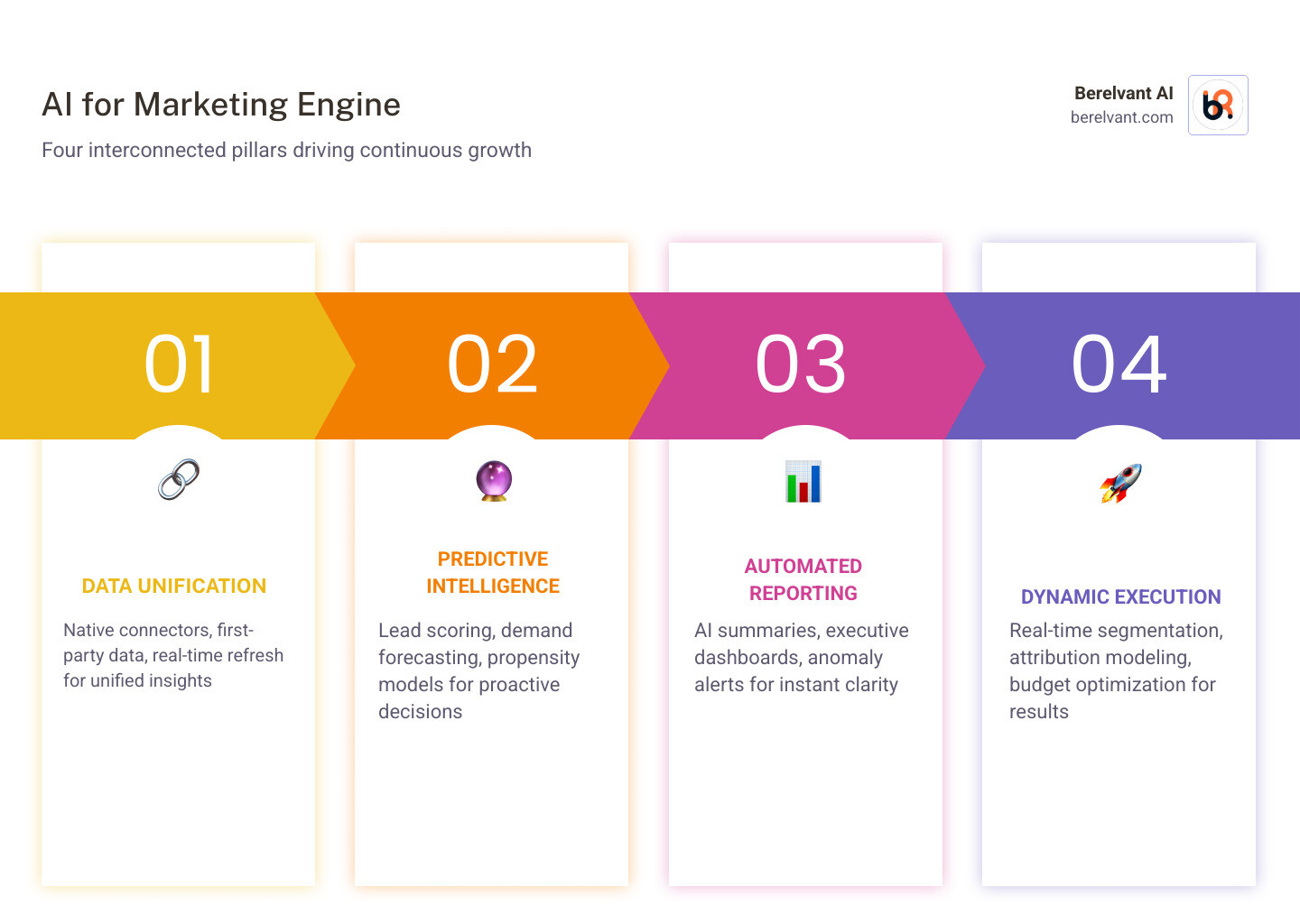
- Lead Scoring: Moving beyond basic demographics to predict which prospects are most likely to convert based on behavioral signals.
- Demand Forecasting: Adjusting inventory and ad spend based on predicted market shifts, reducing waste and maximizing capture.
- Propensity Models: Identifying which existing customers are at risk of churning or are primed for a cross-sell opportunity.
These capabilities allow us to shift from broad-brush tactics to precision-engineered AI Marketing Strategies that optimize every dollar of spend.
Generative AI and Unstructured Data Processing
While predictive AI handles the “numbers,” generative AI is revolutionizing how we process unstructured data—the “digital exhaust” of modern business. Through Natural Language Processing (NLP) and computer vision, we can now analyze sentiment in customer reviews, transcriptions from sales calls, and the effectiveness of visual assets at scale.
This allows for a 360-degree consumer view that includes not just what they bought, but how they feel and how they interact with your brand’s creative infrastructure. Integrating Generative AI in Marketing ensures that these qualitative insights are quantified and fed back into the analytics engine to improve future campaign performance.
Strategic Benefits: Driving Enterprise Growth through Predictive Insights
The ultimate goal of ai in marketing analytics is not just to have “better charts”—it is to drive measurable impact on the bottom line. For organizations operating across the Americas, this means achieving hyper-personalization at scale. When you can predict a customer’s next move, you can deliver the right message in the right language at the perfect moment in their journey.
Operational Efficiency and Automated Reporting
One of the most immediate payoffs of AI is the elimination of the “reporting tax.” We’ve seen agencies and internal teams save hundreds of hours a month by automating data standardization and no-code blending. Instead of manual QA bottlenecks, AI-driven platforms ensure that metrics remain consistent across diverse platforms.
Effective AI Campaign Management relies on this foundational efficiency. When your team isn’t buried in spreadsheets, they can focus on high-value strategic orchestration, such as testing new creative hypotheses or exploring untapped market segments.
Real-Time Segmentation and Dynamic Budgeting
Enterprise-level growth requires the ability to move fast. AI enables dynamic budgeting, where capital is automatically reallocated to the highest-performing channels based on real-time incrementality testing. This moves us away from last-click models—which are often as misleading as crediting only the quarterback for a touchdown—toward a holistic view of the customer journey.
As a specialized AI Digital Agency, we prioritize systems that allow for real-time audience alignment. If a specific segment in the Brazilian market begins to outperform expectations, the system identifies the trend and scales the budget instantly, ensuring you never miss a growth window.
Architecting Enterprise AI Marketing Analytics Platforms for Scalable Growth
Building a robust platform for ai in marketing analytics requires more than just subscribing to a few SaaS tools. It demands a unified architecture that can handle the complexity of multi-country execution and regulated environments. At Berelvant, we build these systems as an end-to-end acquisition engine.
Enterprise-Grade Data Unification and Integration
The “fuel” for any AI system is data. Without stable, managed connectors and a strategy for first-party data leverage, even the most advanced models will fail. We implement data standardization protocols that ensure information from your CRM, web analytics, and ad platforms speaks the same language.
By utilizing no-code blending, we can consolidate cross-market data from across the Americas into a single source of truth. This is particularly vital for companies in compliance-heavy industries where data integrity is non-negotiable.
Advanced Analytics for Actionable Intelligence
Once data is unified, the platform must translate it into intelligence. We deploy several key features to make this happen:
- Executive Dashboards: Automated summaries that highlight what matters to VPs and Directors without the fluff.
- Proactive Monitoring: Anomaly detection that alerts your team to performance dips before they become crises.
- Conversational AI (IQ Chat): Allowing stakeholders to ask plain-language questions like “Which creative assets are driving the most conversions in our Fairfield, CT market?” and get instant, data-backed answers.
Operationalizing Insights for Dynamic Execution
Insights are useless if they don’t lead to action. Our systems bridge the gap between analytics and execution through:
- Hyper-personalization at scale: Using AI to tailor multilingual creative for different cultural nuances.
- Optimized CLV Strategies: Identifying high-value cohorts and focusing acquisition efforts there.
- Advanced Attribution: Moving beyond simple models to understand the true impact of every touchpoint.
This operational layer is what differentiates a standard reporting tool from a comprehensive Generative AI Marketing system. For a deeper dive into these systems, see our AI Digital Marketing Agency Ultimate Guide.
Navigating Implementation: Data Privacy, Bias, and System Integration
As we scale ai in marketing analytics, we must address the “dark side” of the technology. Privacy is not an afterthought; it is a core requirement. For enterprise brands, maintaining strict adherence to GDPR, CCPA, and other regional regulations is essential to protecting both the customer and the brand’s reputation.
Overcoming Technical and Organizational Barriers
The biggest hurdle to AI adoption is often not the technology itself, but existing data silos and a lack of organizational readiness. Success requires a clear digital transformation roadmap and a cross-functional task force that includes stakeholders from marketing, finance, and IT.
We help organizations transition into this new era by providing the technical infrastructure and strategic guidance needed for AI Digital Marketing. This includes training teams to move from “doing” to “orchestrating” the AI engine.
Ethical AI and Transparency in Analytics
Algorithmic fairness is a critical concern. AI models can unintentionally learn and perpetuate biases if they are trained on skewed datasets. We implement robust human oversight protocols to audit AI outputs and ensure that Generative AI Advertising remains transparent and ethical. This “human-in-the-loop” approach ensures that while AI provides the speed, humans provide the heart and ethical judgment.
Future Horizons: Hyper-Personalization and Ethical AI Orchestration
The future of ai in marketing analytics is an “AI flywheel” where creative, media, and measurement are perfectly synchronized. We are moving toward a world of Answer Engine Optimization (AEO), where brands must optimize their data not just for search engines, but for the AI agents that consumers use to make decisions.
The Convergence of AI, IoT, and Blockchain
We are watching the convergence of several technologies that will further revolutionize analytics. The Internet of Things (IoT) will provide even more “real-world” data points, while blockchain can offer immutable transparency for clicks and conversions, virtually eliminating ad fraud.
Furthermore, advancements in AI Calling Agent Automation will allow for real-time, conversational lead qualification that feeds directly back into your analytics engine, creating a seamless loop from first contact to final conversion.
Frequently Asked Questions about AI in Marketing Analytics
How does AI marketing analytics differ from traditional analytics?
Traditional analytics is descriptive (what happened) and manual. AI in marketing analytics is predictive (what will happen) and prescriptive (what we should do), utilizing automated data flows and machine learning to provide real-time, actionable insights.
What are the primary challenges when implementing AI in marketing?
The main challenges include breaking down data silos, ensuring data privacy and compliance (GDPR/CCPA), mitigating algorithmic bias, and upskilling teams to move from manual execution to strategic AI orchestration.
Can AI marketing analytics improve customer experience in regulated industries?
Yes. In fact, AI is often more effective in regulated industries because it can be trained to follow strict compliance guardrails while still delivering personalized experiences. It allows for “always-on” monitoring and automated disclosure management that manual processes struggle to match.
Conclusion
The transition to ai in marketing analytics is no longer a luxury for the “tech-forward”—it is a survival requirement for the enterprise. By unifying your data, leveraging predictive intelligence, and operationalizing insights through automation, you can transform your marketing from a cost center into a high-velocity growth engine.
At Berelvant, we don’t just provide tools; we are an enterprise growth partner that builds the end-to-end systems required to win in complex, multi-market environments. From our offices in Westport and Fairfield, CT, we manage the creative, the media, and the analytics so you can focus on the impact.
Ready to move beyond the hype and start driving measurable revenue growth? Transform your strategy with AI Marketing Strategies today.