How SEO with AI Is Reshaping Search — And What It Means for Growth Leaders
SEO with AI is the practice of using artificial intelligence — including machine learning, large language models (LLMs), and natural language processing — to automate, enhance, and scale search engine optimization across research, content creation, technical audits, and visibility in AI-generated answers.
Here is what you need to know at a glance:
| What’s Changing | What It Means for You |
|---|---|
| Search is moving from links to AI-generated answers | Content must be structured for retrieval, not just ranking |
| LLMs like ChatGPT, Gemini, and Perplexity cite 2-5 sources per answer | Brand visibility now depends on being a cited source |
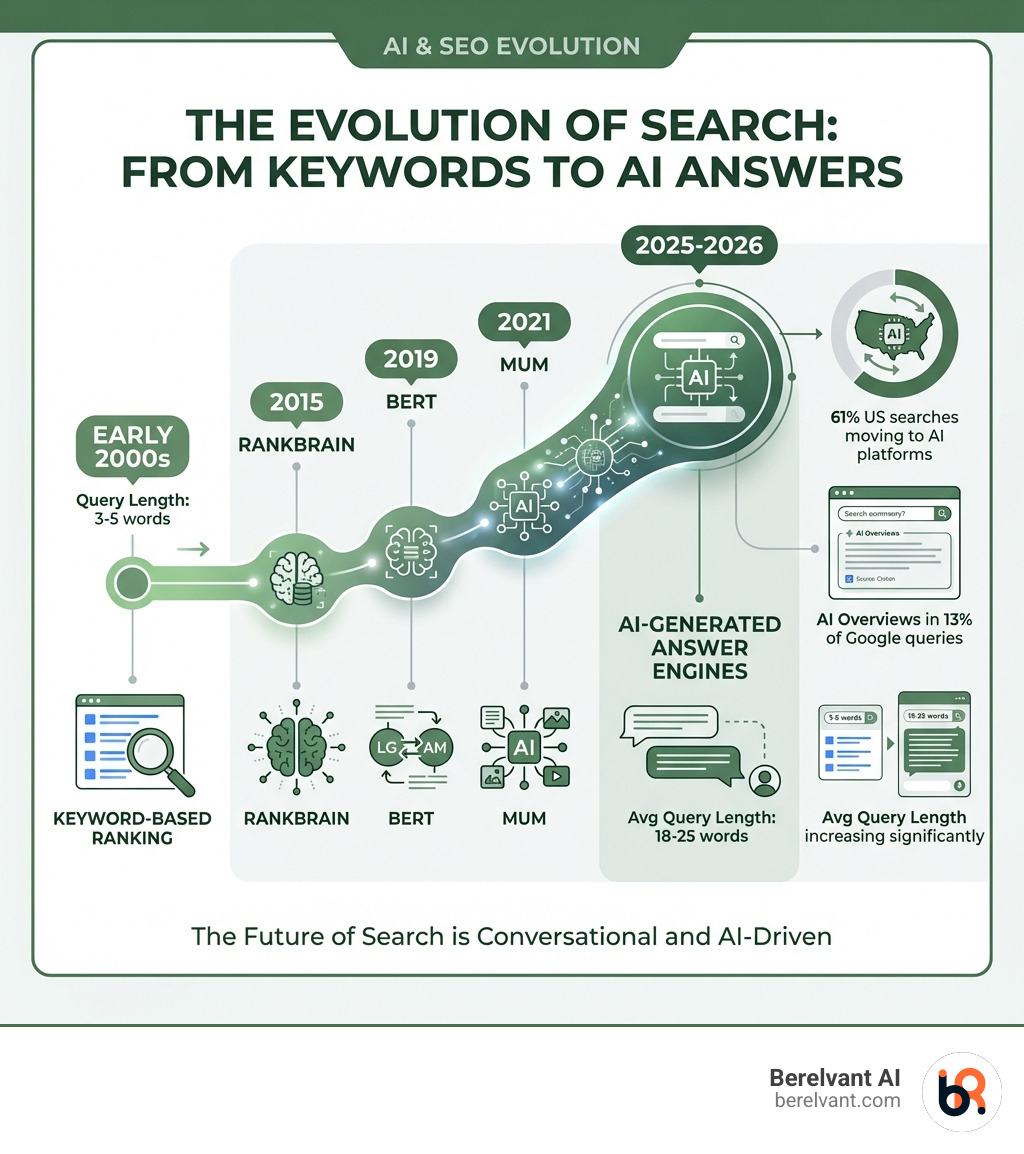
| 61% of US searches will begin on AI platforms by 2026 | Organic strategy must extend beyond Google |
| AI queries average 18-25 words vs. 3-5 on Google | Long-tail, conversational content is now a priority |
| 67% of AI searches with commercial intent lead to action within 48 hours | AI-driven discovery is a high-conversion channel |
The rules of search have changed — fundamentally. For years, SEO meant building links, stuffing the right keywords, and climbing the ten blue links. That model still exists, but it is no longer the whole game.
Today, AI systems synthesize answers directly from content across the web. They cite sources, summarize expertise, and deliver responses without a single click. As of March 2025, Google AI Overviews appeared in 13.14% of all queries — up from 6.49% just two months earlier. That number is accelerating.
For VP and Director-level leaders managing growth across multiple markets, this is not a trend to monitor. It is an operational reality that is already compressing organic traffic for brands that have not adapted.
Every minute, 5.9 million searches are processed on Google alone. The question is no longer whether AI is changing search. The question is whether your content infrastructure is built to win in the environment that already exists.
I’m Renzo Proano, founder of Berelvant AI — I’ve managed over $300 million in digital ad spend and built AI-driven SEO and content automation systems for enterprise brands across financial services, SaaS, and e-commerce, making SEO with AI a core pillar of every growth architecture I design. In this guide, I’ll walk you through exactly how to build and deploy that architecture at scale.
Key terms for SEO with AI:
The Paradigm Shift: Traditional SEO vs. SEO with AI

The transition from traditional search to SEO with AI represents the most significant change in digital marketing since Google’s arrival in 1998. We are no longer just optimizing for a search engine; we are optimizing for “Answer Engines.”
Historically, SEO was a game of matching strings of text. If a user typed “best enterprise CRM,” Google looked for pages that mentioned those exact words. Today, search is driven by sophisticated machine learning systems. It began with RankBrain in 2015, which helped Google interpret queries it had never seen before. This evolved into BERT (2019), allowing the engine to understand the context of words in relation to one another, and finally MUM (2021), which is 1,000 times more powerful than BERT and can process information across 75 languages simultaneously.
The scale is staggering. Every minute, 5.9 million searches are processed on Google—adding up to 354 million searches per hour and 3 trillion annually. However, the way users interact with these searches is shifting.
| Feature | Traditional SEO | SEO with AI |
|---|---|---|
| Primary Goal | Ranking in the “Top 10” blue links | Being the cited source in an AI summary |
| Targeting | Short-tail keywords (3-5 words) | Conversational intents (18-25 words) |
| User Experience | Click-through to website | Zero-click “Answer” consumption |
| Content Focus | Keyword density and backlinks | Entity clarity and information gain |
| Algorithm | Rule-based / Link-based | Neural networks / Semantic-based |
Understanding User Intent and Semantic Analysis
At the heart of SEO with AI is Natural Language Processing (NLP). AI doesn’t just “read” your content; it maps the relationships between concepts, known as entities.
When we deploy systems for our partners, we move beyond Latent Semantic Indexing (LSI) and focus on contextual meaning. For example, if a user searches for “protection for high-net-worth assets,” an AI-driven engine understands the intent is likely related to estate planning or specialized insurance, even if those exact terms aren’t in the query. By prioritizing semantic structure, we ensure that our content answers the intent behind the search, making it more likely to be retrieved by LLMs.
The Rise of Zero-Click Search and AI Overviews
We are entering the era of the “Zero-Click Search.” A 2024 study by Rand Fishkin of SparkToro found that 58.5% of Google searches in the US ended without a click. Users are finding their answers directly on the SERP via AI Overviews.
Scientific research on Google AI Overviews shows that these summaries are now triggered in over 13% of queries. For enterprise leaders, this means visibility is no longer just about traffic—it’s about citation share. If an LLM synthesizes an answer using your data, your brand gains authority and trust, even if the user doesn’t click through immediately. In fact, 72% of users who receive a specific recommendation from an LLM visit at least one of the mentioned sites later.
Architecting Content for the Generative Era
To win in this environment, we use three distinct but overlapping frameworks: Generative Engine Optimization (GEO), Answer Engine Optimization (AEO), and AI Optimization (AIO).
GEO focuses on making your content “extractable.” AI models like ChatGPT or Gemini look for clear, factual statements that they can easily synthesize into a summary. AEO targets the conversational, question-and-answer nature of modern search, while AIO is the holistic umbrella that combines these with traditional trust signals.
At Berelvant, we emphasize AI Marketing Strategies that build topical authority. Instead of isolated blog posts, we build comprehensive topic clusters. Research shows that shifting from narrow pages to in-depth clusters can result in ranking for 68% more long-tail keywords year over year.
Optimizing Content for SEO with AI and Answer Engines
Structuring content for Generative AI Marketing requires a technical shift in how we write. We implement:
- Question-based headings: Using H2s and H3s that mirror exact user queries.
- Concise definitions: Placing a 2-3 sentence “summary” at the top of sections to make them “snippet-ready.”
- Structured data: Using Schema markup to define entities clearly for the bots.
The Critical Role of E-E-A-T in AI Retrieval
As AI-generated content floods the web, search engines are doubling down on E-E-A-T (Experience, Expertise, Authoritativeness, and Trustworthiness). Scientific research on Topic Authority highlights that Google prioritizes content from verifiable experts.
We don’t just use AI to “write content.” We use it to surface insights from first-party data and proprietary research, which we then pair with human expertise. Verifiable authorship, detailed author bios, and “Person” or “Organization” schema are no longer optional—they are the bedrock of credibility in the AI era.
Technical Infrastructure and AI-Driven Automation
For enterprise organizations, manual SEO is a bottleneck. We implement Agentic SEO—using AI agents that don’t just suggest changes but execute workflows. This includes Retrieval-Augmented Generation (RAG), which allows an AI to “read” your entire site’s database to ensure every new piece of content is factually consistent and contextually linked.
Our approach to AI Campaign Management integrates these agents into the technical stack to handle repetitive tasks like meta-tag generation, internal link auditing, and alt-text optimization at a scale humans cannot match.
Automating Technical SEO with AI for Global Performance
Technical health remains the “entry fee” for search visibility. AI-driven systems monitor crawl health in real-time, identifying broken links or rendering issues before they impact rankings.
We also focus heavily on Scientific research on Core Web Vitals. AI tools can predict how changes to your site’s JavaScript or CSS will affect your Largest Contentful Paint (LCP) and Cumulative Layout Shift (CLS), ensuring your site remains high-performing across all devices.
Building an AI-Powered SEO Operating System
We view SEO as an “operating system” rather than a series of projects. As an AI Digital Agency, we build systems that integrate:
- Data Foundations: Connecting CRM, analytics, and rank trackers.
- Predictive Analytics: Forecasting search trends before they peak.
- Workflow Orchestration: Chaining AI prompts to handle everything from research to publication.
Strategic Implementation: Scaling Across the Americas
Berelvant specializes in solving the “multi-market” problem. For brands operating across Westport, CT, and the broader Americas, SEO with AI must account for cultural nuances and regulated environments.
The Google Search Generative Experience (SGE) is rolling out differently across regions. A strategy that works in Connecticut might need significant adjustment for a Spanish-speaking audience in Mexico or a Portuguese-speaking audience in Brazil.
Long-Tail SEO in the Conversational Era
The “Fat Head” keywords (e.g., “Insurance”) are becoming impossibly competitive and less valuable. The real opportunity lies in the long-tail. Scientific research on Long-Tail AI Optimization notes that AI queries are significantly longer—averaging 18-25 words.
Users are asking complex questions like, “What are the compliance requirements for a fintech startup launching in Fairfield, CT versus New York?” By optimizing for these natural language queries, we capture high-intent traffic that competitors overlook.
Multilingual Creative and AI Localization
Standard translation is dead. In the age of AI Digital Marketing, we use AI transcreation. This involves using LLMs to understand the intent and emotion of a message and rewriting it to fit the local dialect and cultural context.
For our enterprise partners, this means scaling across borders without losing the brand’s voice or violating local regulations. We use AI as the “speed layer” to generate drafts, which are then refined by native-speaking subject matter experts.
Frequently Asked Questions about AI SEO
Can AI SEO tools fully automate content optimization?
Not entirely. While AI can handle keyword clustering, structural suggestions, and initial drafts, human oversight is essential for E-E-A-T. AI often lacks the “real-world experience” and emotional nuance required for high-stakes industries. We use AI to do 80% of the heavy lifting, leaving the final 20%—the high-value strategy and “voice”—to our experts.
How do you measure the ROI of AI SEO tools?
We move beyond vanity metrics like “traffic” and focus on revenue-driven outcomes. ROI is measured by:
- Efficiency Gains: Reducing keyword research time from hours to minutes.
- Visibility Share: Tracking citations in AI Overviews and LLM responses.
- Conversion Lift: Measuring how AI-driven personalization and long-tail targeting impact the bottom of the funnel.
- Time-to-Publish: Cutting the content lifecycle by 30-50%.
What are the main challenges and limitations of using AI for SEO?
The biggest risks are hallucinations (AI making up facts) and genericism. If you rely solely on AI, your content will eventually sound like everyone else’s. There is also the risk of “over-optimization,” where content becomes machine-readable but human-unfriendly. Finally, data privacy is a major concern for enterprise brands; we ensure all AI tools used are compliant with SOC2 and other security standards.
Conclusion
At Berelvant AI, we don’t just “do SEO.” We build enterprise-grade acquisition engines. By integrating SEO with AI into a unified system of performance media, automation, and analytics, we solve the complex challenges of multi-country execution and regulated industries.
The “Match Made in the Algorithm” isn’t just about software; it’s about the synergy between AI’s scale and human strategic thinking. If you are ready to move beyond traditional search and dominate the new era of AI-first discovery, we are your growth and performance partner.
Learn more about our AI Marketing Strategies and how we can accelerate your revenue growth today.