
Why Guessing Is No Longer a Strategy for Enterprise Marketing Teams
How agencies use ai in digital marketing has fundamentally changed what’s possible for VP and Director-level leaders who need faster execution, tighter attribution, and scalable creative output across multiple markets.
Here is a quick breakdown of how leading agencies deploy AI across the marketing stack:
| Function | How AI Is Applied |
|---|---|
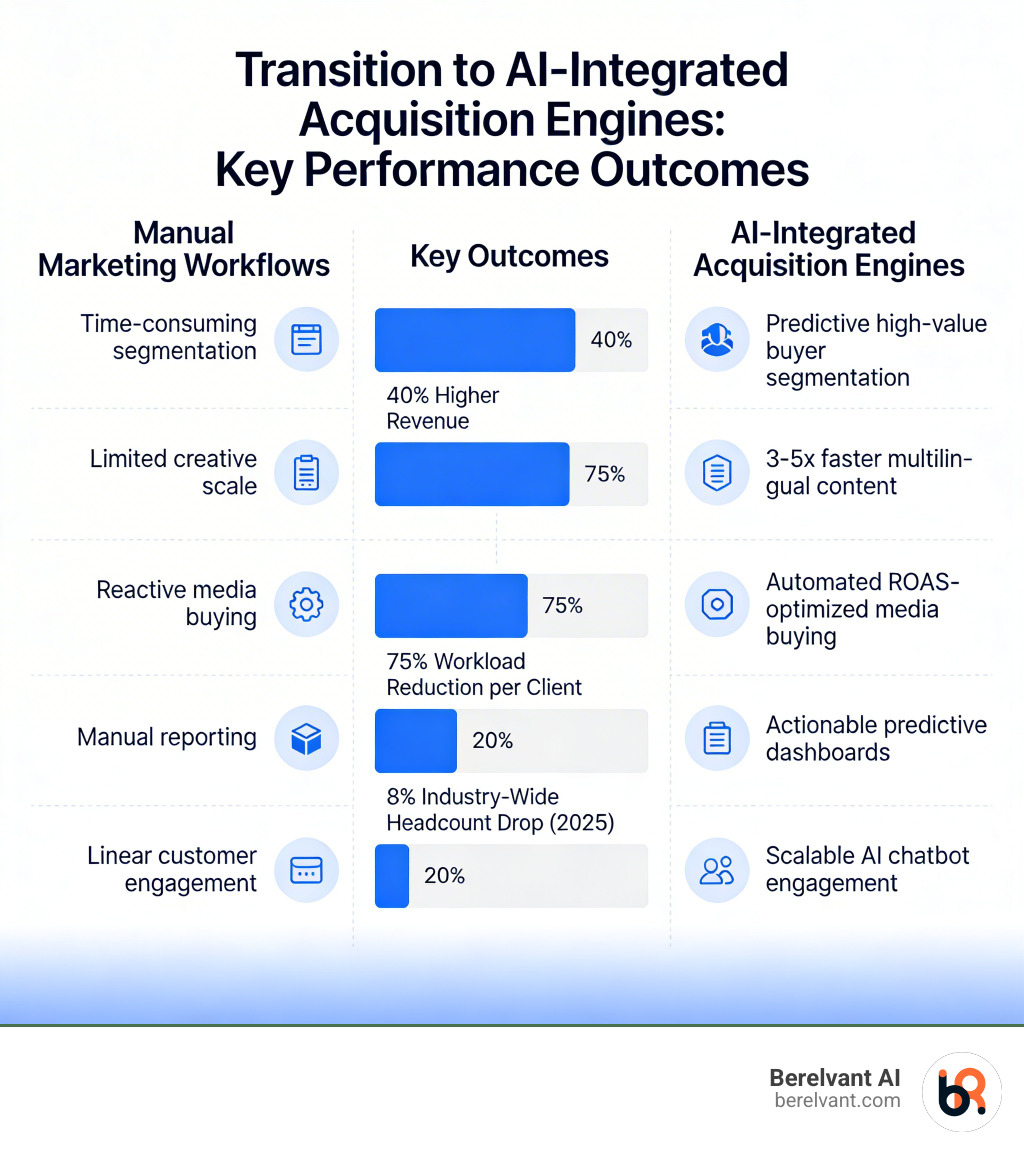
| Audience Segmentation | Predictive models identify high-value buyers, churn risk, and new demand pockets in real time |
| Content & Creative | AI scales multilingual assets 3-5x faster while maintaining brand standards |
| Paid Media | Automated bidding, budget allocation, and creative testing optimize ROAS continuously |
| SEO & AEO | AI surfaces keyword gaps, structures content for AI search engines, and reduces zero-click losses |
| Analytics & Reporting | Predictive dashboards replace manual reporting with actionable signals |
| Customer Engagement | AI chatbots and voice agents handle intake, qualification, and onboarding at scale |
The gap between agencies that talk about AI and those that have rebuilt their operating model around it is widening fast. Early adopters are reporting 40% higher revenue and 75% workload reduction per client. Meanwhile, agency headcounts fell 8% industry-wide in 2025 as AI absorbed execution tasks that once required full teams.
For enterprise organizations managing multi-region campaigns, regulated messaging, and fragmented martech stacks, this shift is not a trend to monitor. It is an operational decision with real cost implications today.
“We’re at a pivotal time with generative AI accelerating change tenfold. Marketers must adapt to new tools while meeting higher personalization expectations.” — Canadian Marketing Association
The pressure is real. 73% of consumers now prefer ads that are relevant to their specific interests, up 12% since 2023. And 47% say irrelevant ads are simply unacceptable given today’s technology.
I’m Renzo Proano, founder of Berelvant AI, and I have spent my career building performance marketing systems and AI-driven acquisition engines for brands across financial services, SaaS, GovTech, and e-commerce — managing over $300 million in digital ad spend. My work on how agencies use AI in digital marketing spans multi-channel acquisition architecture, agentic automation, and cross-market execution for enterprise brands including Microsoft, Cartier, and StoneX. In the sections below, I will walk you through exactly how the most effective agencies have restructured their operations around AI — and what that means for your growth program.
Simple guide to how agencies use ai in digital marketing terms:
The Shift from Traditional to Agentic-First Marketing Systems
The traditional agency model is, quite frankly, becoming obsolete. For decades, agencies were built on “billable hours”—a model that essentially rewarded inefficiency. The more people and time a project required, the more the agency made. In an enterprise environment, this led to bloated teams, slow feedback loops, and creative that arrived weeks after the market trend had already shifted.
We are now seeing the rise of the agentic-first model. This isn’t just about using a chatbot to write a social post; it’s a total reimagining of the agency as an AI Digital Agency. In this framework, AI agents handle 80% of the execution—data scraping, initial drafting, technical SEO audits, and media buying—while humans focus on the 20% that requires high-level judgment, strategy, and relationship management.
Research shows that agentic-first agencies can achieve 60-80% profit margins compared to the 15-25% typical of traditional firms. This efficiency isn’t just good for the agency’s bottom line; it’s transformative for the client. It allows one skilled orchestrator to manage 5-8 enterprise clients with higher precision than an entire department could five years ago. For a deeper dive into this evolution, check out our AI Digital Marketing Agency Ultimate Guide.

| Feature | Traditional Manual Agency | Agentic-First Performance Partner |
|---|---|---|
| Primary Resource | Human Headcount | AI Agent Workflows |
| Speed to Launch | 2-4 Weeks | 48-72 Hours |
| Pricing Model | Hourly / Retainer | Unit-Based / Performance |
| Optimization | Reactive (Weekly/Monthly) | Real-Time (Continuous) |
| Scalability | Linear (Requires more hires) | Exponential (Requires more compute) |
Orchestrating Multi-Agent Workflows
The secret sauce of modern marketing isn’t a single “super AI.” It’s a multi-agent architecture. This involves specialized AI agents working in parallel to solve complex problems. For example, one agent might scrape competitor pricing, another analyzes sentiment on social media, and a third uses that data to adjust ad copy—all coordinated through platforms like Zapier.
This shift moves the marketer’s role from a “doer” to an “orchestrator.” We no longer spend our days manually tagging images or cleaning spreadsheets. Instead, we design the systems that allow these agents to operate autonomously within strict brand guardrails. This system-level thinking ensures that every part of the acquisition engine is connected, removing the silos that typically plague enterprise organizations.
From Billable Hours to Unit-Based Pricing
As execution becomes automated, the old way of charging for time makes zero sense. If an AI agent can perform a task in seconds that used to take a junior designer five hours, should the client pay less? Or should they pay for the value of the result?
Leading partners are moving toward AI Campaign Management models that prioritize performance-based compensation and unit-based pricing. We define “units” of value—such as a localized campaign launch or a set of optimized landing pages—and price accordingly. This aligns our incentives with your growth. When we use value-based bidding to optimize for profit rather than just clicks, everyone wins.
How Agencies Use AI in Digital Marketing to Drive Enterprise Performance
For mid-market and enterprise organizations, the true value of AI lies in its ability to move from hindsight to foresight. Most marketing reports tell you what happened last month. AI tells you what is likely to happen next week so you can adjust your budget before the opportunity vanishes.
How agencies use AI in digital marketing for predictive audience segmentation
One of the most powerful ways how agencies use ai in digital marketing involves moving beyond basic demographics. We don’t just target “males aged 25-34.” We use predictive audiences within Google Analytics 4 to identify “likely 7-day purchasers.”
AI models analyze thousands of signals—site behavior, past purchase frequency, and even mouse movements—to forecast churn risk and customer lifetime value (CLV). In one documented case, targeting “likely purchasers” led to a 550% increase in conversions and a 63% decrease in cost per acquisition (CPA). This level of precision allows enterprise brands to stop wasting spend on users who were never going to convert and double down on those who will.
How agencies use AI in digital marketing to scale multilingual creative infrastructure
Scaling creative across the Americas (from the US and Canada to Brazil and Mexico) used to be a logistical nightmare. Traditional translation often misses cultural nuance, and reshooting visuals for every market is cost-prohibitive.
Today, we use Generative AI in Marketing and Generative AI Advertising tools like Writer to build a creative supply chain that is both global and hyper-local. We can take a single campaign concept and generate localized visuals and copy that respect regional dialects and aesthetic preferences. Large global brands are already using these “CREAITECH” systems to cut content production cycles from 25 weeks to under 8, ensuring they can respond to viral trends in real time across multiple languages.
Answer Engine Optimization (AEO) and GEO Strategies
Search is changing. With the rise of AI-generated summaries, organic traffic to traditional websites is projected to drop by 15-25% as “zero-click searches” become the norm. To combat this, agencies are shifting from SEO to GEO and AEO (Generative Engine Optimization and Answer Engine Optimization).
This involves making your data “machine-readable.” We use tools like Algolia and structured schema to ensure that when a user asks an AI assistant for a product recommendation, your brand is the one cited. We optimize for conversational language, FAQs, and authoritative citations (like Reddit or niche industry journals) that AI models prioritize when building their answers.
Navigating the Risks: Compliance, Privacy, and the “AI Slop” Crisis
With great power comes great… potential for a PR disaster. The “dark side” of AI includes privacy violations, algorithmic bias, and the proliferation of “AI slop”—low-quality, generic content that damages brand authority.
Eliminating AI Slop and Maintaining Brand Authority
“AI slop” is what happens when agencies use AI as a shortcut rather than an amplifier. It’s the repetitive, nonsensical blog posts that clog up search results. Google’s 2023 Search Guidelines are clear: low-value, automated content will be penalized.
A 2023 HubSpot study found that while AI-assisted content increases efficiency by 20%, purely AI-generated content sees 35% lower engagement. Our approach is to maintain rigorous human editorial oversight. We use AI for the “heavy lifting” of research and outlining, but we infuse the final output with proprietary data, expert interviews, and a unique brand voice that a machine simply cannot replicate.
Ethical AI and Algorithmic Bias Mitigation
Bias in AI is a documented risk. We’ve seen examples like Amazon’s AI recruiting tool that unfairly favored certain demographics because it was trained on biased historical data. In marketing, this can lead to skewed targeting that excludes valuable audience segments.
Responsible agencies adhere to frameworks like the Canadian Marketing Code of Ethics and Standards. This means maintaining transparency in data collection, ensuring GDPR and CCPA compliance, and regularly auditing algorithms to ensure they aren’t perpetuating harmful stereotypes. Privacy isn’t just a legal hurdle; it’s a foundation of trust with your customers.
The Economics of Scaling Global Operations Across the Americas
For an enterprise growth partner, the goal is to build a unified acquisition engine that works as effectively in Connecticut as it does in Colombia. This requires solving for complexity at every level.
Solving Complexity in Regulated Industries
In sectors like finance or healthcare, every piece of content must pass through a gauntlet of legal and compliance checks. We use Fullstory to understand the digital experience and the Insights page in Google Ads to monitor performance, but we also build automated intake-to-delivery pipelines. These systems ensure that every AI-generated asset is automatically routed to the correct compliance stakeholders, reducing bottlenecks that typically stall large-scale campaigns.
Hyper-Local Targeting at Global Scale
How do you achieve neighborhood-level visibility across a dozen countries? You use AI Digital Marketing to uncover hyper-local patterns. AI can analyze neighborhood-specific data—like weather patterns in Westport, CT, versus Fairfield—to adjust ad creative and bidding in real time.
By combining localized visuals with AI Calling Agent Automation, we can provide a personalized experience that feels local but scales globally. This is the essence of Generative AI Marketing: using technology to restore the “human touch” at a scale that was previously impossible. As Shopify’s CEO noted in a recent memo on Selling AI strategy to employees, leverage is the new competitive advantage.
Frequently Asked Questions about Agency AI Integration
What is the difference between an AI tool and an AI marketing agency?
An AI tool (like ChatGPT or Jasper) is a piece of software designed to perform a specific task. An AI marketing agency is a strategic partner that integrates dozens of these tools into a cohesive, evolving system. While a tool provides execution, an agency provides the architecture, data strategy, and human oversight necessary to drive business outcomes.
How do agencies balance AI automation with human creativity?
We use the 80/20 rule. AI handles the 80% of work that is data-heavy, repetitive, or requires massive scale. This frees our human experts to focus on the 20% that matters most: high-level strategy, creative storytelling, and understanding the emotional nuances of a brand. Humans set the “heartbeat” and the guardrails; AI provides the “horsepower.”
What are the primary cost models for AI-powered agencies?
We are moving away from hourly billing toward unit-based and performance-based models. This might include a base fee for system setup and maintenance, plus a fee per “unit” of output (e.g., a localized campaign) or a percentage of the measurable revenue growth generated by the acquisition engine.
Conclusion
At Berelvant, we don’t just use AI to “do things faster.” We use it to build unified acquisition engines that solve the most complex challenges facing enterprise brands today. By integrating performance media, multilingual creative, and advanced analytics into one engine, we help you stop guessing and start winning.
Whether you are navigating regulated industries in the US or scaling multicultural audiences across the Americas, our goal is to drive measurable, scalable revenue growth. AI is our speed and scale layer, but our human expertise is the steering wheel.
Ready to see what an AI-integrated acquisition engine can do for your organization? Explore our AI Marketing Strategies and let’s build the future of your growth together.