
The Innovation Gap That’s Quietly Stalling Enterprise Growth
Innovative growth strategies are structured approaches that align new ideas, technologies, and business models with measurable revenue goals — moving beyond incremental gains to create compounding, system-level growth.
Here is a quick breakdown of the most effective types:
| Strategy Type | Core Focus | Example |
|---|---|---|
| Incremental Innovation | Improve existing products or processes | Adding features to a core SaaS platform |
| Adjacent Innovation | Expand into nearby markets or segments | Entering a new geography with an existing offer |
| Disruptive Innovation | Create entirely new markets or models | Netflix replacing traditional TV distribution |
| Business Model Innovation | Rethink how value is delivered and captured | Subscription models replacing one-time purchases |
| Process Innovation | Optimize internal operations for speed and scale | AI-driven automation replacing manual workflows |
The numbers tell a stark story. According to McKinsey research, 84% of executives believe innovation is critical to growth — yet only 6% are satisfied with their organization’s actual performance in executing it. That gap is not a creativity problem. It is a strategy and systems problem.
Most enterprise teams are not short on ideas. They are short on architecture. Fragmented innovation efforts, misaligned portfolios, slow execution cycles, and unclear ownership turn promising growth initiatives into expensive noise. Meanwhile, top-performing companies — those consistently outpacing peers on both revenue and profit — are 63% more likely to innovate at scale by building or acquiring new businesses outside their core industries.
The difference between organizations that grow and those that stall is rarely ambition. It is the presence of a deliberate, measurable, and operationally grounded innovation system.
I am Renzo Proano, founder of Berelvant AI, and I have spent my career designing and deploying innovative growth strategies across regulated and non-regulated markets — managing over $300 million in digital ad spend and building AI-driven acquisition systems for enterprise brands across financial services, SaaS, and e-commerce. The frameworks in this guide reflect what actually works at scale, across complex organizations with real operational constraints.
Easy Innovative growth strategies word list:
The Architecture of Modern Innovative Growth Strategies
When we talk about innovative growth strategies, we are not referring to a singular “eureka” moment in a boardroom. We are describing a rigorous, systemic architecture that turns uncertainty into a predictable engine for revenue. For enterprise leaders in Fairfield County and beyond, the challenge isn’t just coming up with a new product; it’s building the infrastructure that allows that product to reach the right audience, in the right language, across multiple borders, without breaking compliance.
A true innovation strategy serves as a detailed roadmap. It guides the organization toward future goals by solving specific customer problems, optimizing internal processes, or disrupting an entire industry. Without this roadmap, innovation remains episodic and accidental. With it, innovation becomes a repeatable capability.
Defining the Innovation-Growth Nexus
To understand how innovation drives growth, we have to look at the “Innovation-Growth Nexus.” This is where market penetration, diversification, and portfolio momentum intersect. Research shows that only 7% of corporate growth is driven by simple market-share gains. The remaining 93% comes from M&A and portfolio momentum. This means that if you are only focused on selling more of the same to the same people, you are missing the vast majority of your growth potential.
Top performers distinguish themselves by their comprehensive approach. They are 50% more likely to expand geographically and 78% more likely to build new businesses in entirely different industries compared to their lower-performing peers. This isn’t just “growth hacking”; it’s a Growth Strategy that treats the entire business model as a laboratory.
For example, consider how Taiwan Semiconductor Manufacturing Company (TSMC) increased revenues by 17% annually between 1995 and 2023. They didn’t just make better chips; they innovated the very business model of semiconductor manufacturing by providing services to their own competitors, effectively becoming the backbone of an entire global industry.
The Role of AI in Compressing Innovation Cycles
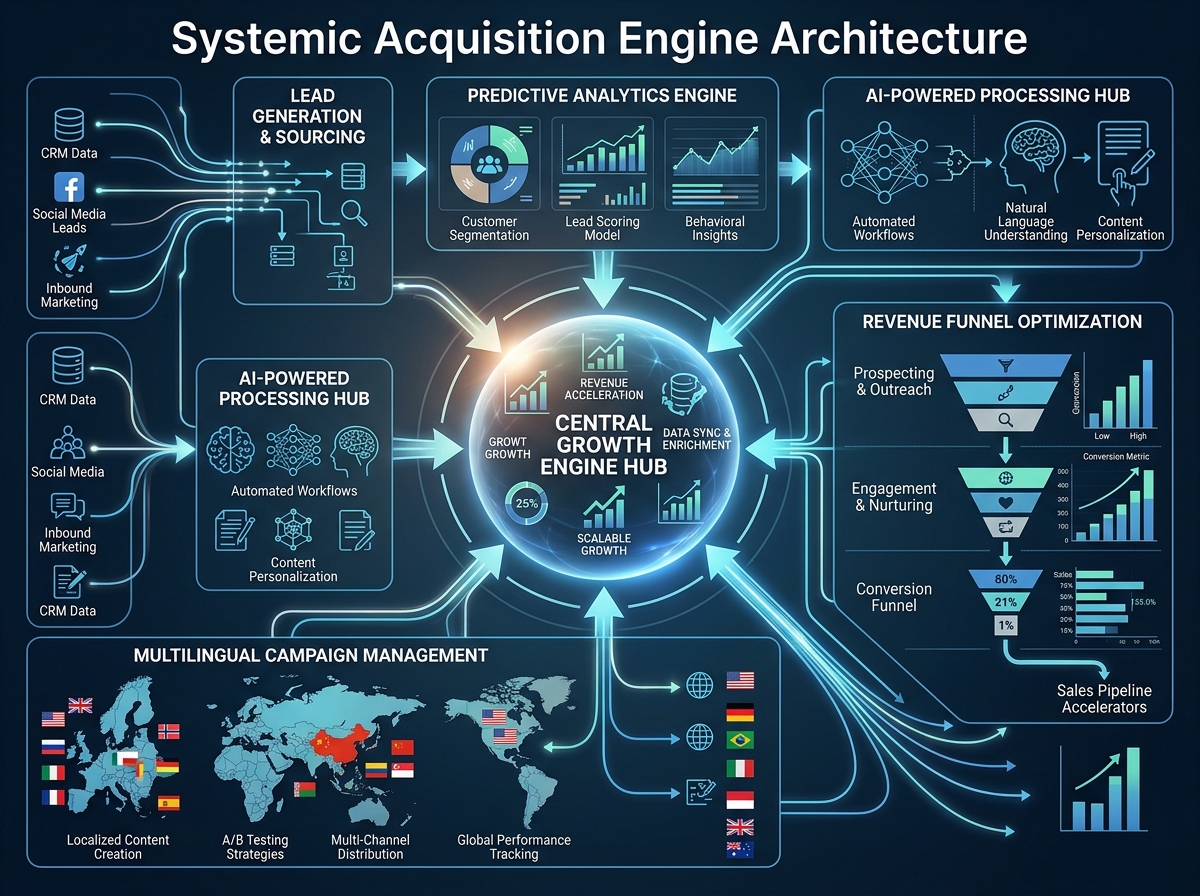
In the modern enterprise, time is the enemy of innovation. Traditional R&D cycles can take years, but in an AI-driven economy, those cycles are being compressed into months or even weeks. At Berelvant, we view AI as the “speed and scale layer.” It’s not just about chatbots; it’s about predictive analytics that identify granular growth pockets faster than any human team could.
AI allows us to:
- Remove Bottlenecks: Automating the creative and technical workflows that usually stall cross-market execution.
- Predictive Lead Scoring: Using deep data to determine which segments have the highest lifetime value before you spend a single dollar on acquisition.
- Scalable Delivery: Managing multilingual campaigns across the Americas with a unified engine, ensuring that a strategy developed in Westport, CT, resonates perfectly in Bogota or Sao Paulo.
Navigating the Three Horizons of Value Creation
To build a balanced portfolio, we use the “Three Horizons” model. This framework helps organizations manage the tension between the need to perform today and the need to transform for tomorrow. Without this balance, companies often suffer from “short-termism,” where they optimize for the next quarter at the expense of the next decade.
Optimizing the NOW: Incremental Innovative Growth Strategies in the Core
Horizon One is the “NOW.” This represents your core business—the engine that pays the bills. Roughly 80% of corporate growth typically comes from within a company’s core industry. However, even the core needs innovative growth strategies to defend against stagnation.
Incremental innovation in the core focuses on operational effectiveness and process optimization. A classic example is LEGO. In 2004, the company was struggling with over-diversification. By refocusing on its core toy-construction kits and optimizing its supply chain and digital engagement, LEGO grew its revenue from €0.9 billion in 2004 to €4.8 billion in 2015. They didn’t reinvent the brick; they reinvented the system around the brick.
Engineering the NEW: Adjacencies and Market Development
Horizon Two is the “NEW.” This is where you leverage your existing “right-to-win” capabilities—like your IP, manufacturing prowess, or customer relationships—to enter adjacent markets. Surprisingly, only 27% of companies are systematically scanning for opportunities outside their core business.
This is a massive missed opportunity. Growth champions like Chobani took a niche product (Greek yogurt) and used innovative growth strategies to expand it into a billion-dollar mainstream category by targeting new customer segments and leveraging retail distribution channels. For an enterprise growth partner, this often involves taking a proven acquisition system and localizing it for a new geographic region or a new demographic.
Architecting the NEXT: Disruptive Innovative Growth Strategies and New Business Models
Horizon Three is the “NEXT.” These are the transformational bets. They are the disruptive ideas that might eventually make your current business model obsolete. If you don’t disrupt yourself, someone else will.
Companies like Netflix and Uber are the poster children for this horizon. Netflix moved from DVD-by-mail to streaming, and then from streaming to content production. Each move was a “NEXT” horizon play that required a completely different Innovative Growth Model. In the enterprise space, this often looks like moving from selling a product to selling a platform or an “Interaction Field” where you orchestrate value between different players in an ecosystem.
From Ideation to Execution: A Systemic Approach to Scaling
The path from a good idea to a scalable revenue stream is littered with failed pilots. To avoid this, we follow a structured four-stage implementation process. This ensures that only the most viable ideas receive full resource allocation.
The Four Stages of Strategic Implementation
- Idea Generation and Ideation: This should be data-driven, not just a result of a “brainstorm.” We use customer interviews, market intelligence platforms like Nielsen or Statista, and internal CRM data to identify unmet needs.
- Idea Evaluation and Selection: Ideas must be audited against costs, time to market, and unique value proposition. We apply the Pareto principle here: typically, 20% of projects will generate 80% of the portfolio’s value.
- Implementation and Execution: This is where agile methods come into play. We use “sprints” and “hackathons” to build prototypes and test assumptions in real-world conditions.
- Monitoring and Evaluation: We track metrics like time-to-release, ROI, and customer acquisition cost (CAC) vs. lifetime value (LTV). If a project isn’t hitting its milestones, we use “stage-gates” to pull the plug and reallocate those resources to higher-performing initiatives.
| Innovation Type | Risk Level | Primary Goal | Time Horizon |
|---|---|---|---|
| Incremental | Low | Defend and optimize the core | 6–18 Months |
| Adjacent | Medium | Expand the perimeter | 2–5 Years |
| Transformational | High | Rewrite the rules / Future-proof | 5+ Years |
Hardwiring M&A into the Innovation Pipeline
For many top performers, innovation isn’t just built; it’s bought. Integrating M&A into your innovation capability allows you to acquire the talent, technology, or market access you need to leapfrog competitors. Research from McKinsey shows that top economic performers are 68% more likely to acquire a business in another sector to fuel their growth.
However, “shrinking to grow” is also a valid strategy. This involves divesting non-core assets that no longer align with your vision, freeing up capital and management attention for higher-growth opportunities. It’s about maintaining a “courageous growth” mindset—one that isn’t afraid to reallocate resources dynamically.
Overcoming Enterprise Barriers to Sustained Innovation
Even the best innovative growth strategies will fail if they are dropped into a culture that is hostile to change. Innovation is often hampered when leaders talk about it but fail to take concrete action or provide the necessary Terms of Service for their teams to take risks.
Solving for Complexity in Regulated Environments
In industries like financial services or healthcare, innovation is often slowed down by compliance. But we believe regulation shouldn’t be a barrier—it should be a design constraint. By building compliance-heavy frameworks into the very beginning of the innovation process, we can move faster than competitors who try to “bolt on” compliance at the end.
This requires:
- Automated Governance: Using AI to ensure all creative and messaging meets regional legal standards in real-time.
- Data Privacy by Design: Ensuring all acquisition systems are built on first-party data strategies that respect global privacy laws.
Multilingual and Multicultural Execution at Scale
For companies operating across the Americas, the “one size fits all” approach is a recipe for failure. A strategy that works in Connecticut may not work in Mexico City without significant localization. We help organizations build a “unified engine” that handles the complexity of cross-border operations.
This isn’t just about translation; it’s about cultural resonance. It’s about understanding that 600 global cities will drive more than 60% of GDP growth by 2025, and many of those cities require a bespoke approach to creative, media, and analytics. When you activate the full organization—involving more than 20% of employees in growth initiatives—you are nearly twice as likely to achieve excess shareholder returns.
Frequently Asked Questions about Innovative Growth Strategies
How do innovation strategies differ from general growth strategies?
A general growth strategy often focuses on “more of the same”—increasing sales through existing channels. An innovation strategy, however, is a deliberate framework that uses new technologies, business models, or processes to create value. While general growth might focus on market penetration, innovation strategy explores diversification and disruptive models that can redefine the market entirely.
What are the primary types of innovation used by top-performing companies?
Top performers typically balance four types:
- Product Innovation: Creating new or improved goods (e.g., the iPhone).
- Process Innovation: Streamlining how things are made or delivered (e.g., Amazon’s logistics).
- Business Model Innovation: Changing how you make money (e.g., Netflix’s shift to subscriptions).
- Disruptive Innovation: Targeting overlooked segments with a simpler, cheaper, or more convenient alternative (e.g., Uber).
How can organizations embed innovation into their corporate culture for sustained growth?
It starts with leadership commitment. Executives must move beyond “innovation theater” and set clear KPIs for innovation at the senior level. Organizations should foster a culture that rewards calculated risk-taking, provides dedicated funding for R&D, and uses agile methods like prototyping to test ideas quickly. Most importantly, innovation should be systemic—built into the daily workflows and the technology stack, rather than being a once-a-year event.
Conclusion
The era of “playing it safe” is over. In a global market where technology breaks down industry barriers every day, the greatest risk is standing still. Innovative growth strategies are no longer a luxury for the tech giants of Silicon Valley; they are a survival requirement for every enterprise, from the financial hubs of Westport to the manufacturing centers of the Midwest.
At Berelvant, we don’t just provide advice; we provide the architecture. As your enterprise growth and performance partner, we integrate performance media, multilingual creative, and AI-driven automation into a single, unified engine. We solve the complex challenges of regulated industries and multi-country execution, ensuring that your growth is not just fast, but sustainable and compliant.
If you are ready to stop playing it safe and start building a system for measurable, compounding revenue, we are here to help you scale.