Why Artificial Intelligence Is Fundamentally Reshaping Marketing Operations
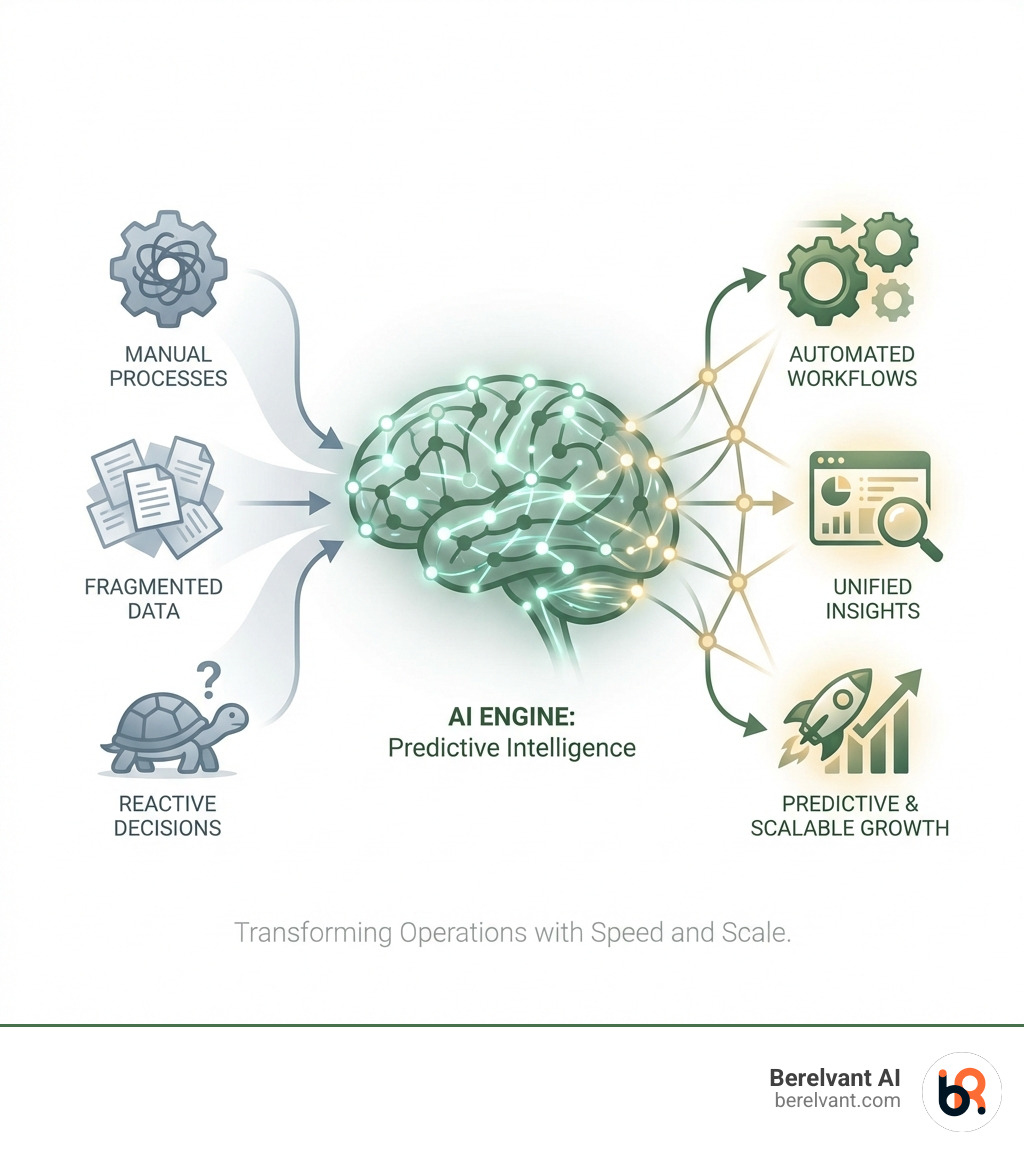
Artificial intelligence AI revolutionizing digital marketing is no longer a future scenario—it’s the operational reality separating market leaders from laggards. Across enterprise organizations, AI is replacing slow, fragmented workflows with predictive systems that operate at speeds and scales impossible for manual teams.
What AI Is Changing Right Right Now:
- Predictive Analytics: AI models forecast customer lifetime value, churn risk, and conversion propensity before campaigns launch
- Autonomous Optimization: Real-time bidding systems adjust spend, creative rotation, and audience targeting without human intervention
- Hyper-Personalization: Next-best-action engines deliver individualized content across channels based on behavioral signals
- Creative Velocity: Generative AI produces localized, compliant creative assets in hours instead of weeks
- Signal Restoration: AI rebuilds attribution accuracy despite privacy regulations and cookie deprecation
The gap between organizations that have integrated AI into their marketing operations and those still running manual processes is widening fast. Companies with deeply integrated AI report 60% greater revenue growth and adapt to market changes twice as fast as their peers. This isn’t about incremental improvement—it’s about system-level change.
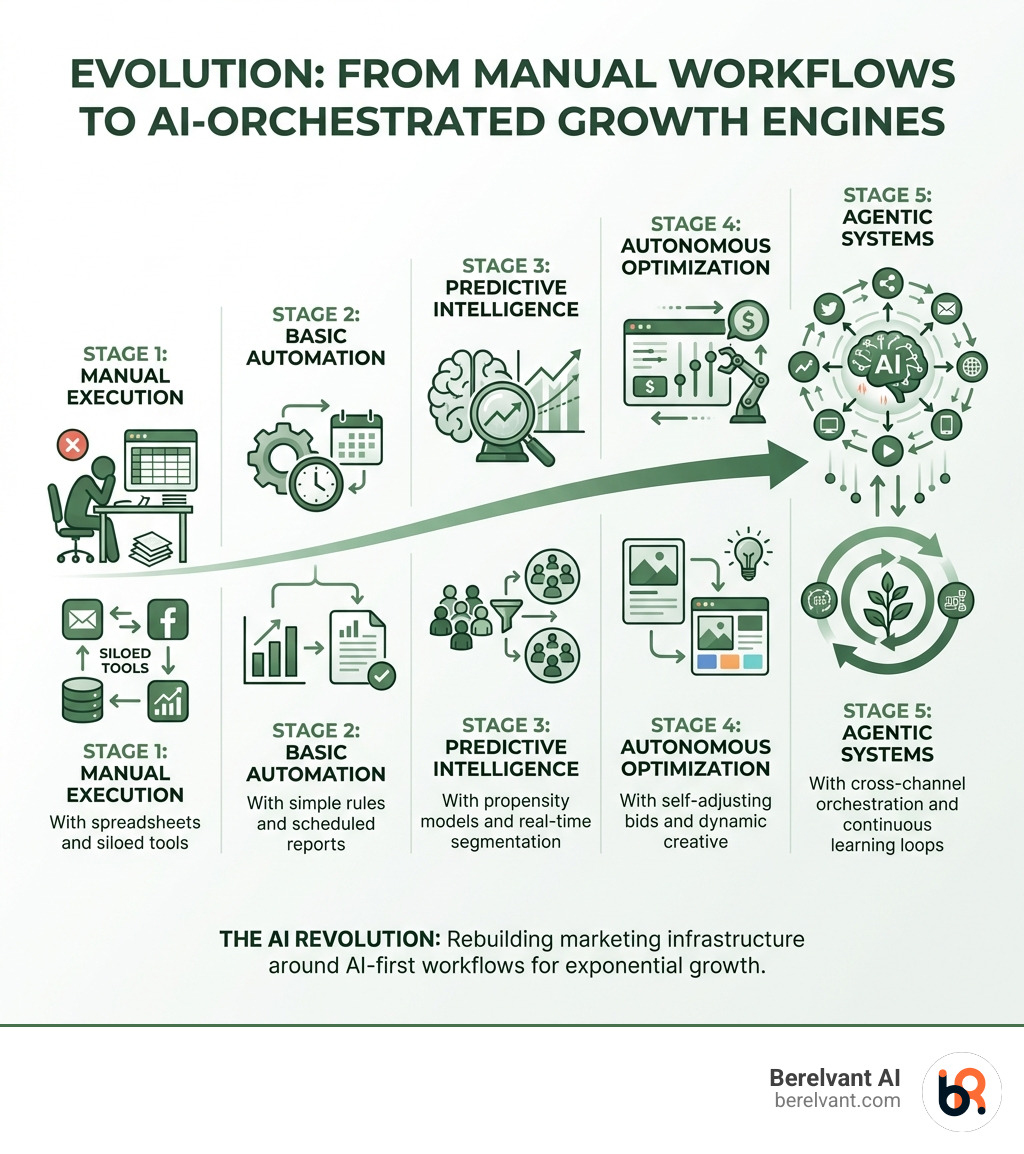
I’m Renzo Proano, founder of Berelvant, where I’ve architected AI-driven growth systems across 300+ million dollars in ad spend for enterprise brands navigating the complexity of artificial intelligence AI revolutionizing digital marketing across financial services, SaaS, and regulated markets. The organizations winning today aren’t just using AI tools—they’re rebuilding their entire marketing infrastructure around AI-first workflows.
Key artificial intelligence ai revolutionizing digital marketing vocabulary:
The Shift from Reactive Data to Predictive Intelligence
For decades, data-driven marketing has been the bedrock of strategic decision-making, emphasizing metrics and insights to optimize campaigns. As explored in Data-Driven Marketing: The 15 Metrics Everyone in Marketing Should Know, the advent of AI has propelled us beyond mere data analysis into the field of predictive intelligence. While traditional data-driven marketing relies on human interpretation of past performance, AI-driven marketing leverages algorithms and machine learning to anticipate future outcomes, automate complex processes, and scale insights exponentially. This represents a fundamental difference and a significant overlap: both are data-reliant, but AI adds layers of automation, prediction, and unprecedented scale.
The role of AI in predictive analytics and forecasting for marketing strategies is nothing short of transformative. Predictive analytics tools, powered by AI, can forecast future trends with remarkable accuracy, allowing us to move from reacting to proactively predicting what customers want. This capability is becoming critical, with 89% of decision-makers asserting that AI-driven personalization will be essential in the next three years. We’re talking about predicting conversion likelihood, churn risk, and customer lifetime value (LTV) before a campaign even launches, then feeding these signals directly into planning, audience building, and budget allocations.
Leaders in personalization, fueled by AI, are growing revenue 10 percentage points faster annually than their competitors. This isn’t just about faster experiments; it’s about smarter ones. AI-driven A/B testing, for instance, dynamically allocates traffic to winning variants in real-time, minimizing losses and maximizing gains. This capability for dynamic adaptation, detecting patterns beyond human intuition in vast datasets, is the future of marketing optimization, enabling hyper-personalized testing at an individual user level. AI augments and accelerates core marketing operations, shifting our efforts from manual analysis to strategic orchestration. More info about AI marketing strategies
How Artificial Intelligence AI Revolutionizing Digital Marketing Analytics
In the analytics sphere, artificial intelligence AI revolutionizing digital marketing means overcoming critical challenges like data fragmentation and privacy restrictions. Google’s research on privacy-safe measurement highlights the importance of signal restoration, where AI and conversion modeling can restore critical data signals for bidding and measurement even when data is incomplete due to evolving privacy regulations.
Google Analytics 4 (GA4) exemplifies this shift, exposing purchase and churn probability alongside predictive audiences. These AI-powered insights allow us to activate highly specific audiences in media and lifecycle campaigns. Our ability to operationalize first-party data for next-best actions has surged, with a 57% increase in predictive traits being reported. This enables AI to find nuanced customer segments that manual rules often miss, clustering behaviors, content affinities, and context for unparalleled precision. This continuous, real-time monitoring and analysis of marketing performance allows for agile strategy adjustments, driven by AI’s capacity to synthesize complex datasets into actionable insights and forecasts.
How Artificial Intelligence AI Revolutionizing Digital Marketing Operations
AI’s impact on digital marketing operations is about efficiency, precision, and strategic agility. We’re witnessing a paradigm shift where AI automates tasks, streamlines workflows, and optimizes campaigns at a granular level previously unimaginable. This is where the rubber meets the road for enterprise organizations, translating into tangible ROI.
For instance, AI is fundamentally changing campaign automation. Modern buying platforms now use AI models to evaluate each impression, adjusting bids, creatives, and frequency in near real-time. This evolution is backed by scientific research on AI in marketing, which highlights the efficiency gains in programmatic environments. Features like bid shading and win-rate prediction significantly reduce media waste in programmatic advertising, leading to substantial cost efficiencies. An SPO (Supply-Path Optimization) case study reported a 40% CPM reduction while maintaining viewability and video completion rates, demonstrating the material savings from smarter supply. AI ensures precision and efficiency in ad targeting, allowing us to allocate resources wisely and achieve higher sales productivity. More info about AI campaign management
The benefits are clear: organizations using AI in service functions report widespread time and cost benefits, with 95% of decision-makers seeing savings and 92% noting improved service quality from generative AI. This translates to an average 6.2% increase in sales productivity, 7% increase in customer satisfaction, and a 7.2% decrease in marketing overhead costs. AI accelerates data flows and decision-making, allowing us to move beyond sequential campaign processes and balance human judgment with AI-driven execution.
How Artificial Intelligence AI Revolutionizing Digital Marketing Personalization
The quest for personalization has always been central to effective marketing, but AI has transformed it into hyper-personalization at scale. McKinsey notes in their research on the personalization frontier that personalization is no longer a “nice-to-have” but a baseline expectation, with 71% of consumers expecting custom interactions and feeling frustrated when they don’t receive them. AI makes this level of relevance practical by scoring propensity and enabling next-best-action models.
AI-powered recommendation engines, similar to those used by leading e-commerce giants, suggest products or services based on past behavior and predicted future interests. AI algorithms assess user behaviors and preferences for precise ad targeting. AI-powered chatbots provide instant customer support and engagement, maintaining a personalized touch. Calm, for example, used Amazon Personalize to tailor wellness recommendations, resulting in a 3.4% increase in daily mindfulness practice.
This hyper-personalization extends across the entire customer journey. Omnichannel programs are becoming “AI-orchestrated,” where models reconcile signals across web, apps, ads, email, and retail, then automatically time the next action. McKinsey highlights that personalization is shifting from isolated use cases to end-to-end workflows, with Gartner underscoring the proactive use of AI for personalized marketing. This means generative models are now tailoring offers, imagery, and tone for each customer at scale, producing highly relevant messages—text and visuals—at high volume while adhering to brand guidelines.
Scaling Creative Infrastructure and Multilingual Execution
Creative production has traditionally been a bottleneck, especially for enterprise organizations operating across diverse markets in the Americas. The need for multilingual, culturally relevant content often meant extended timelines and significant costs. Here, artificial intelligence AI revolutionizing digital marketing accelerates creative workflows, delivering localized, compliant assets with unprecedented speed.
AI tools are changing content creation from brainstorming topics to drafting entire campaigns. The Content Marketing Institute reports that 89% of marketers use generative AI tools, primarily for brainstorming (62%), summarizing material (53%), and writing first drafts (44%). This signifies a shift where AI handles the volume, allowing human creatives to focus on the voice. For instance, Coca-Cola demonstrated this balance by inviting digital artists to generate brand-safe artwork using an OpenAI-powered platform, combining proprietary assets with text-to-image tools.
Enterprise-grade LLM assistants like ChatGPT Enterprise offer secure, admin-controlled writing, analysis, and collaboration, supporting SAML SSO, SCIM, and role-based access. Dedicated marketing writers use tools like Jasper, Writer, Anyword, and Claude for brand-safe drafts and tone checks. For visual assets, tools like Adobe Firefly, Runway Gen-4, Midjourney, DALL·E, and Canva’s “Magic” provide image, vector, and video generation and editing capabilities within existing ecosystems, crucial for rapid iteration and localization at scale.
Generative AI for Enterprise Content Systems
Generative AI is a game-changer for enterprise content systems, enabling the creation of modular creative that can be localized at scale for diverse markets across the Americas. This involves producing highly relevant messages—both text and visuals—at high volume while carefully maintaining brand guardrails.
The impact is evident in areas like email marketing, where generative AI is now mainstream. HubSpot reports that 95% of marketers using genAI for email creation find it effective, with many calling it “very effective.” Marketers leverage AI for subject lines, copy variants, and rapid testing cycles, feeding predictive scores (propensity, churn risk, LTV) into send decisions. Google has even integrated generative writing into Docs and Gmail via Gemini for Workspace, and Slides can generate visuals from prompts, significantly tightening the brief-to-asset loop. Adobe’s 2025 Digital Trends describes genAI as a “copilot for ideation,” empowering teams to produce more options and refine tone efficiently. This allows us to maintain the human “voice” of the brand while AI handles the “volume” of content production and adaptation.
Navigating the Ethical Frontier of Enterprise AI
As we accept the power of artificial intelligence AI revolutionizing digital marketing, we must also steer its ethical complexities. The rapid adoption of AI brings forth critical considerations around data privacy, algorithmic bias, and responsible AI governance. For enterprise organizations, especially those in regulated industries, ensuring compliance with frameworks like GDPR and CCPA is paramount.
AI systems depend heavily on customer data, necessitating rigorous attention to consent, purpose limitation, retention, access, and explainability. Weak signals lead to weak decisions, underscoring the need for impeccable data quality. Moreover, AI can inadvertently create negative feedback loops if trained on biased data, perpetuating or even amplifying existing societal biases. This is a core concern in research on AI-enabled biometrics and ethics, which emphasizes the need for representative datasets and auditing AI systems. We must publish model cards and maintain decision logs for systems that impact targeting, pricing, or eligibility, ensuring transparency and accountability. Balancing the benefits of AI with its potential negative impacts on consumers and society is a continuous responsibility.
Workforce Evolution and the Skill Gap
The rise of AI has sparked debates about job displacement, but our perspective is clear: AI will not replace marketers; rather, marketers who leverage AI will replace those who don’t. The marketing industry is in transition, with a significant gap between individual enthusiasm for AI and organizational readiness.
Our focus is on workforce evolution, necessitating a strategic approach to reskilling and talent development. Marketers must master the use of AI to future-proof their careers, focusing on understanding AI’s capabilities and limitations, ethical best practices, and how to orchestrate AI for data-driven insights, automation, and generative content. More info about AI digital agencies Organizations must invest in educating their workforce, developing policies, and creating implementation roadmaps.
The future of marketing is a human-led, AI-empowered operating model, where human talent shifts to higher-value work such as strategy, partnerships, business planning, and true creativity. AI is a tool meant to augment strategies, not replace the human element that drives brand authenticity and emotional connection. While AI can generate content, it cannot replicate the original ideas, real-life stories, or critical thinking that define compelling brand narratives. Our role is to ensure human oversight for AI-generated content, seeking customer feedback and maintaining transparency to build trust. This blend of human ingenuity and AI efficiency is the hallmark of successful modern marketing.
The Rise of Agentic AI and Autonomous Growth Systems
The progression from predictive intelligence to agentic AI marks the next frontier in artificial intelligence AI revolutionizing digital marketing. While predictive models are now table stakes, autonomy is the next logical step. Agentic AI refers to systems capable of driving complex processes and making decisions autonomously, often with light human oversight. Gartner’s research on agentic software projects that by 2028, 33% of enterprise software applications will include agentic AI, and 15% of day-to-day work decisions could be made autonomously.
This means we can expect campaign agents that dynamically adjust bids, rotate creatives, and re-segment audiences in real-time. Agentic AI is ready to handle over one-fifth of marketing’s total workload within two to three years. These AI systems will continuously learn and act across channels, reconciling signals across web, apps, ads, email, and retail, then automatically timing the next action. The mix of AI for throughput and humans for direction will deliver measurable gains today and set teams up for what’s next, creating a powerful synergy for growth. More info about AI calling agent automation
Emerging Trends in AI for Digital Marketing
Beyond agentic systems, several other emerging trends are reshaping the digital marketing landscape:
- Visual Search and Voice Patterns: Marketers must plan for queries that are spoken, snapped, or circled. Google’s research on visual search trends reports billions of visual searches monthly via Lens, with a significant portion tied to shopping intent. Understanding voice patterns and optimizing for multimodal search is crucial.
- Supply Path Optimization (SPO): In programmatic advertising, SPO uses AI to reduce fees and improve quality. An SPO case study reported a 40% CPM reduction while maintaining viewability and video completion rates, highlighting tangible savings from smarter supply.
- Real-Time Creative Iteration: AI is accelerating creative testing and versioning. This allows for rapid experimentation with different ad creatives and messaging, with AI providing real-time feedback on performance and suggesting optimizations.
- AI-Powered Omnichannel Strategies: We’re moving towards fully AI-orchestrated omnichannel experiences where AI reconciles signals across all touchpoints and automatically times the next best action, creating seamless and highly personalized customer journeys.
Frequently Asked Questions about AI in Digital Marketing
How does AI-driven marketing differ from traditional data-driven marketing?
Traditional data-driven marketing relies on human analysis of historical data to inform strategies and decisions. It’s backward-looking and requires significant manual effort to interpret trends. AI-driven marketing, conversely, uses advanced algorithms and machine learning to automate data analysis, predict future outcomes (like churn risk or LTV), and even execute actions (like bid adjustments or content generation) in real-time. The key difference lies in AI’s ability to provide automation, predictive capabilities, and operate at a scale and speed that manual data analysis cannot match. Both are founded on data, but AI lifts the process from human-interpreted insights to autonomous, proactive intelligence.
What are the primary ROI drivers for enterprise AI implementation?
For enterprise organizations, the ROI from AI implementation is multifaceted and significant:
- Increased Sales Productivity: Marketing leaders have reported an average 6.2% increase in sales productivity.
- Improved Customer Satisfaction: A 7% increase in customer satisfaction is commonly observed.
- Reduced Marketing Overhead Costs: AI drives an average 7.2% decrease in overhead.
- Revenue Growth: Companies with deeply integrated AI report 60% greater revenue growth and adapt to consumer trends twice as fast.
- Time and Cost Savings: 95% of decision-makers using AI report time and cost savings, and 92% attribute improved service quality to generative AI.
- Higher Acquisition, Retention, and Cross-Sell Revenue: “CX Trendsetters” using AI see 33% higher acquisition, 22% higher retention, and 49% higher cross-sell revenue. These gains are driven by AI’s ability to personalize at scale, automate repetitive tasks, and optimize campaigns in real-time.
How can organizations mitigate algorithmic bias in automated campaigns?
Mitigating algorithmic bias is a critical ethical and operational challenge for enterprise AI. Organizations can take several proactive steps:
- Rigorous Auditing: Regularly audit AI systems to identify and address any inherent biases in their decision-making processes.
- Representative Data Sets: Ensure that the data used to train AI models is diverse and representative of the target audience, avoiding skewed outcomes.
- Transparency and Explainability: Publish model cards and maintain detailed decision logs for AI systems that affect targeting, pricing, or eligibility. This provides transparency on how decisions are made.
- Human Oversight: Implement human-in-the-loop processes where AI-generated outputs or automated decisions are reviewed and validated by human experts, especially for sensitive campaigns.
- Continuous Feedback Loops: Actively solicit customer feedback on AI interactions to identify and correct inaccuracies or perceived biases.
- Ethical Guidelines and Governance: Establish clear ethical guidelines and a robust governance framework for AI development and deployment, ensuring compliance with relevant regulations and internal values.
Conclusion
The artificial intelligence AI revolutionizing digital marketing is not just about adopting new tools; it’s about fundamentally rethinking how we build and manage acquisition systems. At Berelvant, we understand that for enterprise brands operating across the Americas, this means integrating performance media, multilingual creative, automation, and analytics into one unified, AI-powered engine. Our focus is on solving complex challenges: navigating regulated industries, ensuring compliance in heavy environments, executing across multiple countries, and engaging multicultural audiences.
AI serves as our speed and scale layer, accelerating delivery, removing bottlenecks, and multiplying the impact of every campaign. The future of enterprise growth lies in mastering this integration—changing marketing from a series of disjointed efforts into a cohesive, intelligent, and continuously optimizing growth machine. This is not merely an advantage; it is a necessity for sustained success in the modern digital landscape.