Why Manual CRO Can No Longer Keep Pace
AI conversion optimization is the application of artificial intelligence—machine learning, predictive analytics, and automation—to analyze user behavior, test experiences, and personalize journeys at scale, driving higher conversion rates faster and more efficiently than manual methods.
Key components of AI conversion optimization:
- Behavioral Analytics: AI processes clicks, scrolls, session replays, and heatmaps to identify friction points and intent signals.
- Automated Testing: Multi-armed bandit algorithms and multivariate testing run continuously, reallocating traffic to winning variants in real-time.
- Predictive Personalization: Machine learning models tailor content, offers, and layouts dynamically based on user attributes and behavior.
- Real-Time Optimization: AI adjusts experiences on the fly across channels, devices, and markets without manual intervention.
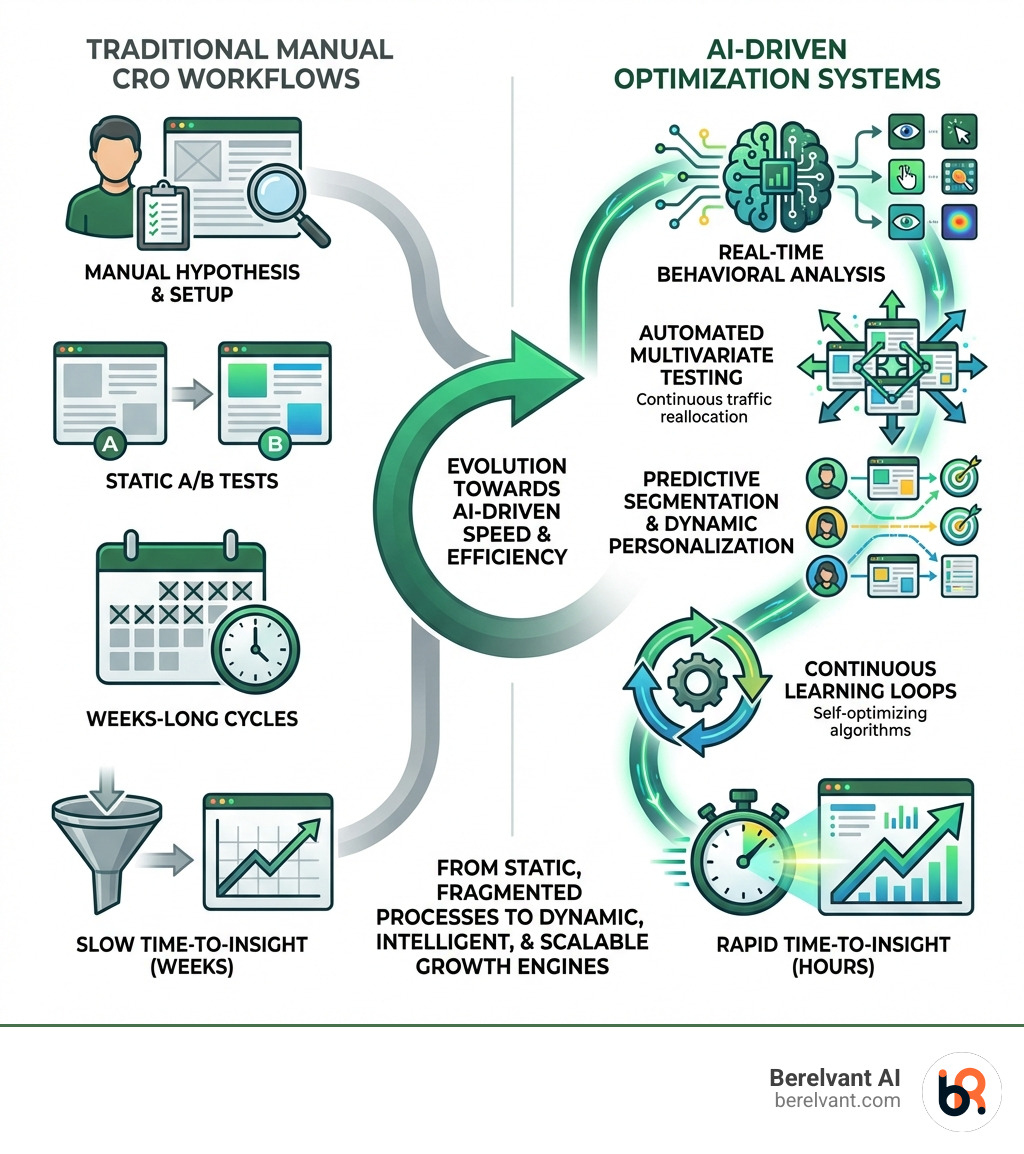
Your conversion rate optimization program is probably too slow. Not because your team lacks skill, but because traditional CRO—manual hypothesis generation, static A/B tests, weeks waiting for statistical significance—was built for a different era. Today’s users move faster. They jump between devices, abandon journeys in seconds, and expect experiences that anticipate their needs. Meanwhile, your competitors are deploying AI systems that test dozens of variables simultaneously, personalize at the individual level, and optimize in real-time while you’re still waiting for your latest test to reach 95% confidence.
According to McKinsey, 35% of companies are already using AI in marketing and sales. Salesforce reports that 68% of high-performing marketers use AI to improve customer experiences. This isn’t experimental anymore—it’s infrastructure. The gap between teams running manual CRO and those leveraging AI-powered optimization systems is widening every quarter, and that gap translates directly to lost revenue, longer sales cycles, and higher customer acquisition costs.
The stakes are especially high for mid-market and enterprise organizations operating across multiple regions, dealing with regulatory constraints, or managing call-centric conversion funnels. In these environments, speed and precision aren’t luxuries—they’re requirements. A 66.6% reduction in friction points, a 12% increase in qualified calls, or a 65% drop in price sensitivity on inbound leads can fundamentally change unit economics. AI conversion optimization delivers these outcomes not by replacing strategic thinking, but by removing the bottlenecks that slow execution and limit scale.
I’m Renzo Proano, founder of Berelvant, where I’ve managed over $300 million in digital ad spend and built AI conversion optimization systems for brands across financial services, SaaS, GovTech, and e-commerce—including regulated markets where compliance, accuracy, and speed are non-negotiable. I’ve seen how the right AI infrastructure transforms fragmented, slow CRO processes into predictive, scalable growth engines that operate faster than internal teams and deliver measurable lift across acquisition, retention, and revenue.
Easy AI conversion optimization glossary:
The Strategic Imperative: Why AI is Reshaping Conversion Systems
For enterprise organizations, the shift to AI conversion optimization isn’t merely an incremental improvement; it’s a strategic imperative. We’re moving beyond the limitations of traditional A/B testing, where static versions are pitted against each other, often taking weeks to gather statistically significant data. AI-driven systems, in contrast, offer a profound leap forward, enabling predictive analytics over reactive analysis, real-time personalization at scale, and a dramatic reduction in opportunity cost. This ultimately leads to sustained conversion growth that simply wasn’t possible before.
A recent McKinsey study highlighted that 35% of companies are using AI in marketing and sales, with CRO being a top application for improving customer journeys and increasing ROI. This adoption isn’t just about efficiency; it’s about competitive advantage. High-performing marketers, as reported by Salesforce, are already leveraging AI to improve customer experiences, including personalization and predictive targeting. This underscores a clear trend: AI is rapidly becoming the backbone of effective marketing and sales operations. To explore how these advancements fit into a broader framework, you can learn More on AI Marketing Strategies.
From Manual Analysis to Predictive Insights
Traditional CRO methods often rely on human intuition and a laborious process of hypothesis generation. Teams spend countless hours analyzing fragmented data, conducting user research, and then manually setting up and monitoring A/B tests. This approach is inherently slow, prone to human bias, and struggles to keep pace with the dynamic nature of user behavior.
AI conversion optimization fundamentally changes this paradigm. AI’s ability to process vast datasets—from user clicks and scroll depth to session recordings and historical purchase patterns—allows it to uncover non-obvious patterns that human analysts might miss. These patterns enable AI to generate data-driven hypotheses for optimization, moving from “what we think might work” to “what the data suggests will work.” Furthermore, AI can forecast the likely impact of proposed changes, allowing us to prioritize high-potential optimizations and make smarter strategic decisions before committing significant resources. It transforms CRO from a reactive process into a proactive, predictive one.
The Economic Impact of AI-Driven Optimization
For enterprise-level operations, the economic implications of slow, traditional CRO are substantial. Every day spent waiting for an A/B test to conclude represents an opportunity cost – lost conversions, lower revenue velocity, and inefficient ad spend. AI conversion optimization significantly reduces this friction. By automating experimentation and optimizing in real-time, AI systems can:
- Increase Revenue Velocity: Faster identification and deployment of winning variants means revenue is generated more quickly.
- Maximize ROAS (Return on Ad Spend): AI can dynamically test ad creatives, keywords, and bidding strategies to maximize ROI while reducing cost-per-click (CPC), ensuring every marketing dollar works harder.
- Achieve Scalable Results: AI allows us to run advanced experiments across numerous campaigns, segments, and markets without linearly increasing headcount. This means scalable growth without the associated operational burden.
The goal is to convert opportunity costs into growth, accelerating optimization workflows and delivering sustained conversion improvements that directly impact the bottom line.
Core Mechanisms of AI Conversion Optimization
At the heart of AI conversion optimization is its ability to deeply analyze user behavior and translate that analysis into actionable insights.
AI Analyzes User Behavior to Identify Friction Points and Opportunities
We leverage AI to analyze a comprehensive array of user interactions, capturing every tap, swipe, click, and scroll. This behavioral data capture is far more granular than what traditional analytics can provide. AI processes these massive data streams to pinpoint exact friction points and identify conversion opportunities:
- Rage Clicks and Dead Clicks: AI identifies instances where users repeatedly click on non-interactive elements (rage clicks) or areas that appear clickable but aren’t (dead clicks), signaling frustration or confusion.
- Session Replay Analysis: AI can summarize user journeys in session recordings, highlighting key behaviors and friction points, allowing us to see exactly where and why users get stuck or abandon their journey.
- Heatmap Analysis: AI-powered heatmaps, trained with extensive eye-tracking studies, can predict how real humans would interact with a webpage with up to 90% accuracy. This helps us understand visual hierarchy and attention flow without requiring actual human eye-tracking studies.
- Predictive Segmentation: AI uses clustering models to segment audiences dynamically based on behavior, intent, or demographics. This allows for hyper-targeted optimization efforts.
- Automated Hypothesis Generation: Based on these deep behavioral insights, AI can generate data-backed hypotheses for optimization, suggesting specific changes to headlines, calls-to-action, or page layouts that are most likely to improve conversion rates.
This detailed analysis helps us understand not just what users are doing, but why they are doing it, enabling us to remove barriers and create smoother, more intuitive user experiences.
AI-Powered Testing and Personalization
One of the most transformative aspects of AI conversion optimization is its ability to automate and accelerate the testing and personalization process. This is where AI truly shines as a “speed and scale layer.”
- Automated A/B/n Testing: Unlike traditional A/B testing, which compares two versions, AI can run multivariate tests, simultaneously evaluating dozens or even hundreds of variations of page elements. This dramatically speeds up the learning process.
- Multi-Armed Bandit Algorithms: These advanced algorithms dynamically allocate traffic to better-performing variants as the test runs, minimizing the opportunity cost of showing underperforming versions. This means more users see the winning experience faster, directly impacting revenue during the testing phase.
- Dynamic Content Optimization: AI can automatically adjust content, layouts, and offers on a webpage in real-time based on a user’s behavior, location, device, or past interactions. This means each user sees the most relevant and persuasive version of your site.
- Real-Time Traffic Allocation: AI continuously monitors performance and shifts traffic towards winning experiences, ensuring that optimization is always happening, 24/7.
- Generative AI for Ideas: AI can generate creative test ideas for headlines, copy, and calls to action, reducing the manual effort in ideation. This is a powerful application of Generative AI Marketing.
With 68% of high-performing marketers already using AI to improve customer experiences, including personalization and predictive targeting, the competitive advantage of these AI-powered testing and personalization capabilities is clear.
The Role of AI in Content and User Experience
AI conversion optimization extends deeply into how we craft and deliver content, fundamentally changing the user experience.
- Personalized User Journeys: AI creates adaptive profiles based on user behavior, context, and intent. This allows for the orchestration of truly personalized user journeys, guiding each visitor through a unique path optimized for their conversion.
- AI-Generated Copy Variations: Generative AI can quickly produce multiple versions of headlines, calls-to-action, and body copy, which can then be tested and optimized by AI-powered testing tools. This ensures that the most effective messaging is always in front of your audience.
- Dynamic Visual Elements: AI can analyze which images, videos, or graphical elements resonate most with specific user segments and dynamically display them. This ensures that your visual communication is as effective as your written content.
- Tailoring Experiences for Multicultural Audiences: For organizations operating across the Americas, AI is invaluable for understanding and adapting content and experiences for diverse cultural and linguistic backgrounds. It can help ensure messaging is not only translated accurately but also culturally resonant, a key component of effective Creative Workflow Automation.
By leveraging AI in content and UX, we ensure that every interaction is relevant, engaging, and precisely custom to drive conversion.
Enterprise Applications: AI CRO in Practice
The practical applications of AI conversion optimization span various industries and business models, offering custom solutions that drive measurable growth.
AI Conversion Optimization for Call-Centric and Regulated Industries
For businesses in regulated industries or those heavily reliant on inbound calls—common in sectors like financial services, healthcare, and automotive—AI conversion optimization is a game-changer. Our expertise often lies in solving complex challenges in these environments, where compliance and precision are paramount.
- Call Intent Scoring: AI analyzes call recordings (or real-time conversations) to score caller intent, identifying high-value leads and understanding their specific needs or pain points.
- Real-time Sentiment Analysis: During a call, AI can analyze the sentiment of the conversation, alerting agents to potential issues or opportunities to optimize their approach.
- Automated Compliance Adherence: In regulated markets, AI can monitor calls for compliance with industry regulations, ensuring that all necessary disclosures are made and appropriate language is used.
- Agent Script Optimization: By analyzing patterns in successful and unsuccessful calls, AI can recommend optimal responses, objection handling techniques, and agent scripts, directly improving call-to-conversion rates.
This application is particularly powerful when integrated with AI Calling Agent Automation, allowing for a comprehensive, AI-driven approach to inbound and outbound call optimization.
AI-Powered Chatbots and Conversational AI
The evolution of chatbots and conversational AI has moved far beyond simple FAQ bots. Today, these AI-driven tools are integral to AI conversion optimization, actively contributing to lead generation and customer experience.
- 24/7 Lead Qualification: AI chatbots can engage website visitors around the clock, asking qualifying questions, and routing high-intent leads directly to sales teams. This reduces the burden on human agents and ensures no lead is missed.
- Reducing Decision Fatigue: By providing instant, personalized answers and recommendations, chatbots can guide users through complex decision processes, reducing friction and preventing abandonment.
- Answering Complex Queries: Advanced conversational AI can handle a wide range of customer inquiries, providing detailed information and support, improving user satisfaction and their likelihood to convert.
- Gathering Zero-Party Data: Chatbot interactions are a rich source of zero-party data (data voluntarily shared by the customer), which can be fed back into the AI CRO system for even more precise personalization and segmentation.
- Guiding Users to High-Converting Paths: Chatbots can proactively suggest next steps, provide personalized product recommendations, or direct users to specific content designed to convert, helping to build High Converting Websites.
These AI-powered assistants act as always-on conversion specialists, enhancing the user experience and ensuring that potential customers are engaged and supported throughout their journey.
Building Your AI CRO Engine: Integration, Tools, and Governance
Implementing an effective AI conversion optimization strategy at the enterprise level requires more than just acquiring a tool; it demands a holistic approach to integration, governance, and strategic oversight.
Key Features of an Enterprise AI CRO Platform
When evaluating solutions for your AI CRO engine, we look for platforms that offer robust capabilities custom for enterprise needs:
- Real-time Analytics: The ability to process and surface insights from behavioral data instantly is crucial. This includes detailed heatmaps, session replays, and conversion funnels, often leveraging AI to summarize and highlight critical patterns.
- Predictive Modeling Capabilities: Beyond simply analyzing past behavior, an enterprise platform should predict future user actions, such as churn likelihood, conversion propensity, or optimal next steps.
- No-code/Low-code Interface: For large teams, ease of use is paramount. Marketers and product owners should be able to set up experiments and personalize experiences without heavy reliance on developers.
- API and Integration Flexibility: Seamless integration with existing CRM, CDP (Customer Data Platform), analytics systems (like Google Analytics, which is used by over 30 million websites), and content management platforms is non-negotiable for a unified view of the customer.
- Scalability and Security Protocols: The platform must be able to handle massive traffic volumes and data processing requirements, all while adhering to stringent enterprise-grade security and data privacy standards (e.g., GDPR, CCPA).
These features ensure that the AI CRO platform can serve as a central nervous system for your conversion efforts, providing the data, automation, and intelligence needed to operate at scale.
Common Pitfalls in Enterprise AI CRO Implementation
Even with the most advanced tools, several challenges can derail an AI conversion optimization initiative if not properly addressed. We guide our clients to avoid these pitfalls:
- Over-reliance on Automation: While AI automates much of the CRO process, it doesn’t eliminate the need for human oversight and strategic direction. AI works best as a “human-in-the-loop” system, where AI surfaces insights for human decision-making and creative strategy.
- Ignoring Qualitative Data: AI excels at quantitative analysis, but qualitative feedback (surveys, interviews, customer support logs) provides invaluable context and “the why” behind user behavior. A balanced approach integrates both.
- Data Silos and Fragmentation: For AI to be truly effective, it needs access to comprehensive, unified data. Fragmented data across different systems (CRM, marketing automation, website analytics) will limit AI’s ability to generate accurate insights and drive holistic optimization.
- Lack of Strategic Oversight: Without clear goals, a defined strategy, and continuous monitoring from leadership, AI CRO efforts can become undirected and fail to deliver meaningful business impact. This is where expert Marketing Operations Consulting becomes critical.
- Forgetting Mobile-First Optimization: With mobile traffic often constituting more than 50% of total users, neglecting mobile-specific testing and optimization is a significant mistake. AI CRO tools must be capable of analyzing and optimizing mobile experiences effectively.
Addressing these challenges requires a disciplined approach to data governance, cross-functional collaboration, and continuous strategic evaluation.
The Future of Conversion: What’s Next for AI CRO?
The trajectory of AI conversion optimization is towards increasingly autonomous, predictive, and hyper-personalized systems. We envision a future where optimization is not a separate project but an inherent, continuous function of every digital experience.
- Hyper-Personalization: Moving beyond segmentation, AI will enable true 1:1 personalization, where every element of a user’s journey—from the content they see to the offers they receive—is dynamically custom to their individual needs and intent in real-time.
- Predictive Creative Generation: Generative AI will play an even larger role, not just suggesting copy or design ideas, but autonomously creating and testing entire creative variations (e.g., ad creatives, landing page layouts) at scale, with immediate feedback loops for optimization.
- Automated Journey Mapping: AI will continuously map and re-map complex customer journeys, identifying emerging patterns and bottlenecks across all touchpoints, even those that are traditionally difficult to track.
- Proactive Optimization: Instead of reacting to performance dips, AI will anticipate potential issues or opportunities and proactively implement optimizations before human intervention is required.
- The End of the “Average” User: With AI’s ability to understand and cater to individual differences, the concept of an “average” user will become obsolete. Every user will experience a uniquely optimized journey.
This future isn’t far off; components of it are already being deployed by leading enterprises. The goal is to create a self-optimizing digital ecosystem that continuously learns, adapts, and drives superior conversion outcomes.
Frequently Asked Questions about AI Conversion Optimization
What’s the difference between AI CRO and traditional A/B testing?
Traditional A/B testing is a manual process comparing static versions, often limited by human intuition and slow to reach statistical significance. It typically compares two variations of a single element (e.g., a button color). AI conversion optimization, on the other hand, automates experimentation at scale. It uses machine learning to test multiple variables simultaneously (multivariate testing), and dynamically allocates traffic to winning variations in real-time (e.g., using multi-armed bandit algorithms), dramatically accelerating the optimization cycle and reducing opportunity cost. AI CRO is about continuous, adaptive learning and personalization, not just comparing fixed versions.
Will AI replace CRO strategists and teams?
No, AI improves them. AI automates data-heavy tasks and pattern recognition, freeing human strategists to focus on higher-level goals, creative direction, interpreting complex insights, and defining the overall optimization strategy. It acts as a powerful partner, not a replacement. While AI can generate hypotheses and run tests, human expertise is still essential for understanding brand voice, emotional nuance, cultural context, and ethical considerations, particularly in regulated industries or for multicultural audiences across the Americas. AI handles the “how,” while humans provide the “why” and “what.”
Is AI CRO only for large enterprises with massive data sets?
While large data sets accelerate learning, modern AI conversion optimization platforms are increasingly accessible. They can deliver value even with moderate traffic by running more efficient tests (like multi-armed bandit, which can start with less data than traditional A/B tests). The key is the quality and consistency of data, not just sheer volume, making it viable for growing mid-market companies as well. Many AI CRO tools offer pricing and features suitable for growing businesses, making advanced experimentation more accessible.
Conclusion: Activating Your AI-Driven Growth Engine
In today’s hyper-competitive digital landscape, relying on outdated CRO methodologies is a luxury most enterprises cannot afford. AI conversion optimization is no longer a futuristic concept; it is the engine driving growth for leading organizations worldwide, especially those navigating complex, multi-market operations across the Americas.
By embracing system-level thinking and leveraging AI as a speed and scale layer, we can transform your conversion strategies from reactive to proactive, from manual to automated, and from incremental gains to sustained, exponential growth. This isn’t just about optimizing individual campaigns; it’s about building a continuous improvement machine that learns, adapts, and converts around the clock.
Our expertise at Berelvant lies in architecting and managing these sophisticated AI-driven acquisition systems, ensuring they are compliant, efficient, and custom to your specific market challenges. It’s a shift from merely executing campaigns to building a robust, AI-powered optimization engine that multiplies the impact of every marketing dollar.
Ready to open up the full potential of your conversion efforts? Let us help you Develop your enterprise AI Marketing Strategies today.