
Why Generative AI Marketing Demands Strategic Rethinking
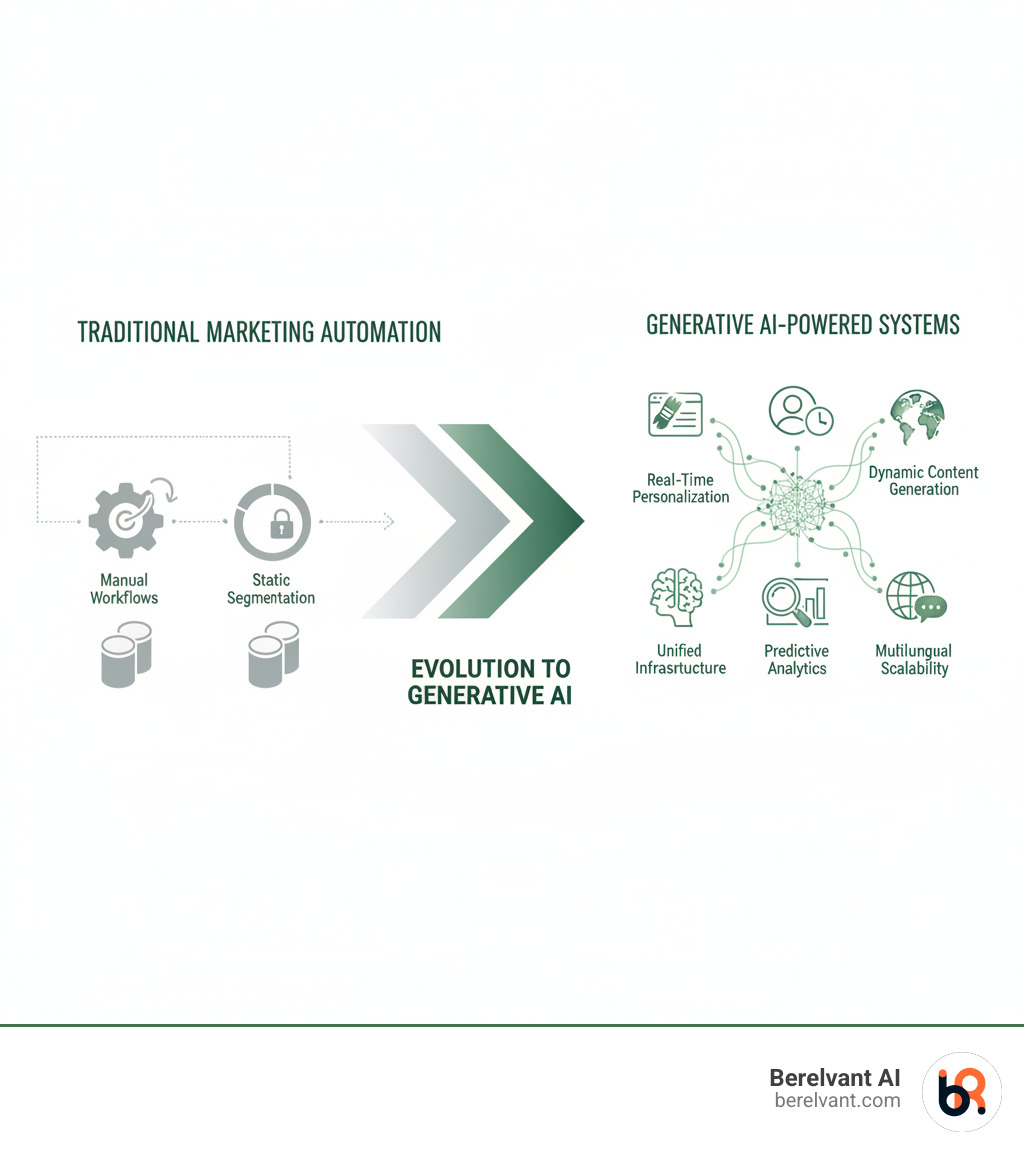
Generative AI marketing represents the shift from isolated automation to a unified growth system that scales creative infrastructure, accelerates delivery, and enables multilingual execution across complex markets. It’s not about replacing your team—it’s about giving them leverage.
Core capabilities of generative AI marketing:
- Content creation at scale – Generate text, images, and video assets custom to brand voice and audience segments
- Hyper-personalization – Move from broad segmentation to individual-level customization in real time
- Predictive insights – Analyze unstructured data to identify trends, sentiment, and competitive shifts
- Process acceleration – Compress production cycles from weeks to hours without sacrificing quality
- Multilingual and multi-market execution – Deploy compliant, culturally adapted campaigns across the Americas
The economic case is clear: generative AI could add $4.4 trillion in annual global productivity, with marketing gaining up to $463 billion in value. This is why over 86% of CMOs plan to implement generative AI within 24 months, with many building foundation models on proprietary data. However, adoption is fragmented. With 50% of use occurring at the individual employee level versus just 20% at the organizational level, most companies face inconsistency, compliance risks, and missed opportunities for system-level change.
The real opportunity isn’t just efficiency. It’s strategic innovation—the ability to deliver personalized experiences at scale, compress time-to-market, and operate with the speed and precision that enterprise leaders demand.
I’m Renzo Proano, and I’ve built performance marketing systems and AI automation infrastructure for brands across financial services, SaaS, GovTech, and e-commerce, managing over $300 million in digital ad spend. At Berelvant, we design generative AI marketing systems that integrate creative infrastructure, multilingual execution, and compliance-ready automation to replace slow, fragmented workflows with fast, predictable growth engines.
The Strategic Imperative: Defining Generative AI in the Marketing Ecosystem
Generative AI marketing isn’t just another automation tool—it’s a fundamental shift in how enterprise marketing systems operate. Where traditional AI analyzes and predicts, generative AI creates. It produces new content, messaging, and visuals by training on massive datasets to learn patterns that mirror human creativity. This enables large language models (LLMs) and multimodal systems to craft personalized ad copy, generate product images, and adapt messaging across languages—all while maintaining brand consistency at enterprise scale. For a broader overview of the underlying technology, see generative artificial intelligence.
The challenge, however, is that only 20% of current generative AI adoption happens at the organizational level, while 50% occurs at the individual employee level. This fragmentation creates inconsistency and missed opportunities. Companies that treat AI as a strategic infrastructure play—not a tactical hack—will capture disproportionate advantage.
From Data Prediction to Content Creation
Understanding the difference between predictive and generative AI is key to building effective marketing systems.
Predictive AI analyzes historical data to forecast future outcomes. It excels at identifying who to target through lead scoring, churn prediction, and behavioral analysis. This technology has been the backbone of marketing automation for years.
Generative AI creates new content based on learned patterns. It produces the messaging and visuals needed to reach your audience, crafting what to say and how to say it. It then adapts that message across channels, languages, and segments.
The real power emerges when these technologies work together. Predictive models pinpoint high-value segments, and generative systems instantly produce personalized ad copy, email sequences, and video scripts for each one. This symbiotic relationship augments human creativity, shifting your team from production work to strategic oversight and decision-making. It’s a speed and scale layer that removes creative bottlenecks and enables hyper-personalization that was previously impossible.
The Business Case: Quantifying the Impact on Growth and Efficiency
The impact of generative AI on enterprise marketing is measurable across cost reduction, revenue growth, and operational efficiency.
Cost reduction stems from automating high-volume tasks. Walmart achieved 3% cost savings using a generative AI chatbot for vendor negotiations, while Unilever reduced customer agent response time by approximately 90%. These are fundamental shifts in operational cost.
Revenue growth accelerates with personalized content at scale. Michaels Stores increased email personalization from 20% to 95%, lifting SMS click-through rates by 41% and email campaign engagement by 25%. A European telecommunications company saw a 40% lift in response rates by using hyper-personalized messaging across 150 segments. Vanguard reported a 15% increase in conversion rates for LinkedIn ads created with generative AI.
Speed-to-market becomes a competitive advantage. An Asian beverage company completed a year’s worth of market research and product concept development in just one month. Mattel now generates four times as many product concept images, accelerating its innovation cycles. This agility allows you to test, learn, and deploy campaigns that adapt to market shifts with unprecedented speed.
High-Impact Use Cases for Enterprise Generative AI Marketing
The real power of generative ai marketing is in building a unified system that connects your creative engine to every channel, market, and customer touchpoint. At Berelvant, we design these systems to operate as a single intelligence layer—feeding social, email, Connected TV, and web—so your team can execute faster and scale smarter across complex, multilingual markets.

Building a Scalable Creative Infrastructure
Creative bottlenecks kill momentum. Generative ai marketing removes that constraint by turning your creative process into a production system.
Text generation has evolved beyond simple templates. Today’s foundation models—like those from OpenAI, Microsoft, and Google—can produce brand-aligned ad copy, product descriptions, and email sequences that maintain voice consistency across every touchpoint.
Image and video creation is where the infrastructure shift becomes tangible. Tools like DALL-E3, Midjourney, Adobe Firefly, and Runway enable your team to generate custom visuals without a full production studio. Carvana created 1.3 million unique AI-generated videos custom to individual customer journeys—a scale that was previously impossible. For enterprise teams, this means producing localized Connected TV ads and social creatives without multiplying your production budget.
Ad copy variation and A/B testing automation compress optimization cycles from weeks to hours. Generative AI can produce dozens of creative variants instantly, giving your strategists the leverage to test more ideas, faster.
We’ve built these systems for clients in regulated industries where speed and consistency are non-negotiable. For a deeper look at how we integrate AI into campaign execution, explore our guide on AI Campaign Management.
Achieving Hyper-Personalization Across the Americas
Generative ai marketing eliminates the trade-off between personalization depth and audience breadth.
Michaels Stores increased email personalization from 20% to 95%, driving a 41% lift in SMS click-through rates. A European telecommunications company achieved a 40% lift in response rates by deploying hyper-personalized messaging across 150 micro-segments. These are step-function improvements.
Micro-segmentation enables dynamic content that adapts in real time based on user behavior and preferences. This is critical for brands operating across diverse markets in the Americas, where cultural and regulatory nuances vary dramatically.
Personalized journey mapping ensures every interaction is optimized for individual needs, which is essential for complex lifecycles in financial services or SaaS.
Multilingual execution becomes indispensable for cross-border operations. The technology can translate content, adapt messaging for cultural context, and generate multilingual audio, allowing your team to operate as one unified engine.
To see how hyper-personalization translates into targeted engagement, dive into our expertise in Connected TV Advertising.
Enhancing Customer Intelligence and SEO
Generative ai marketing creates smarter content by turning unstructured data into strategic insights.
By analyzing social media posts, reviews, and support tickets at scale, generative AI identifies sentiment patterns and emerging trends. This intelligence feeds your creative engine, ensuring messaging is informed by real customer signals, not assumptions.
Predictive analytics helps you anticipate future trends and identify high-value leads, enabling proactive campaign planning and optimized resource allocation.
AI-driven SEO strategy has evolved beyond keywords. Generative AI suggests headlines optimized for search intent, identifies content gaps, and develops content that aligns with how Google’s algorithms are evolving—particularly for Answer Engine Optimization (AEO). The goal is to be the definitive answer when your audience asks a question.
For an assessment of your current digital infrastructure and how AI can improve it, consider our Free Digital Marketing Analysis.
Architecting Your AI-Powered Marketing Engine
Building a generative AI marketing system requires infrastructure—the kind that scales, integrates with existing operations, and delivers measurable outcomes. This demands a structured approach to assess readiness, choose an implementation path, and build the right data and team foundations. Too many enterprises get stuck in pilot purgatory because they lack architectural thinking.

Assessing Enterprise Readiness: Viability, Feasibility, and Trust
Before deploying any solution at scale, you must evaluate readiness across three dimensions.
Viability asks if the use case creates real value. Will it lift campaign response rates by 40% or solve an expensive problem? If the answer is uncertain, the use case needs refinement.
Feasibility is about execution. Do you have the data infrastructure, technical capabilities, and team structure to deploy and scale AI effectively? This includes access to high-quality, proprietary data.
Trustworthiness evaluates risk. For enterprises in regulated industries like finance or healthcare, you need ethical safeguards, compliance protocols, and transparency mechanisms built in from the start to prevent brand damage or regulatory violations.
These questions shape your implementation roadmap, budget, and team structure. They are the foundation for mapping existing capabilities against strategic objectives.
Choosing Your Implementation Model for Generative AI Marketing
There are three primary paths for integrating generative AI marketing. The right choice depends on your strategic goals and organizational maturity.
| Model Type | Speed | Cost | Differentiation | Complexity | Description |
|---|---|---|---|---|---|
| Prebuilt Models | High | Low | Low | Low | Off-the-shelf tools like ChatGPT or DALL-E that are quick to implement and require minimal customization. Ideal for quick wins and common tasks like basic content drafting or image generation. Less custom to proprietary data or brand voice. |
| Customized Models | Medium | Medium | Medium-High | Medium | Fine-tuning existing foundation models with proprietary data, brand guidelines, and historical campaign creatives. Offers more custom and effective marketing solutions, enabling bespoke content creation and stronger brand alignment. |
| Large-Scale Change | Low | High | High | High | Integrating multiple AI technologies to fundamentally alter core marketing processes. This involves re-engineering workflows, building dedicated teams, and potentially developing entirely new marketing paradigms. Highest potential for innovation and competitive advantage. |
Prebuilt models are where most enterprises start. These are off-the-shelf tools like ChatGPT or DALL-E that you can deploy in days for quick wins like drafting social copy or generating image variations. The downside is limited differentiation, as competitors have access to the same tools.
Customized models are where strategic value begins. This means fine-tuning foundation models with your proprietary data—historical campaign performance, brand guidelines, and customer interactions. The result is AI that generates content that sounds like your brand and understands your market nuances.
Large-scale change is the end state for enterprises that view AI as core infrastructure. This involves re-engineering entire marketing processes, integrating multiple AI technologies, and building dedicated teams. This path requires significant investment but delivers true innovation and operational leverage.
For most organizations, a phased approach is best: start with prebuilt models to demonstrate ROI, then move to customized solutions that leverage your proprietary data. The long-term goal is embedding AI as a core layer of your marketing engine to compress time-to-market and enable multilingual execution at scale.
This journey often includes automating complex customer interactions, like those handled through AI Calling Agent Automation, where AI becomes the speed and scale layer for every campaign.
Navigating Risks and Ensuring Enterprise-Grade Governance
While the opportunities of generative AI marketing are immense, enterprise-level deployment comes with significant risks that demand robust governance. These are fundamental issues of brand reputation, legal compliance, and customer trust.
Mitigating Common Pitfalls in Generative AI Marketing
Our approach to risk mitigation is comprehensive, focusing on the integrity and reliability of all AI-generated outputs.
- Data Privacy and Security: Using customer data to train AI models creates privacy risks. We enforce strict adherence to data regulations, ensure user consent, and use advanced security to protect sensitive information, which is critical for regulated industries and operations across the Americas.
- Copyright Infringement and Intellectual Property (IP): Generative AI models trained on vast datasets risk infringing on existing copyrights, as highlighted by lawsuits like the one from The New York Times against OpenAI. We implement strict protocols, including data provenance checks and human review, to ensure all generated content is original and compliant.
- AI Hallucinations and Accuracy: Models can “hallucinate” factually incorrect outputs, which can damage brand credibility. Our mitigation strategies include rigorous validation, cross-referencing AI outputs with trusted sources, and maintaining human oversight for all customer-facing content.
- Algorithmic Bias: AI models can amplify biases from their training data, leading to discriminatory or stereotypical outputs. We conduct thorough bias audits of training data and model outputs to ensure fairness and responsible content generation.
- Transparency and Explainable AI (XAI): It’s not enough for AI to work; we need to understand how it works. We prioritize transparency in our solutions, providing clear documentation on how models are trained and tuned for better accountability.
- Regulatory Compliance: The regulatory landscape for AI is rapidly evolving. We design our generative AI marketing systems with ethical safeguards built for compliance, particularly in regulated environments.
The success of generative AI depends on “humanity in the loop.” We establish an accountable leadership structure and integrate human review for all customer-facing outputs, ensuring that human creativity and ethical judgment remain central to our marketing endeavors.
Frequently Asked Questions about Enterprise Generative AI Marketing
As VP and Director-level leaders evaluate generative AI marketing, we consistently encounter strategic questions about measurement, infrastructure, and organizational change. These are fundamental to building a scalable growth engine.
How do we measure the ROI of generative AI in our marketing efforts?
The ROI of generative AI extends far beyond cost savings. We measure impact across the entire growth spectrum:
- Direct Financial Impact: Track lifts in conversion rates, leads, and click-through rates. Vanguard saw a 15% increase in LinkedIn ad conversions, while Michaels Stores lifted SMS CTRs by 41% through improved personalization.
- Speed-to-Market: Measure the reduction in production cycles. An Asian beverage company cut a year-long R&D process to one month, and Mattel now generates 4x more product concept images, accelerating innovation.
- Creative Scale & Optimization: Quantify the volume of creative variations you can test. This metric, impossible with traditional workflows, directly correlates to campaign optimization velocity.
- Market Penetration: Measure your ability to execute multilingual, culturally adapted campaigns simultaneously. AI provides the leverage to reach new micro-segments without proportionally increasing headcount.
- Customer Lifetime Value (CLV) Lift: Capture the long-term impact of hyper-personalization. Reducing customer service response times and improving experience economics, as one retailer did, compounds loyalty and value.
Our approach attributes these improvements directly to AI initiatives, providing clear insights into value generated across your acquisition system.
What kind of data infrastructure is required to effectively leverage generative AI?
Effective generative AI requires a robust data infrastructure built on several key pillars. The quality of your outputs is constrained by the quality of your data.
- Centralized First-Party Data: A unified view of customer interactions across all touchpoints is non-negotiable. Your proprietary data is your competitive moat, enabling you to fine-tune models for outputs that generic tools cannot replicate.
- Data Governance & Quality: High-quality, consistent, and well-governed data eliminates the “garbage in, garbage out” problem. This requires clear data ownership, access protocols, and accuracy standards.
- Secure Cloud Environments: Enterprise deployment demands infrastructure that can handle vast datasets, train complex models, and maintain compliance across jurisdictions—especially when operating across the Americas.
- Real-Time Data Pipelines: This capability enables true one-to-one engagement at scale, allowing your AI to respond dynamically to customer behavior as it happens.
For organizations serious about AI-driven growth, we recommend a comprehensive assessment of your current data landscape. Our Free Digital Marketing Analysis helps identify infrastructure gaps and prioritize investments.
How does generative AI impact marketing team structure and talent requirements?
Generative AI marketing evolves marketing roles rather than replacing them, multiplying your team’s impact.
- Upskilling Existing Talent: The fastest ROI comes from training your current team. Marketers who master AI tools—understanding prompt engineering and model limitations—gain 10x leverage on their output.
- Emerging Specializations: New roles are appearing, such as AI prompt engineers, AI content strategists, and AI ethics specialists. These are evolutions of existing marketing, editorial, and compliance functions.
- Cross-Functional Collaboration: The highest-value use cases require joint ownership between marketing, who articulate strategic goals, and technical teams, who ensure feasibility and integration.
- Shift to Strategic Oversight: As AI automates tactical execution, your team’s capacity is redirected toward brand building, complex campaign architecture, and innovative problem-solving. Human creativity is liberated, not diminished.
At Berelvant, we integrate AI as the speed and scale layer, but strategic direction remains deeply human. The goal is augmentation, not replacement. Explore how we structure these hybrid teams through our AI Marketing Strategies approach.
From Isolated Tactics to a Unified Growth System
The shift to generative AI marketing is a fundamental rethinking of how enterprise marketing operates. We’re moving from fragmented campaigns to a unified growth system that creates, personalizes, and optimizes at a scale that was previously impossible.
Traditional marketing is defined by fragmented workflows, handoffs, and delays. Every new market or campaign variation multiplies production time. Generative AI marketing collapses these timelines, turning what took weeks into days. It’s the difference between testing three creative variations versus three hundred, or speaking to one market versus operating seamlessly across the Americas with culturally adapted, compliant messaging.
This isn’t automation for its own sake. It’s about freeing your team to focus on strategy, innovation, and the complex decisions that drive growth. When AI handles production, your leaders can focus on market expansion, competitive positioning, and building systems that compound value.
At Berelvant, we integrate AI as the speed and scale layer across your entire acquisition system. Our approach combines performance media, multilingual creative, automation, and analytics into one unified engine. We specialize in solving complex challenges for enterprises operating across the Americas: regulated industries, multi-country execution, and multicultural audiences.
The companies winning today aren’t just using AI—they’re building it into their operational foundation. They are creating systems where creative infrastructure scales on demand and expansion into new markets doesn’t require proportional increases in budget.
This is the future we build with our clients: not isolated tactics, but unified growth systems. If you’re ready to transform your acquisition engine, we invite you to Explore our AI Marketing Strategies. For a direct conversation about architecting your AI-powered marketing system, please Book a Meeting.