
Why Traditional Agency Models No Longer Scale for Enterprise Growth
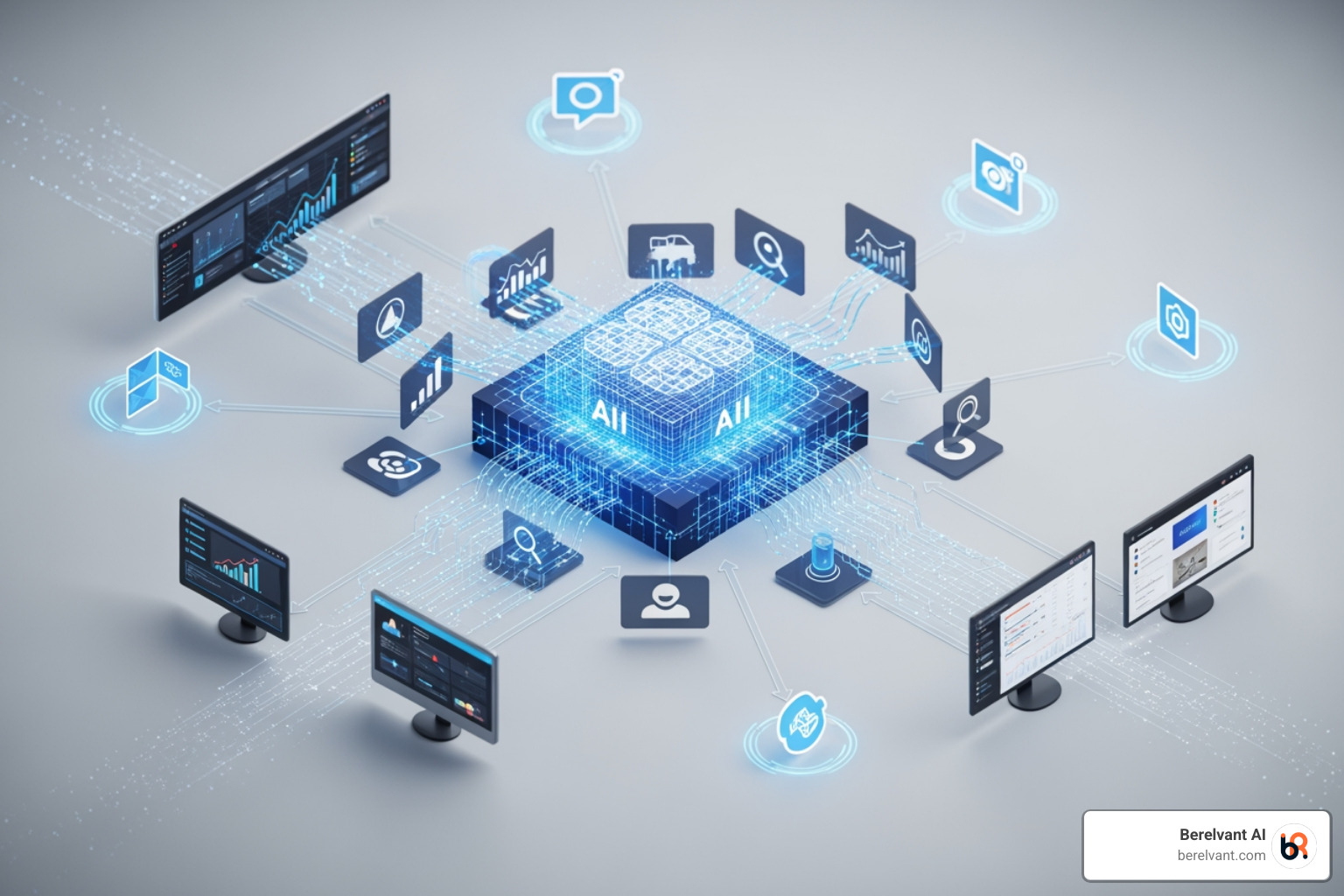
An ai digital agency is a marketing and technology partner that uses artificial intelligence, machine learning, and automation to design, deploy, and optimize acquisition systems across multiple channels, markets, and languages. Unlike traditional agencies that offer siloed services, an AI digital agency builds integrated growth engines that connect performance media, multilingual creative, advanced analytics, and real-time optimization into one unified system.
Key characteristics of an AI digital agency:
- Unified Technology Stack: Proprietary AI platforms that manage audience data, bidding, creative deployment, and attribution in one place
- Predictive Intelligence: Real-time forecasting, anomaly detection, and automated budget allocation based on performance signals
- Multilingual & Multi-Market Execution: Localized creative production, compliance-ready campaigns, and cross-border measurement at scale
- Full-Funnel Attribution: Connecting marketing spend directly to revenue outcomes, not just proxy metrics like impressions or clicks
- Human + AI Collaboration: Strategic teams augmented by machine learning models, not replaced by them
The traditional agency model—built on manual workflows, fragmented reporting, and reactive optimization—cannot keep pace with the operational demands of enterprise organizations. Leaders managing growth across the Americas face regulatory complexity, cultural nuance, slow creative cycles, and attribution blind spots. These challenges require more than a media buyer or a content team. They require a system.
AI is not a feature. It is the operational layer that removes friction, accelerates execution, and multiplies campaign impact. When performance media, multilingual creative, automation, and analytics are integrated into one intelligent engine, brands gain the speed, precision, and visibility needed to scale efficiently across markets. The research is clear: 40% of enterprise-level companies already use AI, and those who treat it as infrastructure—not a tool—are outpacing competitors in acquisition efficiency and revenue growth.
I’m Renzo Proano, founder of Berelvant, an ai digital agency that has managed over $300 million in ad spend and built acquisition systems for Microsoft, Cartier, StoneX, and high-growth SaaS and e-commerce brands across regulated and non-regulated markets. My work focuses on designing end-to-end growth engines that integrate paid media, AI automation, multilingual creative, and full-funnel attribution to deliver measurable revenue outcomes at enterprise scale.
Deconstructing the Modern AI Digital Agency: Beyond Automation
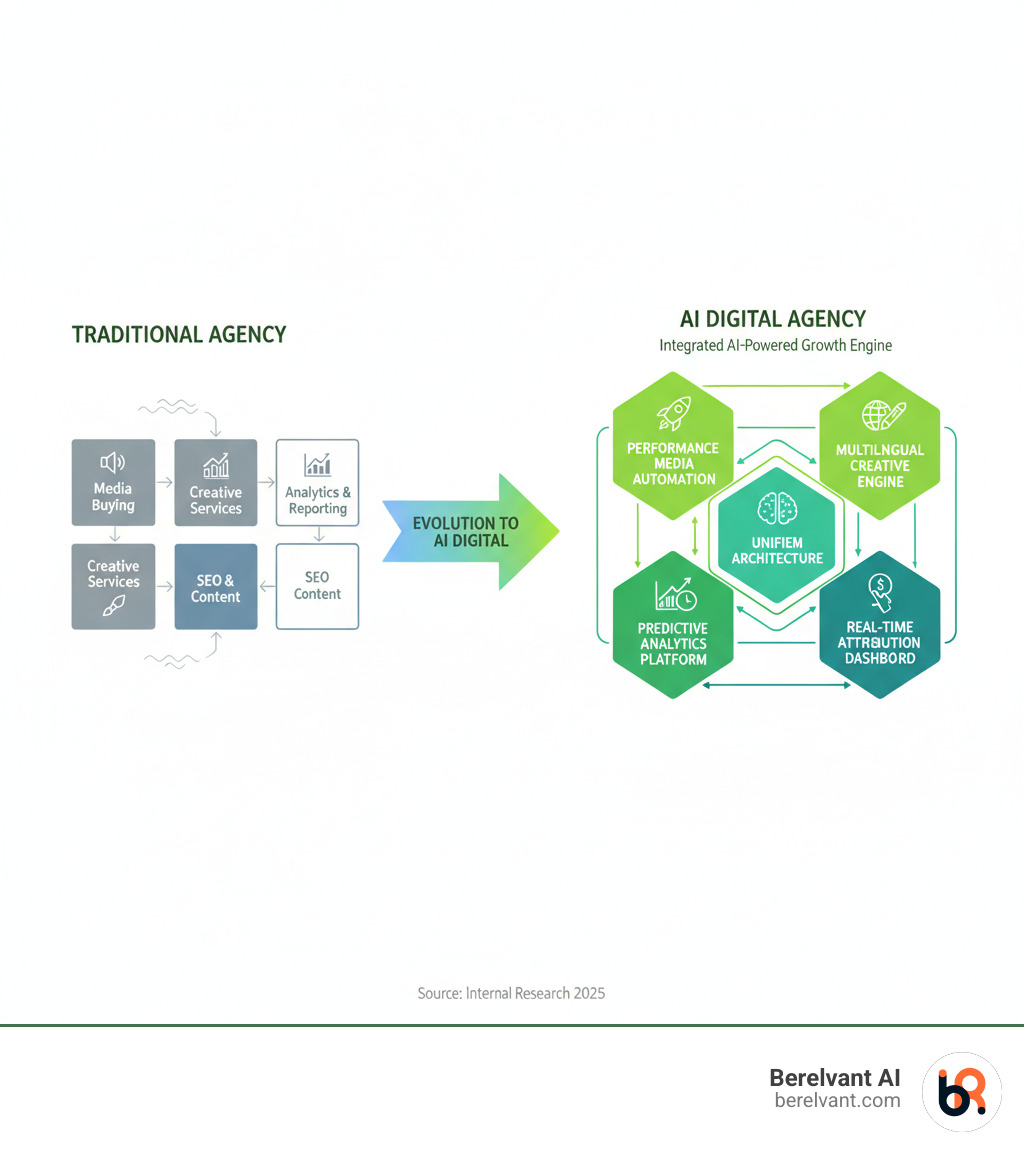
For enterprise organizations operating across the Americas, the difference between a traditional agency and an ai digital agency comes down to architecture. It’s not about having more services on a menu. It’s about building a unified engine where performance media, multilingual creative, and analytics function as one integrated system.
Most agencies still operate in silos. Media buying happens in one platform. Creative production runs through a separate workflow. Analytics gets assembled in spreadsheets after the fact. That fragmentation creates bottlenecks, delays, and blind spots that compound at scale. When you’re managing campaigns across regulated industries, multiple countries, and diverse audiences, you need system-level thinking, not a collection of disconnected services.
At Berelvant, we focus relentlessly on business outcomes. That means measuring what actually matters: revenue growth, market share expansion, and operational efficiency. Media metrics like impressions and clicks have their place, but they’re not the finish line. We architect systems that connect marketing spend directly to revenue outcomes, so you can make decisions based on what drives the business forward, not what looks good in a dashboard.
The real power comes from human expertise augmented by AI. Our teams include strategists who understand complex market dynamics, data scientists who build custom attribution models, and creative technologists who design multilingual content systems at scale. AI isn’t replacing that expertise—it’s amplifying it. It removes friction, accelerates execution, and gives our teams the speed and precision to operate at enterprise scale. You can explore more about our strategic approach on our SEO and Internet Marketing Firm page.
Key Differentiators of a True AI Digital Agency
What separates an enterprise-grade ai digital agency from a conventional marketing firm? It’s the technology infrastructure and the commitment to transparency at every layer.
Proprietary technology stacks are foundational. We don’t rely solely on off-the-shelf tools. We integrate and build custom models custom to specific client needs, unique data environments, and niche market behaviors. This approach lets us solve problems that generic platforms can’t address—whether that’s navigating compliance frameworks in healthcare and finance, or optimizing for audience segments that don’t fit standard targeting parameters.
Data marketplaces and first-party data strategies matter more than ever. With the deprecation of third-party cookies and evolving privacy regulations, enterprise brands need future-proof data infrastructure. We work with 270+ people-based data partners and prioritize first-party data activation, ensuring continuous access to high-quality audience insights without compromising compliance or performance.
No DSP bias is critical for cost efficiency and reach. We don’t lock clients into a single demand-side platform. Instead, we access 99.9% of premium supply across the ecosystem, ensuring optimal placement, competitive pricing, and strategic flexibility. This unbiased approach means we’re always optimizing for your outcomes, not a platform vendor’s margins.
End-to-end system management gives you full-funnel visibility. We track every touchpoint from initial awareness to conversion and beyond, using advanced attribution platforms like Atrilyx that leverage Universal IDs and multi-touch attribution modeling. This isn’t reactive reporting—it’s predictive analytics. We forecast performance, detect anomalies in real time, identify top-converting paths, and scale them faster. The result is continuous improvement in CPA and ROI, driven by data that shows both direct conversions and the indirect, organic impact of every channel.
According to the 2025 State of Marketing AI Report, AI adoption is accelerating in enterprise companies. The brands that treat AI as infrastructure—not just a feature—are the ones gaining competitive advantage in acquisition efficiency and revenue growth. That’s the shift we’re building for.
Core Operational Pillars: How AI Transforms Enterprise Marketing

The integration of AI into core marketing functions creates a unified, intelligent acquisition system that operates with speed and precision most enterprises can only dream of. This isn’t about making your existing processes slightly better. It’s about fundamentally rethinking how growth systems work when you’re managing campaigns across multiple countries, languages, and regulatory environments.
For VP and Director-level leaders, the question isn’t whether AI will transform your marketing operations. It’s whether your current infrastructure can support the level of execution your business demands. Let’s examine how an ai digital agency rebuilds the three core pillars of enterprise marketing.
AI-Improved Media Planning & Execution
The complexity of enterprise media buying multiplies exponentially when you’re operating across the Americas. Different markets, different platforms, different audience behaviors. Manual planning and optimization simply cannot keep pace.
We approach programmatic advertising through the lens of supply path optimization (SPO), treating supply as a strategic input rather than a commodity. This means evaluating bidstream quality, identifying the most efficient paths to premium inventory, and eliminating wasteful intermediaries. AI handles the computational heavy lifting, analyzing millions of data points to determine optimal placements in real-time bidding (RTB) environments.
Consider Connected TV Advertising, where audiences are now spread across 11+ platforms and streaming owns 40% of total TV time. Yet there’s a massive gap between viewing (47%) and spend (8%) in CTV. Why? Because most marketers lack the AI-powered planning infrastructure to capitalize on this shift at scale.
Our AI-improved planning delivers actionable insights in under 30 seconds, optimizing budget allocation across display, video (OLV), CTV/OTT, live sport CTV, paid social, search, digital audio, and Digital Out-of-Home (DOOH). This isn’t about spreading budget evenly. It’s about dynamic, predictive allocation based on performance signals, audience modeling, and cross-platform attribution.
When you’re navigating walled gardens and fragmented streaming media landscapes, AI becomes the operational layer that maintains visibility and control. We prove lift, not just impressions, because our systems connect media investment directly to business outcomes.
Intelligent Creative & Content Systems
Multilingual creative production is where most agencies hit a wall. The traditional model—brief, translate, produce, review, revise—creates bottlenecks that kill campaign velocity. For enterprises operating across the Americas, this isn’t just inefficient. It’s a competitive disadvantage.
Generative AI for creative automation changes the economics and timeline of content production entirely. We can generate multilingual ad variants at scale while maintaining brand consistency and cultural nuance. This isn’t about replacing human creativity. It’s about removing the mechanical barriers that slow down execution.
Dynamic creative optimization (DCO) takes this further by enabling personalized content delivery based on customer segmentation and behavioral triggers. The system learns which messages resonate with which audiences, automatically adjusting creative elements in real-time. AI-powered tools automate and optimize email campaigns, ensuring personalized messaging and better click-through rates.
The performance analytics loop closes the system. Automated A/B testing runs continuously, testing variations across markets and channels simultaneously. What would take weeks or months manually happens in days. The AI identifies winning patterns, scales them, and continues testing new hypotheses.
Think of AI as a smart assistant that handles production and optimization at machine speed, freeing your creative teams to focus on strategy, emotional resonance, and the high-level thinking that actually moves markets. One executes. The other innovates. Both are essential.
AI-Powered Customer Interaction & Acquisition
The customer journey doesn’t end when someone clicks your ad. For enterprise organizations, the handoff from marketing to sales is where enormous value gets lost. Intelligent lead scoring and predictive lead quality models solve this by applying machine learning to identify which prospects are most likely to convert.
This application of predictive analytics and automatic customer segmentation ensures your sales teams focus on high-value opportunities. The system learns from historical conversion data, identifying patterns that human analysts would miss or take months to uncover.
Sales funnel automation streamlines the entire journey from lead to customer. Automated customer support systems, leveraging AI chatbots and virtual assistants, provide instant, personalized responses 24/7. Our AI Calling Agent Automation solutions handle routine inquiries and qualify leads, freeing your human agents for complex, high-value interactions.
Beyond efficiency, AI powers sophisticated sentiment analysis and voice-of-customer monitoring. We track brand perception across markets in real-time, identifying emerging issues before they become crises and opportunities before competitors spot them. This proactive approach to customer interaction doesn’t just improve efficiency. It strengthens brand reputation and creates competitive moats that are difficult to replicate.
When these three pillars—media execution, creative systems, and customer acquisition—operate as one integrated engine powered by AI, you achieve something traditional agencies simply cannot deliver: system-level performance that compounds over time. Each component learns from the others, creating a growth machine that gets smarter and more efficient with every campaign.
Evaluating an Enterprise-Grade Partner for Complex Environments

Choosing an ai digital agency for enterprise operations across the Americas is fundamentally different from hiring a vendor for a single campaign. You’re not buying services. You’re selecting a partner who will become part of your operational infrastructure, navigating regulatory frameworks, cultural complexity, and cross-border execution challenges that would derail most agencies within the first quarter.
The stakes are high. A misstep in a regulated market can trigger compliance violations. A tone-deaf creative in one country can damage brand perception across an entire region. Fragmented reporting can hide attribution blind spots that cost millions in wasted spend. The right partner doesn’t just understand these risks—they’ve built systems specifically designed to eliminate them.
Technical & Strategic Capabilities
When you operate in regulated industries like healthcare or finance, compliance isn’t a checklist item. It’s the foundation of every campaign decision. We’ve spent years building acquisition systems that inherently comply with frameworks like HIPAA, financial advertising regulations, and data protection laws across multiple jurisdictions. Our teams don’t just know the rules—we design technology stacks and creative workflows that make violations structurally impossible.
Multi-country execution across the Americas means more than running campaigns in different languages. It means understanding that a high-performing audience segment in Mexico City behaves completely differently from one in São Paulo, even when the product is identical. We’ve managed cross-Americas operations for brands like Microsoft and Cartier, where success required not just translation, but deep cultural nuance and market-specific optimization strategies.
This is where multilingual creative infrastructure becomes critical. Most agencies treat localization as an afterthought—translating English copy at the last minute and hoping it resonates. We approach it as a core system. Localization vs. transcreation isn’t just semantics; it’s the difference between a message that technically says the right words and one that emotionally connects with an audience. Our creative systems are built to generate, test, and optimize culturally adapted content at scale, ensuring every market gets messaging that feels native, not imported.
Transparency, Security, and Accountability
In enterprise partnerships, trust isn’t given—it’s built through consistent transparency and measurable accountability. We operate with a philosophy of radical transparency: no bias, no black boxes, just performance. You’ll always know exactly how your budget is allocated, which channels are driving revenue, and where optimization opportunities exist. Our clear attribution models connect every dollar spent to tangible business outcomes, eliminating the ambiguity that plagues most agency relationships.
Data privacy and security aren’t optional considerations—they’re operational requirements. Our systems are built to comply with GDPR, CCPA, and evolving privacy regulations across the Americas. We’re also preparing you for the cookie-less future by focusing on first-party data strategies, universal ID solutions, and privacy-centric measurement frameworks that maintain attribution accuracy without compromising user privacy.
The best indicator of an agency’s true value isn’t their case studies—it’s their client retention rate. We maintain a 98% client retention rate because we treat partnerships as long-term collaborations, not transactional relationships. We provide proactive service, identifying opportunities and addressing issues before they become problems. This matters because 57% of agency breakups stem from poor communication, and 95% of proactive service efforts directly improve retention. We don’t wait for quarterly reviews to share insights. We act as an extension of your team, delivering foresight and strategic guidance continuously.
Key questions to ask any potential AI digital agency partner:
- How do you ensure compliance in regulated industries across multiple countries?
- What proprietary technology or custom AI models do you use for attribution and optimization?
- How are you preparing clients for a cookie-less future while maintaining attribution accuracy?
- Can you demonstrate full-funnel attribution that connects media spend directly to revenue outcomes?
- What is your client retention rate, and what systems do you have in place for proactive communication?
These questions will quickly separate agencies that talk about AI from those who have actually built enterprise-grade acquisition systems powered by it.
Measuring System-Level Impact: Attribution and ROI in the AI Era
Here’s the truth: most enterprise marketing teams are drowning in data but starving for insight. You have dashboards full of metrics, but when your CFO asks about revenue impact, the conversation gets uncomfortable. That’s because traditional marketing measurement was built for a simpler time—before customers touched twenty different channels before converting, before privacy regulations reshaped data access, and before AI made real-time optimization possible.
The shift from vanity metrics to tangible business results isn’t just a nice-to-have anymore. It’s the difference between defending your budget and expanding it. AI-driven analytics and full-funnel visibility have made this transition not only possible but essential for enterprise organizations competing across complex, multi-market environments.
Moving Beyond Proxy Metrics
Let’s be direct: impressions don’t pay salaries. Clicks don’t fund expansion. Engagement rates don’t appear on your P&L statement. Yet many organizations still measure marketing success by these proxy metrics because that’s what their systems can track. The real question isn’t whether your campaign got views—it’s whether those views turned into customers, and whether those customers were worth acquiring.
We focus relentlessly on business outcomes vs. media metrics. This means connecting marketing spend directly to revenue, understanding Lifetime Value (LTV), and optimizing Customer Acquisition Cost (CAC) across the entire customer journey. When you can see that a customer acquired through CTV advertising has 40% higher LTV than one from paid search, your budget allocation decisions become clear. When you find that your call center revenue can finally be “recognized and associated to digital” efforts, you stop treating offline conversions as a black box.
This level of insight requires full-funnel attribution and sophisticated multi-touch attribution (MTA) that tracks every interaction a customer has with your brand. Our AI-powered attribution platforms use Universal ID solutions combined with deterministic and probabilistic data modeling to map these complex journeys. We’ve helped clients “integrate with legacy CRMs to see what our LTV was per client,” enabling them to identify which markets, channels, and segments deserve more investment.
The speed of insight matters just as much as the depth. AI-improved planning and forecasting in under 30 seconds means your teams can make decisions in the moment, not weeks later when the opportunity has passed. Anomaly detection alerts you when performance shifts before it impacts your bottom line. Forecasting models help you allocate budgets with confidence, knowing which scenarios are most likely to deliver your revenue targets.
What to Expect from a Partnership with an AI Digital Agency
When you partner with an enterprise-grade ai digital agency like Berelvant, you’re not just getting better reporting. You’re getting a fundamentally different operational model—one where AI serves as the speed and scale layer that accelerates delivery, removes bottlenecks, and multiplies campaign impact.
Accelerated delivery means launching campaigns in days instead of weeks, testing creative variants at scale without manual production delays, and adapting to market changes before your competitors even notice them. Reduced bottlenecks come from automation that handles the repetitive work—bid optimization, budget reallocation, creative deployment—freeing your strategists to focus on the decisions that require human judgment.
The business outcomes speak for themselves. Clients experience measurable revenue growth because our AI-driven strategies work backward from your business goals. We aim to “guarantee revenue growth on the same dollar spend” by identifying and scaling the highest-performing conversion paths. Improved CPA & ROI comes from analyzing the indirect and organic impact of all channels, not just the last click. When you understand that your CTV campaign doesn’t just drive direct conversions but also increases branded search by 30%, you optimize differently.
You’ll receive actionable insights from unified data through platforms like Power BI, Looker Studio, and GA4. These aren’t just pretty dashboards—they’re decision-making tools that combine website behavior, sales data, media performance, and customer lifetime value into a single view. This unified perspective helps you quickly identify what’s working and what needs adjustment.
If you’re ready to move beyond proxy metrics and build a measurement system that connects marketing spend to revenue outcomes, we invite you to Request a Free Digital Marketing Analysis. We’ll show you exactly where visibility gaps exist in your current setup and how AI-powered attribution can close them.
Here’s how traditional KPIs evolve when you shift to an AI-driven, outcome-focused measurement approach:
| Traditional Marketing KPI | AI-Driven Business Outcome Metric |
|---|---|
| Impressions / Reach | Market Share Growth / Brand Equity Lift |
| Click-Through Rate (CTR) | Qualified Lead Volume / Sales Conversion Rate |
| Cost Per Click (CPC) | Customer Acquisition Cost (CAC) Optimized by LTV |
| Website Traffic | Segmented User Engagement / Revenue Per User |
| Conversion Rate | Full-Funnel Conversion Rate / Multi-Touch Attribution ROI |
| Engagement Rate | Customer Lifetime Value (LTV) / Retention Rate |
| Ad Spend | Incremental Revenue Generated / Profitability per Channel |
The difference isn’t subtle. One column tracks activity. The other tracks impact. One justifies budgets. The other grows them. For enterprise organizations operating across complex markets, this distinction determines whether marketing is seen as a cost center or a growth engine.
Conclusion: The Future is an Integrated, AI-Powered Growth System
The shift is unmistakable. Enterprise marketing is moving away from the old model of disconnected service providers and toward something fundamentally different: integrated, AI-powered growth systems that function as unified engines rather than collections of tools.
This isn’t about adopting AI as a feature or a nice-to-have. For organizations operating across the Americas—navigating regulated industries, compliance frameworks, and the cultural complexity of multiple markets—AI has become the indispensable operational layer that makes scale possible. It’s what enables speed without sacrificing precision. It’s what turns fragmented campaigns into coherent systems.
But technology alone isn’t the answer. What separates a true AI digital agency from a vendor with some automation tools is the fusion of technical depth and strategic business acumen. At Berelvant AI, we build end-to-end acquisition systems that integrate performance media, multilingual creative, automation, and full-funnel analytics into one unified engine. We don’t just optimize campaigns—we engineer solutions that accelerate delivery, remove operational bottlenecks, and multiply the impact of every dollar spent.
The future belongs to organizations that treat AI as infrastructure, not innovation theater. It belongs to leaders who understand that growth at enterprise scale requires systems, not services. And it belongs to partnerships built on transparency, accountability, and a relentless focus on measurable revenue outcomes.
If you’re ready to build your own intelligent acquisition system and move beyond the limitations of traditional marketing, we invite you to explore our AI Marketing Strategies and see what’s possible when human expertise and AI work together at full capacity.