
The Strategic Shift: Why Enterprise Leaders Must Rethink Advertising Infrastructure
Generative AI advertising is changing how enterprises build, scale, and optimize acquisition systems. It replaces slow creative workflows with automated pipelines that produce multilingual campaigns, adapt to audience segments in real time, and deliver measurable performance gains. For enterprise organizations, this means reducing creative production from weeks to hours, cutting costs by up to 14x, and achieving up to 50% higher click-through rates with AI-optimized creatives.
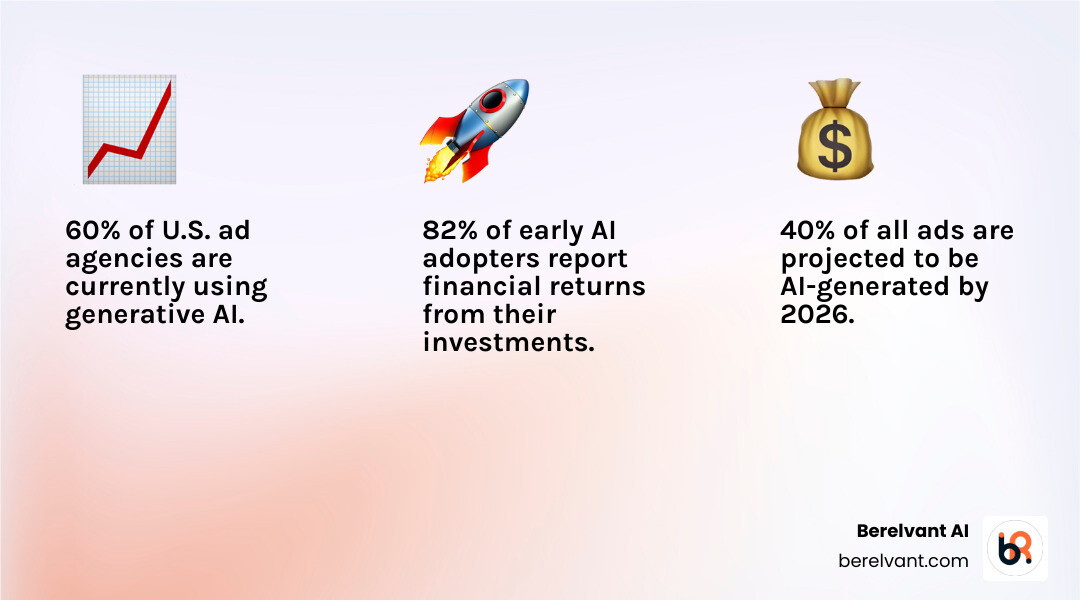
The data is clear: over 60% of U.S. ad agencies already use generative AI, with buyers projecting AI-generated creative will reach 40% of all ads by 2026. Early adopters are seeing results, with 82% reporting financial returns from their AI investments.
This isn’t about replacing human teams; it’s about removing operational friction. AI handles repetitive tasks like asset generation and variant testing, freeing human teams to focus on strategy, brand alignment, and creative direction. The result is faster iteration, cleaner attribution, and predictable revenue growth.
I’m Renzo Proano, founder of Berelvant. After managing over $300 million in digital ad spend, I now build generative AI advertising infrastructure for enterprise and mid-market brands. We automate creative production and accelerate testing to deliver measurable performance gains across regulated and multilingual markets.
The New Imperative: AI as a Core Component of Advertising Infrastructure
The advertising industry is undergoing a structural change. Generative AI advertising isn’t just another tool—it’s becoming the core infrastructure that determines whether enterprise teams can execute at market speed and scale.
This disruption is forcing a strategic shift. Leaders are asking: Can our current infrastructure keep pace with AI-enabled competitors? For most, the answer is no. We’re watching generative AI advertising reshape the value chain, from creative briefs to media planning and real-time optimization.
The shift is critical for organizations operating across the Americas. Enterprise readiness now means having infrastructure that can generate multilingual campaigns, adapt creative to cultural contexts, and maintain compliance across regulated industries—all while scaling velocity. Traditional workflows cannot deliver this.
At Berelvant, we integrate these capabilities into unified acquisition systems that treat AI as the speed and scale layer. It removes the operational bottlenecks that slow testing and limit personalization. AI handles repetitive execution, while human teams focus on brand alignment and strategic innovation.
Organizations that wait to build this infrastructure will compete against teams that can test 100 variants in the time it takes traditional workflows to produce five. The question isn’t whether to adopt AI—it’s how to integrate it strategically by choosing the right AI Marketing Strategies for your goals. The imperative is clear: AI must become a core component of your advertising infrastructure.
How Generative AI Is Restructuring the Advertising Value Chain
Generative AI advertising is fundamentally rebuilding the advertising value chain by collapsing timelines and eliminating production bottlenecks. What used to require weeks of coordination now happens in compressed cycles, delivering measurable financial returns. This isn’t about replacing strategic thinking; it’s about removing the operational friction that slows execution. AI handles repetitive tasks, allowing human teams to focus on brand strategy, audience insight, and creative direction. At Berelvant, our AI Marketing Strategies treat AI as the speed and scale layer that enables enterprise velocity.
From Concept to Campaign: Accelerating Creative Production
The traditional creative production cycle is a relic. Generative AI advertising compresses it into a workflow where concepts become testable assets in hours. This removes the primary bottleneck for enterprise teams: you can’t optimize what you haven’t tested, and you can’t test what you haven’t produced.
Key accelerations include:
- Content Ideation at Scale: Instead of a single creative direction, AI generates dozens of concepts custom to specific audience segments and markets.
- Rapid Prototyping: Move from concept to functional asset in a single session, generating variations across formats and languages simultaneously. This is critical for multilingual campaigns across Latin America or multicultural audiences in North America.
- Video Ad Production: Historically resource-intensive, video production is being restructured. Nearly 90% of advertisers will use Gen AI for video, democratizing high-quality production for channels like Connected TV Advertising.
This shift delivers proven performance gains, with AI-generated ads achieving up to 50% higher click-through rates. You can test thirty variations instead of three, scaling winners based on real performance and accelerating approval cycles in regulated industries with compliant, AI-generated templates.
The Impact on Human Capital and Agency Models
The reality of AI in enterprise marketing is clear: AI is restructuring roles, not eliminating them. It handles repetitive production tasks, freeing human teams to focus on work that drives differentiation.
This shift creates new roles like AI prompt engineers and AI governance leads. Marketing teams need AI literacy—not deep technical expertise, but operational fluency. As one industry leader noted, “Your job will not be taken by AI. It will be taken by a person who knows how to use AI.”
Human-AI collaboration becomes the standard operating model. AI generates the raw material, and human teams apply strategic judgment and cultural nuance. This is augmentation, not replacement. Our AI Calling Agent Automation solutions show this in practice: AI handles routine interactions, allowing human agents to focus on high-value conversations. The job role change is directional: from execution to oversight and from production to strategy.
Scaling Creative Operations: Key Use Cases for Generative AI Advertising
For enterprises managing campaigns across multiple countries and languages, scaling creative operations is a competitive advantage. Generative AI advertising turns this bottleneck into a strategic asset, providing the foundation for high-performance creative for channels from digital to Connected TV Advertising. AI handles the complexity of scale, generating creative variants for different markets while maintaining brand consistency and freeing your team to focus on strategy.

Hyper-Personalization: The Impact of Generative AI Advertising on Customer Segmentation
Generic messaging fails across the diverse audiences of the Americas. Hyper-personalization works, and generative AI advertising makes it operationally feasible at scale. AI excels at dynamic content optimization, analyzing customer data in real time to adjust messaging and visuals. Over 85% of marketing AI users already employ it for personalization. For multilingual campaigns, this is transformative; AI adapts tone and cultural references, not just language. Our Free Digital Marketing Analysis can identify where hyper-personalization will drive the most impact in your acquisition system.
Predictive Performance and Campaign Optimization
Enterprise advertising demands predictable outcomes. Generative AI advertising transforms campaign optimization into a predictive system that anticipates performance and improves results.
Key capabilities include:
- Predictive Analytics: AI forecasts campaign performance before launch, allowing for smarter budget allocation.
- Real-Time Optimization: AI continuously monitors performance, shifting budget toward high-performing segments and creative variants automatically.
- A/B Testing at Scale: AI tests hundreds of creative variations simultaneously, identifies winning elements, and generates new variants based on performance data. Creative scoring AI can even predict ad performance before launch.
- Demand Forecasting: By analyzing market signals, AI helps anticipate demand shifts, reducing waste and capitalizing on opportunities.
The result is a campaign optimization system that learns continuously and delivers measurable revenue growth.
Navigating Enterprise Risks: Governance and Ethical Implementation
The performance gains from generative AI advertising are undeniable, but they come with governance challenges that enterprise leaders must mitigate, especially in regulated industries.
Key risks include:
- Accuracy and Hallucinations: AI models can produce factually incorrect or misleading information, requiring thorough human review to protect brand credibility.
- Algorithmic Bias: AI can perpetuate stereotypes found in its training data, as noted in reports on tools like Stable Diffusion. This is a major business risk when managing multicultural campaigns.
- Copyright and IP Law: The legal landscape is in flux, as highlighted by cases like The New York Times versus OpenAI. Enterprises must understand the provenance of training data to avoid infringement.
- Data Privacy: AI’s use of consumer data for personalization can create exposure to data breaches and non-compliance with regulations like GDPR and CCPA.

Building a Responsible AI Framework for Advertising
A responsible AI framework establishes the governance to scale with confidence. This is how we approach AI Marketing Strategies at Berelvant, building systems that deliver both performance and protection.
Core components include:
- Transparency and Disclosure: Be clear with audiences when AI influences content to maintain trust.
- Accountability and Auditing: Regularly audit AI systems and training data to ensure outputs align with brand values and are free of bias.
- Human-in-the-Loop Systems: Retain final human review and editorial control to ensure brand voice, cultural nuance, and strategic alignment. This embeds quality control at the system level.
- Data Governance: Implement robust security and transparent data usage policies to protect customers and comply with all relevant regulations across markets.
The Future of Advertising: Trends and Strategic Outlook
The advertising infrastructure of yesterday won’t deliver tomorrow’s results. For enterprise leaders, the question is how quickly you can integrate generative AI advertising into your operational backbone.
Several critical trends are reshaping the landscape:
- Cookieless Marketing Solutions: As third-party cookies disappear, generative AI offers a path forward by analyzing first-party data to deliver contextual ads that respect user privacy.
- AI Overviews in Search: Google’s AI-generated summaries create a new acquisition channel, placing sponsored ads directly within AI-powered search experiences.
- Immersive Ad Experiences: AI-powered virtual try-on features and 3D ads are moving from experimental to essential, improving conversion rates by removing friction.
- Audio and Podcast Production: Generative AI makes scalable audio production accessible, creating human-like voiceovers and full audio narratives for multilingual campaigns.
To explore how these trends can benefit your acquisition systems, Book a Meeting with our experts to discuss a custom implementation roadmap.
Future-Proofing Your Strategy: The Future of Generative AI Advertising
Organizational readiness is the biggest gap between AI potential and performance. Enterprises must build internal AI expertise and foster cross-functional collaboration between marketing, legal, data, and creative teams. As an SEO and Internet Marketing Firm, we integrate AI across the entire acquisition engine. The long-term impact isn’t just cost savings; it’s the ability to operate across multiple markets with speed and precision. The enterprises that treat AI as infrastructure, not an experiment, will win the next three years.
Frequently Asked Questions about Enterprise Generative AI in Advertising
How does generative AI impact the ROI of large-scale advertising campaigns?
Generative AI advertising delivers substantial ROI through a multiplier effect. It drives increased efficiency by cutting creative production costs by up to 14x and enabling faster testing cycles. This leads to higher performance, with studies showing up to 50% higher click-through rates for AI-generated ads. Finally, real-time budget allocation ensures spend is continuously shifted to top-performing assets, maximizing the financial impact. 82% of early adopters are already reporting financial returns.
What is the real impact of generative AI on advertising jobs and team structures?
AI is evolving roles, not eliminating them. It automates repetitive execution, causing a shift toward strategy and oversight. Human teams are freed to focus on brand alignment, creative direction, and strategic judgment. This creates demand for new roles like AI prompt engineers and requires a new level of AI literacy across marketing teams. The new operating model is human-AI collaboration, where AI provides speed and scale while humans provide the creativity and strategic insight that drives differentiation.
How can enterprises ensure responsible AI use while maintaining a competitive edge?
The key is to build governance frameworks that enable both speed and accountability. This is not a constraint but a competitive advantage. Core principles include:
- Human Oversight: Implement human-in-the-loop systems to ensure final editorial control and brand alignment.
- Transparency: Be clear with consumers about AI’s role to build trust.
- Bias Auditing: Proactively monitor AI outputs to prevent the scaling of stereotypes and ensure cultural relevance.
- Data Security: Adhere strictly to data privacy regulations like GDPR and CCPA to operate without regulatory risk.
By integrating these practices, as we do in our AI Marketing Strategies, organizations can innovate aggressively while protecting their brand.
Conclusion: Integrating AI as Your Growth Catalyst
The conversation around generative AI advertising has shifted from experimental to essential. It is now fundamental infrastructure for enterprise advertising, with 82% of early adopters seeing financial returns. This is about building systems for predictable, scalable growth.
For organizations operating across the Americas, the challenge is strategic integration. Multilingual campaigns and regulated industries demand a level of precision and speed that only generative AI advertising can provide. It removes production bottlenecks, cuts manual overhead, and creates the testing velocity needed to optimize performance across markets.
At Berelvant, we use AI as the speed and scale layer that transforms creative potential into measurable revenue. We amplify human expertise, not replace it. Our teams focus on strategy and cultural nuance while AI handles repetitive execution, allowing our partners to operate with enterprise precision. Building a resilient advertising system requires accepting this shift through investment in training, governance, and human-AI collaboration. The organizations that act decisively now will define future market leadership.
If you’re ready to transform your acquisition systems, explore our AI Marketing Strategies to see how we build end-to-end acquisition systems that drive results across complex, multilingual markets.