Beyond the Hype – Systematizing Generative AI for Enterprise Growth
Generative AI in marketing is no longer experimental. It’s operational. And for VP and Director-level leaders managing cross-regional teams, regulatory constraints, and performance expectations measured in millions, the question isn’t whether to adopt it—it’s how to deploy it without adding friction, risk, or wasted cycles.
What You Need to Know About Generative AI in Marketing:
- Definition: AI systems that create new content—text, images, video, data-driven insights—designed to accelerate execution and improve personalization across marketing functions.
- Core Applications: Hyper-personalization at scale, multilingual content generation, predictive analytics, process automation, and real-time campaign optimization.
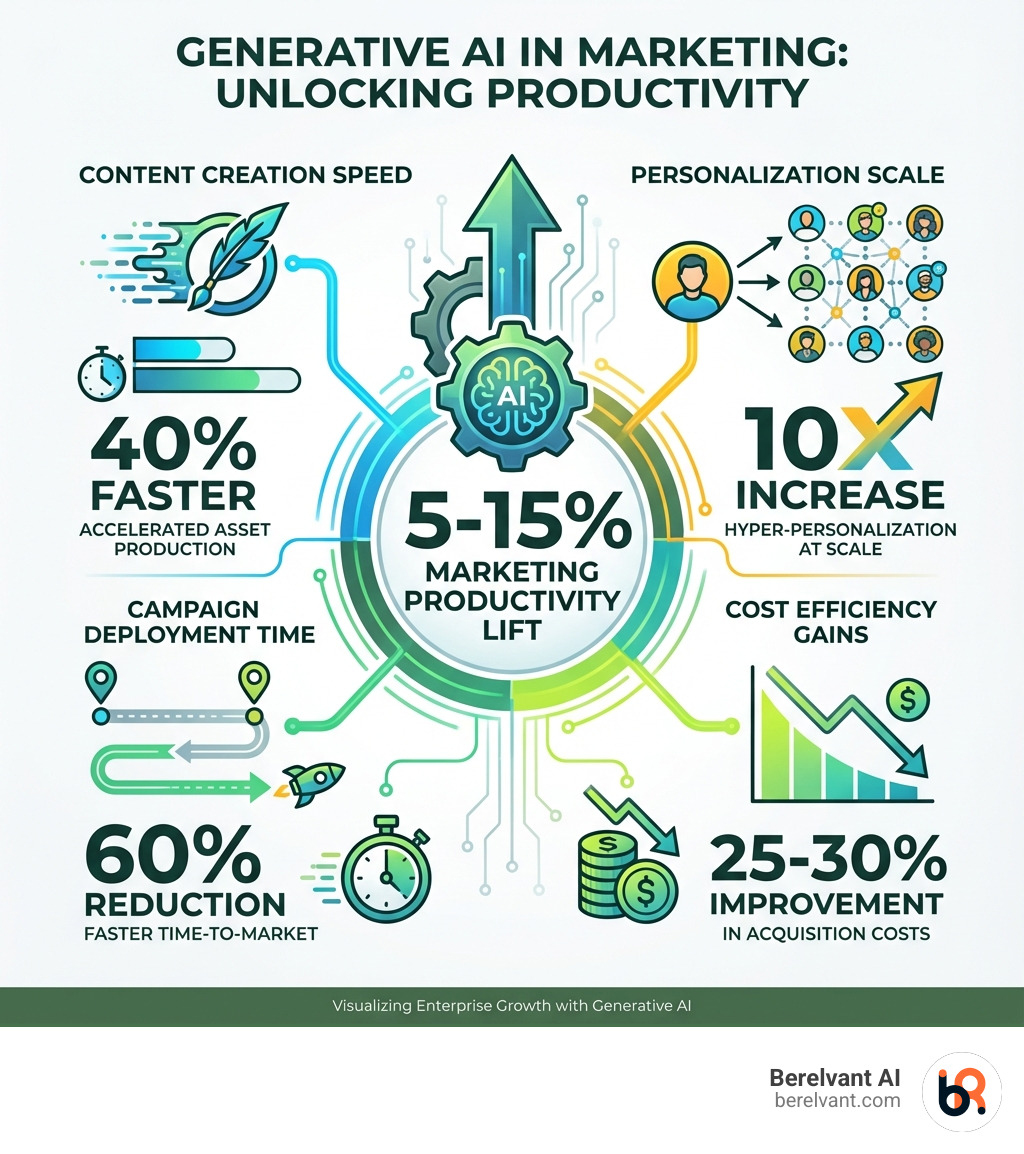
- Economic Impact: McKinsey estimates generative AI could add $2.6 trillion to $4.4 trillion annually across industries, with marketing productivity gains of 5–15% of total spend—approximately $463 billion per year.
- Adoption Timeline: 67% of CMOs plan to implement generative AI within 12 months; 86% within 24 months.
- Strategic Imperative: Organizations that move quickly gain compounding advantages in speed, creative velocity, and attribution clarity. Those that wait risk falling behind competitors who already operate faster.
This isn’t about replacing teams. It’s about removing bottlenecks. Scaling execution without adding headcount. Maintaining compliance across markets. And giving leadership the visibility and control they need to make better decisions under pressure.
I’m Renzo Proano, founder of Berelvant AI. I’ve managed over $300 million in digital ad spend and built AI-driven growth systems for brands in financial services, SaaS, GovTech, and e-commerce—many operating under strict regulatory frameworks. My work with generative AI in marketing focuses on replacing slow, fragmented workflows with fast, predictable automation that scales across regions, languages, and compliance requirements.
Core Capabilities: Driving Value Across the Marketing Value Chain
The true power of generative AI in marketing for enterprise organizations lies in its ability to fundamentally reshape how we approach core marketing functions. We’re not just talking about minor tweaks; we’re talking about system-level upgrades that drive measurable revenue growth and operational efficiency across complex, multi-country operations. Our focus is on leveraging AI as a speed and scale layer, accelerating delivery, removing bottlenecks, and multiplying the impact of every campaign. This translates into tangible benefits across the entire marketing value chain, from hyper-personalization to a radically accelerated content supply chain and intelligent automation.
The integration of generative AI in marketing means we can move faster, understand our audiences deeper, and execute with precision previously unattainable. It’s about building an end-to-end acquisition system where every component is optimized for performance. More info about AI Marketing Strategies

Hyper-Personalization and Segmentation at Scale
In today’s competitive landscape, generic messaging is a fast track to irrelevance. Enterprise marketing demands hyper-personalization, delivering the right message to the right person at the exact right time. Generative AI in marketing makes this achievable at a scale that human teams alone could never manage.
We leverage generative AI for sophisticated micro-segmentation, moving beyond broad customer groups to identify and target individuals based on nuanced behaviors, preferences, and real-time intent. This isn’t just about segmenting by demographics; it’s about dynamic audience creation, where AI continuously refines segments and personalizes communication based on evolving customer journeys.
For example, a crafts retailer successfully shifted from personalizing just 20% of its email campaigns to an astounding 95%. This granular personalization led to a 41% lift in click-through rates for SMS campaigns and a 25% lift for email campaigns. Similarly, a telecommunications company, utilizing generative AI, moved from four macro-segments to 150 specific segments, achieving a remarkable 40% lift in response rates and a 25% reduction in deployment costs. These aren’t small wins; they’re significant revenue drivers achieved through the power of AI-driven precision. This level of impact is precisely what enterprise organizations in the Americas need to stay ahead.
Accelerating the Multilingual Creative Supply Chain
Operating across the Americas, we understand the critical importance of multilingual creative execution. Traditional content creation, localization, and adaptation for diverse markets can be a slow, costly, and complex endeavor. Generative AI in marketing transforms this challenge into a competitive advantage.
Our approach uses automated content generation to rapidly produce high-quality text, images, and even AI-powered video content. Imagine generating hundreds of ad copy variations, social media posts, or product descriptions custom to specific cultural nuances and linguistic preferences, all while maintaining brand compliance across multiple regions. AI-driven localization and automated translation capabilities ensure that our messaging resonates authentically with multicultural audiences, accelerating time-to-market for campaigns.
A leading online automotive retailer, for instance, created over 1.3 million unique AI-generated videos, tailoring content to individual customer journeys at an unprecedented scale. This demonstrates how generative AI can empower creative teams to produce a massive volume of highly personalized and effective assets, allowing us to rapidly A/B test variants and optimize performance across diverse markets without compromising on brand consistency or quality. This creative infrastructure is vital for large organizations requiring speed and scale.
Intelligent Automation and Predictive Analytics
The sheer volume of data generated in enterprise marketing can be overwhelming. Without intelligent systems, insights remain buried, and opportunities are missed. Generative AI in marketing acts as our central nervous system, automating routine processes and extracting actionable intelligence through advanced predictive analytics.
We deploy AI for comprehensive process automation, streamlining everything from campaign setup and execution to reporting and optimization. This frees our expert teams to focus on strategic initiatives rather than repetitive tasks. Generative AI excels at analyzing vast datasets to provide predictive lead scoring, identifying the most promising prospects and optimizing our resource allocation.
Furthermore, AI empowers us with unparalleled market intelligence. It can conduct sophisticated competitor analysis, identifying emerging trends and strategic shifts. It monitors market dynamics to pinpoint opportunities and threats, providing us with real-time insights for agile strategy adjustments. Critically, generative AI facilitates automated campaign optimization, constantly refining ad delivery, bidding strategies, and content performance to maximize ROI. This is not just about doing things faster; it’s about doing them smarter, ensuring every dollar spent works harder. More info about AI Campaign Management.

A Phased Framework for Enterprise Generative AI in Marketing
Implementing generative AI in marketing within an enterprise environment isn’t a flip of a switch; it’s a strategic journey. Our experience building end-to-end acquisition systems for leading brands in the Americas has taught us that a phased, structured approach is crucial for success. This framework minimizes risk, ensures scalability, and builds organizational buy-in, changing the theoretical potential of AI into tangible business outcomes. It’s about establishing clear governance and proactive risk management from day one.
Phase 1: Foundational Readiness and Quick Wins
Before we can aim for change, we must establish a solid foundation. Our initial phase focuses on assessing an organization’s AI readiness, understanding its current capabilities, resources, and existing data infrastructure. This involves asking critical questions about viability, feasibility, and trustworthiness: Can generative AI in marketing add significant value? Do we have the necessary data and technical capabilities? How will it impact customer trust and ethical safeguards? Aligning resources across your organization to understand whether you are AI-ready is an essential first step.
We start by defining clear, measurable business goals for AI adoption. This isn’t just about adopting AI for AI’s sake, but identifying specific pain points where generative AI can deliver immediate, high-impact value. A thorough data infrastructure audit ensures we have the clean, accessible data required to train and operate AI models effectively.
In this phase, we pilot pre-built models for low-complexity, high-volume use cases. Generating ad copy, basic social media posts, or initial email drafts are excellent starting points. These quick wins demonstrate the immediate benefits of AI, build confidence within the organization, and provide valuable learning experiences without requiring extensive custom development. This incremental approach allows teams to adapt, understand the technology’s nuances, and refine processes before scaling up.
Phase 2: Customization and System Integration for Generative AI in Marketing
Once foundational wins are secured, we move to deeper integration and customization. This phase is about leveraging an enterprise’s unique assets – its proprietary data – to gain a significant competitive advantage. Generic AI models are a good start, but fine-tuning them with your specific brand voice, customer data, and historical campaign performance lifts their output dramatically.
This involves seamless integration with existing marketing automation platforms, ensuring that generative AI outputs flow effortlessly into your campaign workflows. We work on building custom models where necessary, training them on your internal datasets to generate highly relevant and on-brand content. This might involve creating unique content variations for specific customer segments, optimizing product descriptions for niche markets, or even generating highly personalized landing page experiences.
Data privacy protocols and a robust security architecture are paramount here. As we leverage sensitive proprietary data, we ensure that all implementations adhere to the strictest data governance standards, protecting customer information and maintaining compliance across all operating regions. As Harvard Business Review suggests, knowing How to train generative AI using your company’s data is key to open uping its full potential and building a truly differentiated marketing engine.
Phase 3: Full-Scale Change and Governance
The final phase is where generative AI in marketing truly transforms the enterprise. This involves reinventing end-to-end marketing processes, fundamentally rethinking how campaigns are conceived, executed, and optimized. It’s a large-scale AI change management initiative that requires strong leadership and cross-functional collaboration.
We establish a dedicated technology oversight board to guide this change, ensuring that AI initiatives align with broader business objectives and ethical considerations. Ethical safeguards are woven into every aspect of implementation, from data sourcing to output generation, addressing concerns like algorithmic bias and model “hallucinations.” We implement human-in-the-loop processes, recognizing that AI is a powerful co-pilot, not an autonomous driver.
Measuring ROI becomes increasingly sophisticated in this phase, moving beyond simple cost savings to quantifying the impact on customer lifetime value, brand equity, and market share. This comprehensive approach ensures that our generative AI in marketing investments deliver sustained, measurable value. It’s about building an intelligent, adaptive marketing engine that can respond to market changes, anticipate customer needs, and consistently drive growth across all our operations. More info about AI Calling Agent Automation.
Navigating the Challenges: Risk Mitigation in Regulated Environments
For enterprise organizations operating in regulated industries or multicultural markets across the Americas, the implementation of generative AI in marketing comes with unique challenges. While the opportunities are immense, we approach AI deployment with a pragmatic understanding of the associated risks. Our strategy prioritizes robust risk mitigation, ensuring compliance, maintaining brand integrity, and safeguarding customer trust.
- Data Security and Privacy: Leveraging vast datasets for AI training and personalization necessitates ironclad data security. We implement advanced encryption, access controls, and anonymization techniques. All our solutions are designed to comply with local data protection laws and industry-specific regulations, ensuring customer data is handled responsibly and ethically.
- Intellectual Property (IP) and Copyright Management: Generative AI’s ability to create content raises questions about ownership and potential infringement. Our processes include careful vetting of AI-generated assets, integrating tools for plagiarism detection, and establishing clear guidelines for content sourcing and usage. We ensure that our creative output, whether AI-assisted or human-generated, respects existing IP rights.
- Model Accuracy and “Hallucinations”: Generative AI models, while powerful, can sometimes produce inaccurate or nonsensical outputs, often referred to as “hallucinations.” This is particularly risky in marketing where factual accuracy and brand voice consistency are paramount. Our mitigation strategies include rigorous validation processes, continuous model monitoring, and mandatory human-in-the-loop review for all customer-facing content.
- Regulatory Compliance: The AI regulatory landscape is rapidly evolving. We proactively monitor and adapt our AI implementations to comply with emerging guidelines and existing regulations relevant to the Americas, including those governing advertising, financial services, and consumer data. Our solutions are built with flexibility to adjust to new legal frameworks.
- Brand Voice Consistency: Maintaining a consistent brand voice across all marketing touchpoints is crucial for enterprise brands. We fine-tune generative AI models with extensive brand style guides and historical content to ensure outputs align perfectly with the desired tone, style, and messaging. Human oversight remains critical to catch any deviations.
Our approach is rooted in transparency and accountability. We understand that trust is hard-earned and easily lost. Therefore, we embed ethical considerations into every stage of our AI development and deployment. More info about our approach to building trustworthy AI systems.
| GenAI Risk | Enterprise-Level Mitigation Strategy |
|---|---|
| Hallucination | Mandatory human-in-the-loop review for all outputs, prompt engineering, fact-checking workflows, continuous model validation. |
| Bias in Algorithms | Diverse and representative training data, regular bias audits, human oversight for critical decisions, explainable AI (XAI) techniques. |
| Data Privacy | Strict adherence to data protection laws (e.g., CCPA), robust anonymization, access controls, secure data handling protocols, privacy-by-design principles. |
| IP/Copyright Infringement | Clear content sourcing guidelines, plagiarism detection tools, legal review of AI-generated assets, licensing agreements for training data. |
| Brand Voice Inconsistency | Fine-tuning models with extensive brand style guides, human editorial review, iterative feedback loops with creative teams. |
| Security Vulnerabilities | Advanced cybersecurity measures, secure API integrations, regular penetration testing, threat intelligence monitoring, robust access management. |
Frequently Asked Questions about Enterprise Generative AI in Marketing
How do we measure the ROI of generative AI initiatives?
Measuring the ROI of generative AI in marketing at an enterprise level goes beyond simple cost savings. We focus on a holistic view, tying AI initiatives directly to key performance indicators (KPIs) that impact the bottom line. This includes:
- Increased Efficiency and Productivity: Quantifying reductions in time and resources for tasks like content creation, campaign deployment, and data analysis. For instance, an Asian beverage company reduced a year-long product innovation process to just one month with generative AI, a clear indicator of efficiency.
- Improved Personalization and Engagement: Measuring uplift in conversion rates, click-through rates, and customer lifetime value due to hyper-personalized campaigns. We’ve seen examples where personalizing 95% of email campaigns led to double-digit increases in click-through rates.
- Revenue Growth: Attributing direct revenue increases from AI-optimized campaigns, improved lead scoring, and more effective sales enablement.
- Cost Reduction: Identifying savings in areas like agency fees for content creation, manual labor for data processing, and optimized ad spend through AI-driven bidding.
- Speed to Market: Tracking the reduction in time required to launch new products, campaigns, or enter new markets, providing a competitive edge.
Our approach involves establishing clear benchmarks before AI implementation, carefully tracking data throughout the pilot and scaling phases, and utilizing advanced attribution models to isolate the impact of AI. This allows us to present a compelling, data-driven case for continued investment.
What skills does my marketing team need to leverage generative AI effectively?
The advent of generative AI in marketing doesn’t diminish the need for human talent; it redefines it. Our experience shows that the most successful enterprise marketing teams accept AI as a powerful co-pilot. Key skills for marketers in this evolving landscape include:
- Prompt Engineering: The ability to craft precise and effective prompts to guide AI models to generate desired outputs. This is where creativity meets technical understanding.
- Strategic Thinking and Critical Analysis: Marketers need to define the “why” and “what” for AI, interpreting its outputs, identifying potential biases or inaccuracies, and integrating AI-generated content into overarching brand strategies.
- Data Literacy: Understanding how to interpret AI-driven insights, identify relevant data for AI training, and ensure data quality.
- Ethical AI Acumen: A strong grasp of ethical considerations, including data privacy, bias, and responsible AI usage, to ensure campaigns are effective and trustworthy.
- Cross-functional Collaboration: Working closely with data scientists, IT, and legal teams to implement and govern AI solutions effectively.
- Adaptability and Continuous Learning: The AI landscape is rapidly changing. Marketers must be agile, eager to experiment, and committed to continuous skill development.
We believe that your job won’t be taken by AI, but by a person who knows how to use AI. Our focus is on empowering your teams with the knowledge and tools to harness this technology effectively, changing them into AI-augmented marketing powerhouses.
How does generative AI work with, not replace, our existing marketing automation stack?
Generative AI in marketing is designed to augment and improve, not replace, your existing marketing automation platforms. We view it as an intelligent layer that boosts your current infrastructure. Here’s how:
- Content Augmentation: Instead of manually drafting every email, social post, or ad copy, generative AI can produce highly personalized first drafts within your automation platform. Marketers then review, refine, and approve, significantly accelerating content creation.
- Dynamic Personalization: AI can feed hyper-personalized content variations directly into your automation platform’s segmentation and delivery mechanisms, ensuring each customer receives the most relevant message.
- Advanced Segmentation: Generative AI analyzes customer data to create more granular and predictive segments than traditional rules-based systems, which can then be used by your automation platform for targeted campaigns.
- Automated Workflows: AI can automate decision points within your customer journeys, such as triggering specific emails, adjusting ad bids, or personalizing website content, all managed through your existing automation tools.
- Insight Generation: AI integrates with your analytics tools to provide deeper, real-time insights into campaign performance and customer behavior, informing strategic adjustments within your automation platform.
Generative AI acts as a force multiplier for your marketing automation stack. It enables your platforms to operate with greater intelligence, speed, and personalization, allowing you to achieve outcomes that were previously impossible with traditional automation alone. It’s the brain that optimizes the brawn of your existing systems.
Conclusion: Building Your Future-Proof Marketing Engine
The journey to effectively integrate generative AI in marketing is a system-level upgrade, demanding a strategic partnership and a phased implementation approach, particularly within the complex and compliance-heavy environments of enterprise operations across the Americas. We’ve seen how AI can transition from a theoretical concept to a tangible driver of value, fundamentally enhancing hyper-personalization, accelerating creative workflows, and powering intelligent automation.
At Berelvant AI, we specialize in building and managing end-to-end acquisition systems that leverage the full potential of generative AI. Our expertise lies in navigating regulated industries, ensuring compliance, and delivering measurable revenue growth across multicultural audiences in Westport, CT, Fairfield, CT, and beyond. We understand that the future of marketing isn’t just about adopting new tools; it’s about fundamentally rethinking processes, empowering teams, and creating a resilient, high-performance marketing engine.
By partnering with us, your organization can move beyond the hype and implement generative AI in marketing with confidence. We provide the strategic guidance, technical infrastructure, and operational expertise to ensure your AI initiatives deliver clear ROI, remove bottlenecks, and multiply the impact of every campaign. The future of marketing is intelligent, automated, and hyper-personalized – let us help you build it.
Develop your enterprise AI marketing strategies with a free analysis.