The New Paradigm of Advertising Performance
AI in digital advertising is changing how enterprises execute campaigns, optimize performance, and scale creative production across markets. It functions as a speed and scale layer that removes operational bottlenecks, accelerates delivery, and enables precision targeting through advanced data analytics, predictive modeling, and real-time optimization.
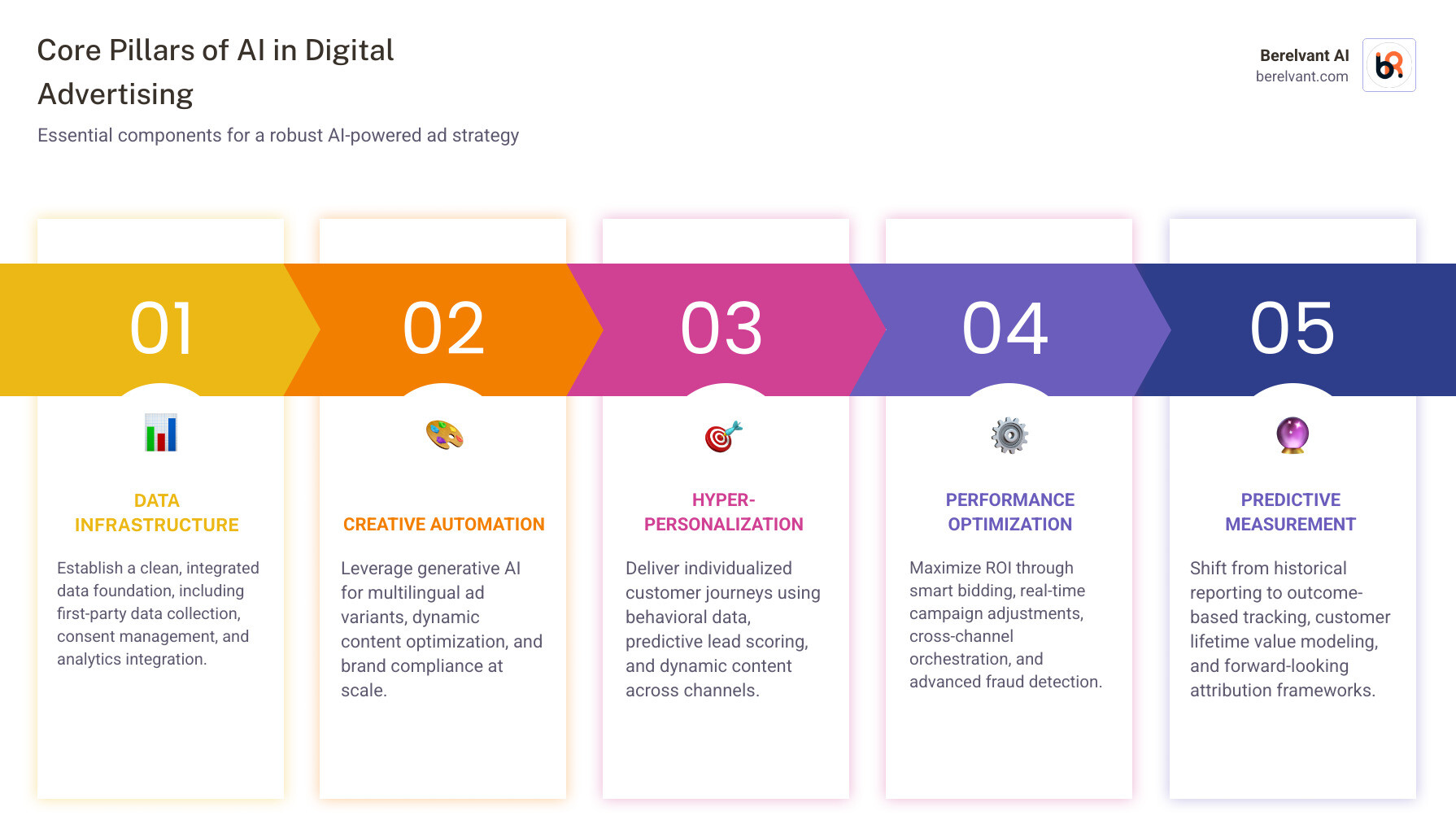
Core capabilities of AI in digital advertising include:
- Creative Automation – Generate multilingual ad variants, optimize messaging, and produce assets at scale without expanding headcount
- Performance Optimization – Deploy smart bidding, predictive analytics, and real-time adjustments to maximize ROI and reduce wasted spend
- Hyper-Personalization – Deliver individualized customer journeys using behavioral data, predictive lead scoring, and dynamic content
- Fraud Prevention – Identify and eliminate invalid traffic (IVT) using machine learning models that analyze user behavior and ad placement signals
- Measurement Infrastructure – Shift from historical reporting to predictive insights that inform strategy and budget allocation
The shift is already underway. More than 60% of U.S. ad agencies are using generative AI, and 80% of Google’s customers have adopted at least one AI-powered Search ads product. Industry leaders describe AI as a force that will “totally revolutionize” advertising by making expertise available at scale, enabling personalization that was previously impossible, and creating new opportunities across search, social, video, and connected TV.
But AI is not a plug-and-play solution. It requires clean data infrastructure, strategic orchestration, and operational discipline. Organizations that treat AI as a layer within a broader growth system—one that combines creative velocity, compliance-ready execution, and cross-channel measurement—will gain a decisive advantage over competitors still managing campaigns manually.
The challenge for enterprise leaders is execution speed. Internal teams often lack the bandwidth, technical depth, or cross-functional alignment to deploy AI systems effectively. Campaigns move too slowly. Creative production becomes a bottleneck. Attribution remains fragmented. And without a unified approach, AI tools deliver isolated wins instead of compounding growth.
I’m Renzo Proano, and I’ve managed over $300 million in digital ad spend across financial services, SaaS, GovTech, and e-commerce, building AI-powered acquisition systems that replace fragmented workflows with predictable, scalable execution. My work focuses on integrating AI in digital advertising to deliver multilingual campaigns, compliance-ready creative, and real-time performance optimization for mid-market and enterprise organizations operating across the Americas.
For leaders looking to dive deeper into the underlying technologies, the Wikipedia overview of artificial intelligence provides a useful technical primer on the models and methods now powering modern advertising systems.
Simple guide to ai in digital advertising:
The Strategic Imperative: Why AI is Reshaping the Advertising Value Chain
The digital advertising landscape is undergoing a profound change, driven by the rapid evolution of AI in digital advertising. This isn’t just another tech trend; it’s a strategic imperative that is fundamentally reshaping how we approach marketing, impacting everything from creative development to campaign execution and measurement. Leaders of the world’s largest advertising holding companies acknowledge that AI is “totally disrupting” the business, viewing it as a force that will ultimately create more jobs than it displaces.
This disruption is certainly “unnerving” investors across industries, as AI promises to make world-class expertise available at an extremely low cost. For enterprise leaders, this means a redefinition of ROI. The benefits of using AI in digital advertising strategies are clear: improved efficiency, better decision-making, and significantly improved return on investment. AI allows us to move from guesswork to data-driven precision, leveraging predictive analytics to anticipate consumer behavior and optimize ad spend in real-time.
A core advantage of AI in digital advertising is its ability to achieve personalization at scale. Historically, tailoring messages to individual consumers was a resource-intensive endeavor. Now, AI algorithms analyze vast datasets—from browsing history to purchase patterns—to deliver hyper-personalized content, product recommendations, and targeted advertisements. This level of customization ensures that the right message reaches the right person at the right time, maximizing engagement and conversion rates.
Generative AI tools, such as DALL-E, Veo, and Midjourney, are particularly impactful in content creation. They empower us to produce a high volume of diverse creative assets quickly and efficiently, moving beyond the traditional bottlenecks of manual design. This speed and scale are critical for maintaining relevance in today’s digital environment.
However, with great power comes great responsibility. While the opportunities are immense, challenges remain. Industry leaders highlight ethical considerations, particularly around data privacy and algorithmic bias. Consumers are also voicing concerns; an overwhelming 82% believe firms using generative AI should prioritize preserving human jobs, even if it means lower profits. This underscores the need for responsible AI adoption, focusing on transparency and human oversight to maintain trust.
The consensus among experts, as highlighted in the 2024 State of Marketing AI Report, is that AI adoption is accelerating, with many marketing professionals finding these tools indispensable in their daily workflows. This indicates a clear path forward for businesses that accept AI in digital advertising not just as a tool, but as a strategic partner for growth.
Systematizing Creativity: AI-Powered Content Production at Scale
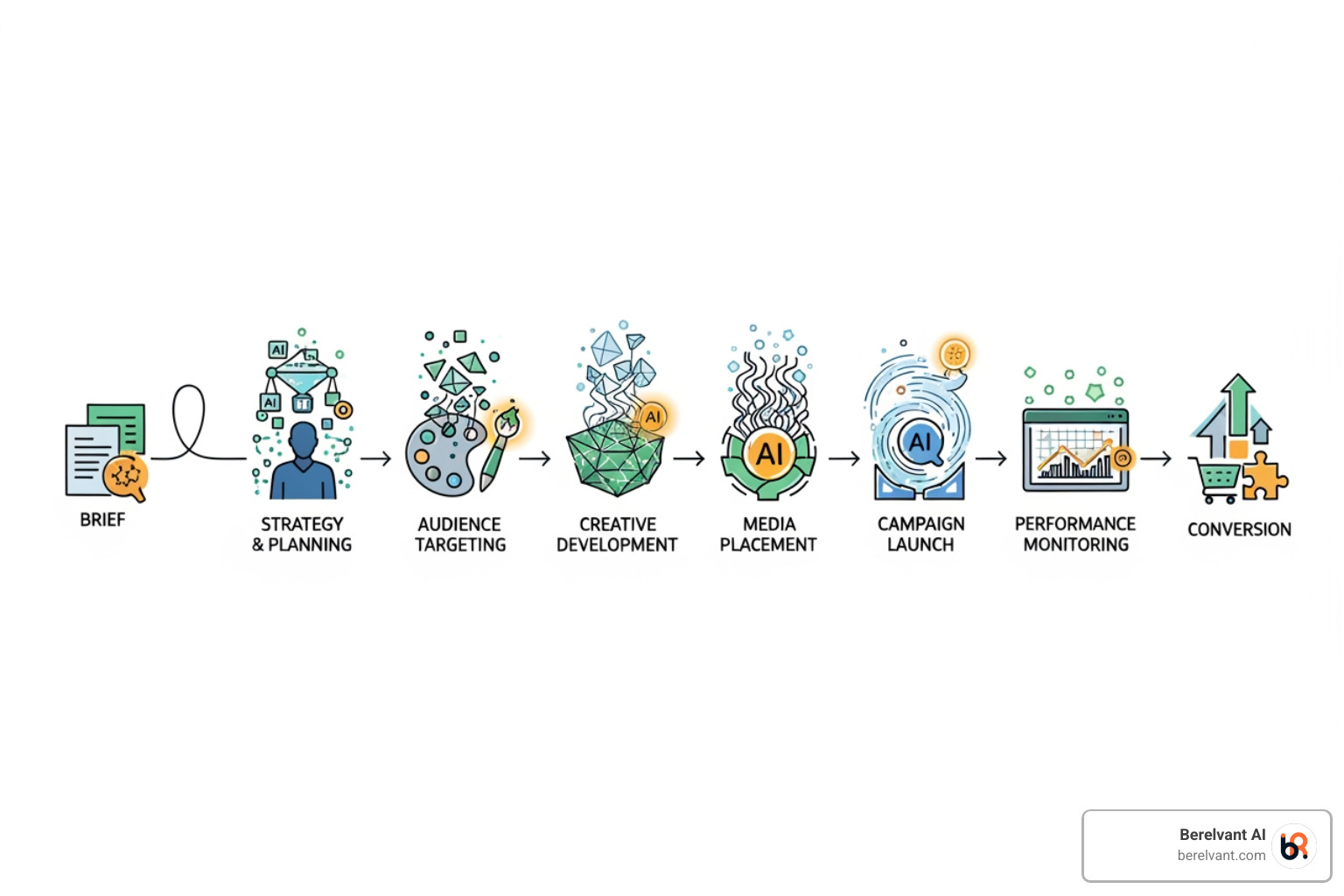
In the past, generating a high volume of diverse creative assets for digital campaigns was a laborious and expensive undertaking. Today, AI in digital advertising acts as a powerful accelerator, enabling us to systematize creativity and produce content at an unprecedented scale. For enterprise operations, this means moving beyond manual bottlenecks and leveraging advanced tools to create, optimize, and deploy multilingual assets across varied platforms.

Enterprise-grade generative AI tools are at the forefront of this revolution. Platforms like DALL-E, Veo, and Midjourney are changing how we approach visual content, allowing us to generate high-quality images and even videos from simple text prompts. This drastically reduces the time and cost associated with traditional creative production. Imagine an AI creative studio, similar to what French retailer Carrefour built with Google Cloud, where AI learns from historical campaign data and brand guidelines to generate comprehensive marketing campaigns in minutes. This level of Creative Workflow Automation ensures brand consistency while enabling rapid iteration.
Our expertise lies in leveraging these tools for multilingual asset generation, ensuring that campaigns resonate across diverse cultural audiences in the Americas. This includes automated translation, localization, and even dynamic adjustments to visuals based on regional preferences, all while maintaining brand compliance. The ability to move from brief to execution at such velocity multiplies the impact of every campaign, allowing us to test, learn, and scale with unparalleled agility.
Practical Applications of Generative AI in Advertising
Generative AI offers a myriad of practical applications that directly improve our advertising efforts:
- Dynamic Ad Copy: Tools like Jasper AI and Writer.com enable the rapid generation of compelling ad copy, headlines, and calls to action. We can input specific instructions, target audience parameters, and brand voice guidelines to produce numerous variants, which can then be tested and optimized for performance. This capability is crucial for hyper-personalization, ensuring each user sees the most relevant message.
- Image and Video Generation: Beyond DALL-E and Midjourney for static images, tools like Crayo streamline the creation of short-form videos for platforms like TikTok and YouTube Shorts. Synthesia can even generate AI-powered videos, reducing the need for costly video shoots. PhotoRoom, for instance, allows for quick background removal, making asset creation for product ads a breeze.
- Sentiment Analysis for Creative Resonance: Platforms like Brand24 leverage AI to monitor online mentions and perform sentiment analysis. This allows us to understand how our creative assets are being perceived by the audience in real-time, helping us fine-tune messaging for optimal emotional resonance and brand perception. This falls under Generative AI Advertising, where the AI not only creates but also helps refine the impact of the creative.
- Creative Intelligence for Competitive Advantage: Tools like Browse AI can scrape competitor websites for creative insights, pricing strategies, and product launches. This allows us to analyze what’s working for others and adapt our strategies, ensuring our campaigns remain competitive and innovative.
Leveraging Advanced AI Models for Marketing
For enterprise-level operations, the integration of advanced AI models into our marketing ecosystem is paramount. These aren’t just standalone tools but components of a larger, interconnected system designed for efficiency and scale.
We use enterprise-ready AI platforms that bring together various functionalities. For example, some of the largest agency networks have developed proprietary AI-powered marketing platforms used by thousands of their employees to streamline processes. Similarly, Google Ads integrates AI across its products for campaign management and creative asset generation.
These platforms improve marketing workflows by automating repetitive tasks, providing predictive insights, and facilitating rapid content iteration. Tools like Zapier act as the “Lego of tech stack integration,” allowing us to build automated connections between thousands of different systems, from CRM to social media schedulers. Gumloop, another powerful automation tool, connects various LLMs to internal workflows without requiring coding expertise. Notion AI integrates AI directly into productivity, helping teams brainstorm, write, and automate within their workspaces.
Our approach as an AI Digital Agency is to seamlessly integrate AI in digital advertising into both creative and operational systems. This means not only generating assets but also ensuring they are deployed efficiently, tracked carefully, and optimized continuously. By doing so, we create a unified engine that drives measurable revenue growth for our clients operating across the Americas.
The Performance Engine: AI in Digital Advertising Campaign Execution
The true power of AI in digital advertising is realized in its ability to transform campaign execution from a reactive process into a proactive, performance-driven engine. This involves leveraging advanced data analytics, hyper-personalization, and predictive insights to optimize every aspect of a campaign, ensuring maximum ROI and minimal waste.
Advanced data analytics is the fuel for this engine. AI allows us to process and analyze massive amounts of structured and unstructured data in real-time, extracting deeper insights into consumer preferences, motivations, and purchasing behavior. Tools like Fullstory track user journeys on websites, identifying opportunities and errors in digital experiences that would be impossible to uncover manually. This granular understanding empowers us to move beyond broad demographics and create truly hyper-personalized campaigns.
Predictive analytics takes this a step further, using machine learning to forecast future events and anticipate customer needs. This enables us to refine audience segmentation, identify emerging opportunities, and adjust messaging proactively. For instance, predictive lead scoring, driven by AI, can identify which leads are most likely to convert, allowing us to prioritize efforts and optimize resources. This is central to effective PPC Campaign Management: The Ultimate Guide.
A critical aspect of campaign execution is combating invalid traffic (IVT). IVT, defined as ad activity that doesn’t come from a real person with genuine interest, wastes ad budgets and erodes trust. Google, for example, uses advanced AI, including large language models, to identify ad placements generating invalid behaviors, analyzing app and web content, and user interactions. This innovative AI-driven fraud prevention has led to significant reductions in IVT, ensuring that advertising spend reaches genuine potential customers. Our own systems integrate similar advanced AI models to safeguard our clients’ budgets and maintain campaign integrity.
Mastering AI-Powered Ad Platforms
Leading ad platforms are rapidly integrating AI, making it indispensable for campaign managers. Google, for instance, is revolutionizing its advertising products with generative AI. Their Search Generative Experience (SGE) in Search Labs is reimagining search, and ads will be seamlessly integrated, customized to specific steps in a user’s search journey. This means new ad formats native to the AI experience, where ads appear above and below AI-powered snapshots and even within conversational modes.
For performance-driven campaign orchestration, tools like Performance Max campaigns and broad match, combined with Smart Bidding, are crucial. Google reports that 80% of its customers already use at least one AI-powered Search ads product. Advertisers who improve their responsive search ads’ ad strength from ‘Poor’ to ‘Excellent’ can see 12% more conversions on average. This highlights how AI optimizes bids at auction time using real-time signals, automatically adjusting to maximize ROI. This is the essence of effective AI Campaign Management.
The “Ads Power Pairing” — combining AI-powered Search campaigns with broad match and Performance Max campaigns — allows us to drive more conversions across all of Google’s properties, including YouTube, Shorts, and Connected TV. Value-based Smart Bidding further refines this, investing in conversions that are worth the most to our clients’ businesses. This automation-first approach, as demonstrated by companies achieving significant increases in signups and clicks, is key to staying relevant and maximizing efficiency.
Building Hyper-Personalized Customer Journeys with AI in Digital Advertising
The dream of delivering the “right ad, right person, right place, right time” is now a reality thanks to AI in digital advertising. This capability extends beyond simple targeting to building truly hyper-personalized customer journeys.
AI enables real-time journey mapping, where we can track and analyze customer interactions across multiple touchpoints. This allows us to understand behavior as it unfolds, predicting next steps and tailoring content accordingly. For example, AI-powered tools like Reply.io’s AI Sales Email Assistant can automate email campaigns and apply AI-powered response scoring to identify potential leads, creating dynamic, personalized communication flows.
Cross-channel orchestration ensures that these personalized experiences are consistent across all platforms—from search and social to email and Connected TV Advertising. AI algorithms understand a user’s preferences and behavior, recommending products and relevant content that creates a seamless and engaging consumer experience. This level of personalization is changing how companies engage with their audiences, making marketing more intelligent, data-driven, and responsive.
Governance and Future-Proofing: Building a Responsible AI Framework
While the opportunities presented by AI in digital advertising are immense, it’s crucial for enterprise leaders to address the ethical considerations and potential drawbacks. As a growth partner operating across the Americas, we understand the importance of establishing a robust, responsible AI framework that prioritizes data privacy, mitigates algorithmic bias, and addresses the evolving nature of job roles.
One of the primary concerns is data privacy. AI systems thrive on vast amounts of consumer data, and there’s a growing apprehension about how this data is collected, used, and potentially misused. High-profile incidents, such as Facebook’s Cambridge Analytica scandal, serve as stark reminders of the risks involved. Regulations like the European Union’s General Data Protection Regulation (GDPR) and the California Consumer Privacy Act (CCPA) provide frameworks, but our commitment goes beyond mere compliance. We believe in transparency and obtaining explicit consent, especially considering that 91% of people want brands to be clear about their data usage.
Algorithmic bias is another significant challenge. AI models are trained on historical datasets, and if these datasets contain inherent biases, the AI can unintentionally perpetuate them. We’ve seen examples like Amazon’s AI recruiting tool unfairly favoring male candidates. In advertising, this could lead to skewed targeting, misrepresentation, or discrimination against certain groups. Addressing this requires careful auditing of data, diverse training datasets, and continuous monitoring to ensure fairness and inclusivity.
The impact on jobs is a frequent topic of discussion. While AI will automate many repetitive tasks, it’s more likely to transform roles than eliminate them entirely. The focus shifts from executing mundane tasks to higher-level strategy, human-led insight generation, and managing AI systems. As the 2024 State of Marketing AI Report suggests, AI adoption is accelerating, and “marketers who accept AI will replace those who don’t.” This necessitates investment in Marketing Operations Consulting to reskill teams and adapt organizational structures. Consumer concerns are valid here; 82% of consumers believe firms using generative AI should prioritize preserving human jobs, even if it means lower profits.
Implementing Responsible AI in Digital Advertising
To ensure responsible AI in digital advertising adoption, we advocate for several key practices:
- Transparency and Disclosure: We believe in being transparent about AI’s involvement in content creation and campaign decisions. This builds trust with consumers and allows them to make informed choices. The “Sports Illustrated” AI scandal, where undisclosed AI-generated content led to the CEO’s firing, serves as a powerful cautionary tale.
- Human-in-the-Loop Oversight: AI is a powerful tool, but it’s not infallible. Human oversight is crucial to verify the accuracy of AI-generated information, correct mistakes, and ensure that creative output aligns with brand values and ethical standards. This “human-in-the-loop” approach ensures that AI augments, rather than replaces, human judgment.
- Customer Feedback Mechanisms: Providing channels for customer feedback is essential. This allows us to quickly address inaccuracies, discomfort, or privacy concerns arising from AI interactions, helping to refine our AI systems and build trustworthy experiences.
- Building Internal AI Expertise: Organizations need to invest in educating their workforce and developing AI expertise. This involves understanding the basics of AI, gaining hands-on experience with AI applications, and staying updated on trends. For individuals, this means proactively building AI literacy, mastering predictive analytics, generative AI, and marketing automation to future-proof their careers.
- Organizational Readiness: Beyond individual skills, organizations must develop policies, guidelines, and implementation roadmaps for AI. This requires engaging C-suite leadership to reframe marketing as a growth driver, aligning marketing KPIs with business goals, and fostering a culture of experimentation. Bridging the gap between individual enthusiasm and organizational readiness is key to open uping AI’s full potential.
Frequently Asked Questions about AI in Digital Advertising
How does AI tangibly improve advertising ROI beyond simple automation?
AI in digital advertising transcends simple automation by enabling a comprehensive approach to ROI improvement. Firstly, through predictive modeling, AI analyzes vast historical and real-time data to forecast consumer behavior, market trends, and campaign performance with remarkable accuracy. This allows us to allocate budgets more effectively, target high-value segments, and anticipate shifts in demand, leading to significantly optimized ad spend and reduced waste.
Secondly, AI facilitates market expansion efficiency. It can identify untapped demand and niche audiences across new search queries, channels, and geographies in the Americas, allowing us to launch campaigns that would be impossible to manage manually. This proactive approach uncovers new revenue streams.
Thirdly, AI actively combats invalid traffic (IVT) and ad fraud, ensuring that every dollar spent reaches a genuine human audience. This directly prevents budget drain and improves the integrity of campaign data. Finally, through hyper-personalization, AI drives increased conversion rates by delivering highly relevant messages and experiences that resonate deeply with individual consumers, leading to stronger customer connections and higher lifetime value. The ability to dynamically adapt creative and bidding strategies in real-time based on these insights is what truly lifts AI’s impact on ROI.
What is the first step for an enterprise to integrate AI into its existing advertising operations?
The foundational first step for an enterprise to integrate AI in digital advertising is a thorough data infrastructure audit. This involves assessing the quality, accessibility, and integrity of existing data sources, with a strong emphasis on establishing a clean data foundation. Without robust, consented first-party data, AI models operate on shaky ground. Key elements include:
- Data Collection & Governance: Ensuring comprehensive and compliant data collection mechanisms, including robust sitewide tagging and consent management (e.g., Consent Mode).
- Data Unification: Consolidating disparate data sources (CRM, website analytics, ad platforms) into a unified, accessible repository.
- Measurement Framework: Defining clear conversion values and establishing improved conversion tracking to accurately measure the impact of AI-driven campaigns.
Once the data foundation is solid, the next critical step is identifying a high-impact pilot project. This should be a well-defined use case where AI can deliver measurable, tangible results quickly, such as optimizing a specific PPC campaign for lead generation or automating creative variants for a particular product line. Defining clear business outcomes for this pilot is essential. Finally, partnering with an expert Campaign Operations Agency is crucial for successful implementation, as they bring the technical expertise, strategic guidance, and operational discipline required to steer these complexities and scale initial successes into a full-fledged AI-powered growth engine.
Will AI replace creative and strategic roles in advertising?
The prevailing view among industry leaders and our own experience is that AI will not replace creative and strategic roles in advertising, but rather augment them. The narrative is shifting from “AI will take your job” to “a person who knows how to use AI will take your job.”
AI excels at data analysis, automation, and generating variations at scale. This means it can handle the repetitive, data-intensive, and time-consuming tasks that traditionally consumed much of a creative or strategist’s time. For example, AI can generate countless ad copy options, analyze performance data for creative insights, or manage complex bidding strategies.
This shift frees human talent to focus on higher-level strategic thinking, conceptual ideation, emotional intelligence, and ethical judgment—areas where AI currently falls short. Human-led insight generation, understanding cultural nuances, and crafting compelling brand narratives remain indispensable. The role evolves from manual execution to orchestration, curation, and critical evaluation of AI outputs.
AI in digital advertising increases the demand for AI-literate strategists and creatives who can effectively leverage these tools, guide them, and infuse them with human ingenuity and empathy. It lifts the human role, making it more impactful and strategic.
Conclusion: Activating Your AI-Powered Growth Engine
The integration of AI in digital advertising is no longer a futuristic concept; it’s a present-day reality that offers a decisive strategic advantage for mid-market and enterprise organizations. By leveraging AI as a speed and scale layer, we can open up unprecedented operational velocity, changing fragmented workflows into a predictable, high-performance growth engine. From systematizing creative production and ensuring multilingual asset generation to mastering real-time campaign optimization and building hyper-personalized customer journeys, AI empowers us to achieve measurable revenue growth across the Americas.
This journey demands more than just adopting tools; it requires a holistic approach to data infrastructure, a commitment to responsible AI governance, and a proactive investment in building AI expertise across the organization. For enterprises navigating complex, compliance-heavy environments and diverse multicultural audiences, AI provides the precision and agility needed to thrive.
The future of advertising is intelligent, data-driven, and hyper-responsive. To build a resilient and scalable advertising system, you need a cohesive strategy. Explore our guide on AI Marketing Strategies to get started.