
Why AI for Local SEO Is Now Critical for Enterprise Visibility
AI for local SEO is the practice of optimizing your local business presence to be finded, understood, and recommended by generative AI systems like ChatGPT, Perplexity, Google AI Overviews, and voice assistants. Here’s what it means for your organization:
Key Components of AI for Local SEO:
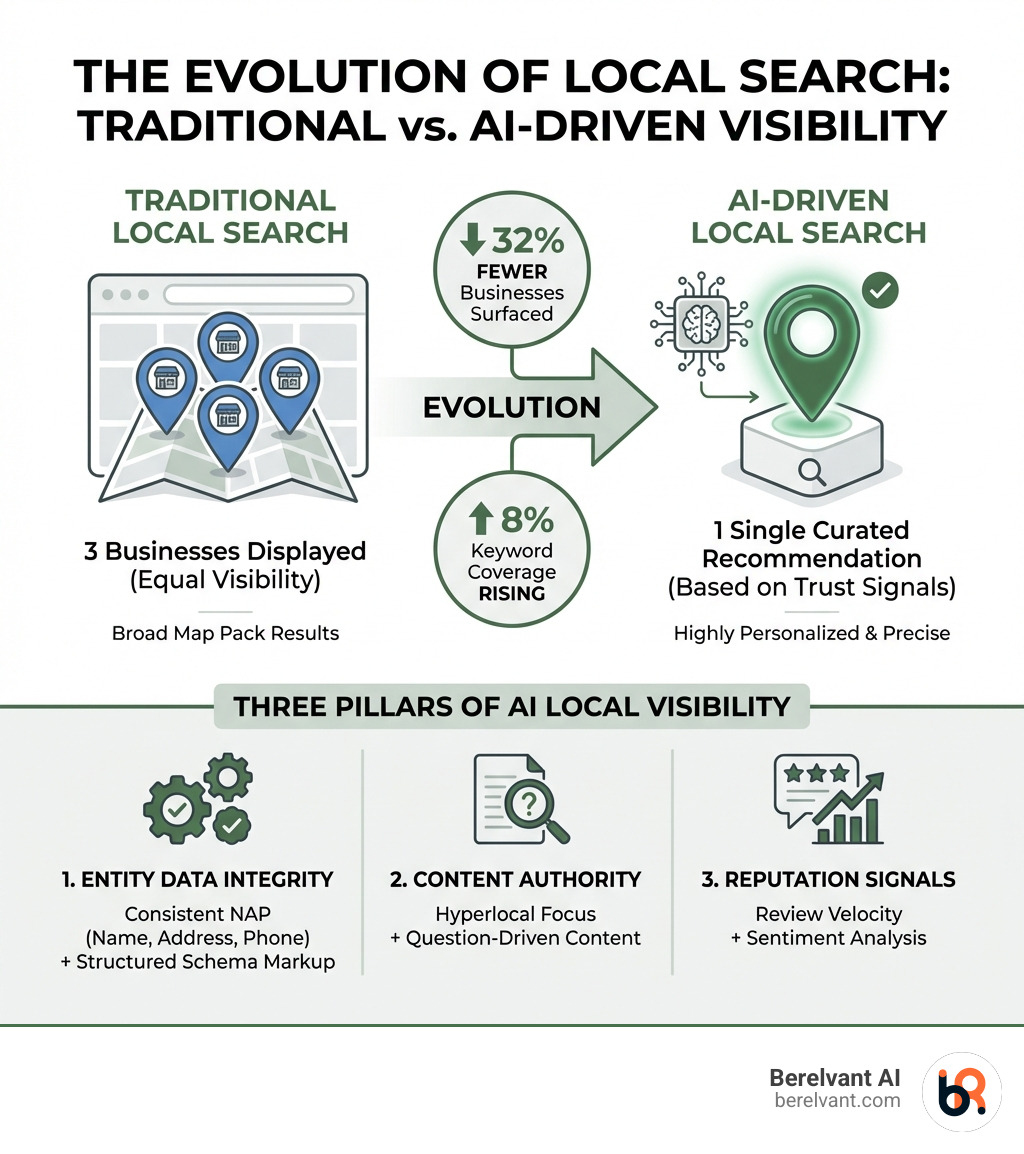
- Entity Data Integrity – Ensuring consistent NAP (Name, Address, Phone) and structured data across all platforms so AI systems trust your information
- Hyperlocal Content Depth – Creating question-driven, location-specific content that AI engines can cite and reference
- Reputation Signals – Building review velocity, sentiment, and response patterns that signal authority to AI recommendation engines
- Schema Markup Coverage – Implementing LocalBusiness, FAQPage, and Review schema so AI can parse and understand your offerings
- Cross-Platform Consistency – Maintaining authoritative mentions across Google Business Profile, directories, Reddit, and industry forums
The numbers tell a stark story. AI Local Packs now appear on roughly 8% of keywords and rising, yet they surface 32% fewer unique businesses than traditional packs. For multi-location enterprises, this isn’t just a visibility problem—it’s a systematic revenue leak. While your traditional rank tracking shows stability, AI assistants are intercepting purchase-ready customers and recommending your competitors. Nearly 46% of searches have local intent, and with AI tool adoption jumping from 8% to 38% of consumers, the question isn’t whether to adapt, but how quickly you can operationalize a response.
The shift is architectural. Traditional local SEO focused on ranking in the map pack. AI for local SEO requires becoming the definitive source that generative engines cite and trust. This means moving from keyword optimization to entity optimization, from content quantity to content structure, and from monthly reporting to real-time AI visibility monitoring. For enterprises managing hundreds of locations across multiple markets and languages, this demands an execution system—not a campaign.
What’s driving this change? AI engines don’t just index your content; they synthesize it. They evaluate your business through the lens of trust, authority, and relevance across dozens of data sources simultaneously. A single inconsistency in your NAP data, a gap in your schema markup, or a cluster of negative reviews can eliminate you from consideration—invisibly and instantly. The top 10 AI chatbots received over 55 billion visits between April 2024 and March 2025, up more than 80% year over year. Your customers are already using these tools to make decisions. The question is whether your locations are being recommended.
I’m Renzo Proano, founder of Berelvant, and I’ve managed over $300 million in digital ad spend building acquisition systems for enterprises across financial services, SaaS, and e-commerce. My work in AI for local SEO centers on deploying automation frameworks that unify data, generate hyperlocal content at scale, and measure AI visibility as a revenue metric—giving leadership the control and clarity they need to compete in generative search environments.
Quick AI for local SEO definitions:
The Paradigm Shift: From Search Engines to Generative Recommendation Engines
The local landscape is undergoing a profound change. AI Overviews, chatbots, and voice assistants are rapidly replacing the familiar “ten blue links” with synthesized, direct answers. This isn’t merely an update; it marks the emergence of a new discipline: Generative Engine Optimization (GEO). Our objective is no longer just to rank high in a list, but to become the definitive source that AI systems cite and recommend. This fundamental shift demands a strategic pivot away from traditional keyword-centric tactics toward building a robust, machine-readable entity that AI can trust and understand at scale.
How AI Search Differs from Traditional Local Search
The way AI search engines like ChatGPT, Perplexity, and Google AI Overviews present local business information fundamentally differs from traditional search engines. This divergence creates both challenges and opportunities for local businesses in Fairfield, CT, Westport, CT, and across Connecticut.
- AI Overviews & Direct Answers: Unlike traditional search that presents a list of links, AI search often synthesizes information into a direct answer or an “AI Overview.” While AI Overviews are less likely to appear for local queries compared to informational ones, their presence for even a small percentage of local searches is impactful. This means users get immediate answers without needing to click through to a website, shifting the goal from a click to a citation.
- Conversational Queries: AI search excels at understanding natural language and conversational queries. Users are no longer typing short, stilted keywords like “plumber Fairfield CT” but asking questions like “Who is the best plumber in Fairfield that offers emergency services?” or “Where can I find a good Italian restaurant in Westport open late tonight?”. This requires our content to be structured to answer these questions directly.
- Fewer Businesses Surfaced: AI Local Packs and generative answers tend to surface significantly fewer businesses. Our research shows AI packs surface 32% fewer unique businesses than traditional packs, often recommending only one or two. This intensifies the competition for those coveted AI recommendations.
- Aggregation of Multiple Sources: AI engines don’t rely on a single source. They aggregate and cross-reference information from Google Business Profile, Yelp, review sites, local directories, social media, and your website. Consistency across these sources is paramount.
- Impact on Local Findy: This shift means customers searching for “plumber near me” or “best pizza in Westport” through an AI assistant might receive a curated recommendation directly, bypassing traditional map packs entirely. This is why AI Digital Marketing strategies must evolve to capture this new form of findy.
The Rise of Generative Engine Optimization (GEO) for Local
Generative Engine Optimization (GEO) is the strategic discipline focused on optimizing your digital presence to be directly cited and summarized by AI search engines. For our enterprise clients in Connecticut, this is not just an SEO tactic; it’s a critical component of market survival and growth.

According to Search Engine Journal, GEO is based on 3 pillars:
- Structured Information: This involves presenting your business data in a clear, unambiguous format that AI can easily parse. Think clear titles, logical sections, bulleted lists, and comprehensive FAQs. For a business in Westport, CT, this means ensuring your services, hours, and contact details are not just present, but explicitly structured.
- Reliable Data: AI values accuracy and timeliness. This pillar emphasizes providing up-to-date prices, schedules, testimonials, and statistics. For instance, if your Fairfield, CT location has specific holiday hours, that information needs to be consistently updated across all platforms.
- Brand Credibility (E-E-A-T Signals): AI engines are designed to recommend trustworthy sources. This means demonstrating Expertise, Experience, Authoritativeness, and Trustworthiness (E-E-A-T). For local businesses, this translates to strong local mentions, verifiable testimonials, and clear sourcing of all information. AI is an aggregator, and it needs strong, credible sources to suggest a company.
The goal of GEO is to ensure your business is not just found, but actively recommended by AI, turning generative answers into a new local front door for your enterprise locations.
The New Local Ranking Corpus: What AI Engines Prioritize
AI recommendation engines evaluate businesses less on traditional keyword density and more on a holistic understanding of their real-world prominence and trustworthiness. They build this understanding by corroborating data across a wide array of sources. For our enterprise clients across Connecticut, your ability to present a consistent, authoritative, and reputable narrative across all digital touchpoints is now the primary driver of local visibility. This moves beyond simply ranking; it’s about earning the AI’s confidence to be recommended.
| Traditional Local SEO Signals | AI-Era Local Signals |
|---|---|
| GBP Category | Entity Data Integrity |
| Keyword in Business Name | Hyperlocal Content Depth |
| Proximity (geographic) | Review Sentiment & Velocity |
| Backlinks | Schema Markup Coverage |
| Citation Volume (quantity) | Cross-Platform Consistency |
| Website Authority | Brand Mentions & Context |
Entity & Data Integrity
For AI engines, your business is an “entity”—a real-world concept with attributes. The clarity and consistency of this entity data are paramount.
- NAP Consistency: Name, Address, Phone number consistency across every online mention is a foundational trust signal for AI. Inconsistent NAP details for your Westport or Fairfield, CT locations can confuse AI, leading to exclusion from recommendations. This extends to business hours, website URLs, and service offerings.
- Structured Data (Schema Markup): This is how we speak AI’s language. Implementing schema markup, particularly
LocalBusinessschema, on your website’s location pages explicitly tells AI about your business type, services, operating hours, reviews, and geographic service areas. UsingsameAslinks within your schema helps AI connect your website presence with your Google Business Profile, Yelp, and other authoritative profiles, reinforcing your entity. - Data Aggregators: While direct API integrations are ideal for enterprise, ensuring your data is accurate across key data aggregators that feed information to various platforms remains important. These aggregators serve as corroborating sources for AI.
This meticulous approach to data integrity is crucial for building high converting websites that are also AI-ready.
Content Coverage and Depth
AI engines are designed to answer user questions comprehensively. Our content strategy must reflect this by providing rich, hyperlocal, and question-driven information that addresses the specific needs of customers in Fairfield, Westport, and beyond.
- Hyperlocal Content: This means going beyond generic service pages. Create content that references local landmarks, neighborhood features, and regional terminology relevant to your Connecticut locations. For example, a law firm in Westport, CT, might have content discussing local zoning laws or specific community initiatives.
- Question-Driven Content: AI users often ask conversational questions. Our content should anticipate these. Develop in-depth FAQs, blog posts, and service pages that directly answer common queries related to your specific local offerings.
- Service Pages & Neighborhood Pages: For enterprise clients with multiple locations in Connecticut, dedicated, unique service pages for each location and neighborhood-specific pages can significantly boost AI visibility. These pages should be rich in detail and custom to the local context.
- Long-Tail Keywords: While AI understands context, optimizing for long-tail, question-based keywords is still vital. Long-tail keywords make up 92% of all search engine queries, and these are precisely the types of queries AI excels at answering. Using tools to uncover these specific local queries ensures our content directly matches user intent.
This deep, localized content strategy is a cornerstone of effective AI Marketing Strategies for local findy.
Reputation & Community Signals
AI systems rely heavily on social proof and community sentiment to assess a business’s quality and trustworthiness. Your brand’s reputation is no longer just for human customers; it’s a critical ranking factor for AI.
- Review Volume & Velocity: A consistent flow of recent, positive reviews signals an active, reputable business to AI. AI models often use review counts and ratings in their recommendations.
- Review Sentiment & Response Rate: AI analyzes the sentiment within reviews. Positive sentiment, especially when mentioning specific services or staff, is highly valued. Equally important is your response rate: 88% of consumers say they would use a business that responds to all reviews – a clear signal of engagement and customer care to both humans and AI. Our goal is to respond to every review quickly and thoughtfully.
- GBP Q&A: The Google Business Profile Q&A section is a direct channel for customer interaction and an opportunity to provide clear, public answers that AI can leverage.
- Social Proof: Beyond formal reviews, AI considers mentions and discussions across social platforms and forums. Active engagement in community management services helps build this broader social proof.
An Enterprise Execution Framework for AI for Local SEO
Adapting to this new paradigm requires a systemic, not campaign-based, approach. For our multi-location and multilingual enterprises, this means building a centralized system for data governance, content creation, and reputation management that can be executed with precision across hundreds or thousands of locations. AI isn’t just the challenge; it’s the solution for achieving the necessary scale and speed. We leverage AI as the speed and scale layer that accelerates delivery, removes bottlenecks, and multiplies the impact of every campaign.

Step 1: Unify and Structure All Location Data
The first, and arguably most critical, step is to establish a single source of truth for all your location data. Inconsistent data is a silent killer of AI visibility.
- Data Audits: We begin with comprehensive data audits across all existing platforms—Google Business Profile, your website, Yelp, Apple Maps, industry-specific directories, and any other relevant local listing. This identifies inconsistencies in NAP, services, hours, and attributes for every location in Fairfield, Westport, and other Connecticut markets.
- Centralized Data Warehouse: For enterprise scale, we implement a centralized data warehouse or management system. This system acts as the master record for all location-specific information, ensuring that any update propagates accurately across all platforms.
- Schema Deployment Automation: Manual schema implementation for hundreds of location pages is inefficient and prone to errors. We automate the deployment of
LocalBusinessand other relevant schema types, ensuring every location page is machine-readable and explicitly signals its attributes to AI. - NAP Governance & API Integrations: Establishing strict NAP governance rules and leveraging API integrations with key platforms allows for programmatic updates and real-time synchronization, critical for managing data at scale. This forms the backbone of efficient AI Campaign Management.
Step 2: Build a Hyperlocal Content Generation Engine
Generating unique, hyperlocal content for every location, especially across multiple languages and markets, is a monumental task without AI. Our approach uses AI to build a scalable content generation engine.
- Content Templates: We develop intelligent content templates that are pre-optimized for GEO principles. These templates ensure consistent structure, schema integration, and a framework for hyperlocal details.
- AI Content Briefs: AI tools assist in generating detailed content briefs for each location, incorporating specific local search intent, competitor analysis, and unique selling propositions relevant to areas like Westport or Fairfield, CT.
- Multilingual Content Workflows: For enterprises operating across the Americas, AI facilitates efficient multilingual content workflows. It can generate localized content that respects cultural nuances and linguistic specificities, ensuring relevance in each market.
- Localized FAQs: AI is exceptionally good at predicting and generating FAQs based on local search patterns and customer queries. This allows us to populate location pages and GBP profiles with highly relevant, question-driven content.
Here are some AI-powered tasks for local content that we implement:
- Generating neighborhood-specific service descriptions (e.g., “Emergency Plumbing Services in downtown Westport, CT”).
- Creating FAQs based on local search intent (e.g., “What are the common building codes for home renovations in Fairfield, CT?”).
- Personalizing offers for regional events or local community needs.
Step 3: Automate Reputation and Review Management
Reputation signals are paramount for AI. Managing reviews at scale is a significant challenge for multi-location brands. AI offers powerful solutions.
- AI-Powered Review Response: AI models can generate personalized, context-aware responses to reviews, ensuring every customer interaction is acknowledged quickly and professionally. This maintains a high response rate, a key signal for AI.
- Sentiment Analysis: AI tools analyze the sentiment of incoming reviews, allowing us to quickly identify and address negative feedback or escalate critical issues before they impact AI recommendations.
- Review Generation Campaigns: We leverage AI to identify opportune moments to request reviews from satisfied customers and to craft compelling prompts that encourage detailed, keyword-rich feedback.
- Misinformation Monitoring: AI continuously monitors for mentions of your brand across the web, alerting us to any misinformation or inaccurate citations that could negatively influence AI recommendations.
This automation, often integrated with AI Calling Agent Automation, ensures that your brand’s reputation is not only managed but actively optimized for AI.
Step 4: Adapting the Framework for Multi-Location & Multilingual Operations
For multi-location brands and franchises, adapting to AI-driven search means striking a delicate balance between centralized brand control and localized nuance.
- Franchise Playbooks: We develop comprehensive playbooks for franchises, outlining standardized GEO practices, content guidelines, and review management protocols that can be implemented consistently across all locations.
- Centralized vs. Localized Control: Our framework defines clear lines of responsibility. Centralized teams manage core entity data, overarching content templates, and AI system integrations, while local teams contribute hyperlocal details, photos, and respond to unique local reviews.
- Cross-Border Compliance & Language-Specific Entity Signals: For enterprises operating in regulated industries or across multiple countries, we ensure that AI optimization strategies adhere to local compliance requirements and that language-specific entity signals are correctly implemented to serve multicultural audiences effectively.
This strategic approach transforms each location into a powerful, AI-optimized entity, managed efficiently through our Local Digital Marketing Company framework.
Measuring & Future-Proofing Your Local AI Visibility
Traditional rank tracking, which focuses on blue links, is increasingly obsolete for measuring success in AI-driven local search. Leaders need a new dashboard focused on outcomes. Success is measured by the frequency and quality of your brand’s inclusion in generative answers, and the subsequent impact on revenue. This requires a shift to specialized monitoring tools and building an internal “AI Visibility Score” to communicate progress to the C-Suite.
Developing an AI Local Visibility Score
To effectively measure the success of your AI for local SEO efforts, we move beyond traditional metrics to an “AI Local Visibility Score.” This composite score provides a holistic view of your brand’s presence in generative AI environments.
- AI Overview Presence: Tracking how often your locations appear in Google AI Overviews and other generative summaries.
- Citation Frequency: Monitoring how frequently your brand is cited or referenced by AI chatbots (like ChatGPT, Perplexity) when answering local queries. Ahrefs’ Brand Radar tool helps track AI citations and provides valuable insights into your brand’s prominence in these new search modalities.
- Share of Voice in Chatbots: Analyzing the proportion of AI-generated recommendations that feature your brand compared to competitors.
- Assisted Clicks & Store Visit Conversions: Measuring direct actions resulting from AI recommendations, such as phone calls, directions requests, website visits, and ultimately, physical store visits or conversions. This ties AI visibility directly to tangible business outcomes.
Operationalizing an Agile GEO Maintenance Routine
The AI landscape is dynamic, with models constantly evolving. An agile GEO maintenance routine is essential to adapt and future-proof your local visibility.
- Quarterly Audits: Conduct comprehensive quarterly audits of your entity data, schema implementation, and hyperlocal content. This ensures continued accuracy and alignment with the latest AI best practices.
- Continuous Testing: Regularly test how your locations appear in various AI search engines (ChatGPT, Perplexity, Google AI Overviews). Query these platforms with diverse local intent questions relevant to your markets in Connecticut and analyze the responses. This helps identify new opportunities or areas for improvement.
- Iterative Refinement: Based on audits and testing, continuously refine your content, schema, and data. The goal is an iterative process of optimization, ensuring your brand remains a trusted source for AI.
- Monitoring AI Misrepresentations: Proactively monitor for instances where AI might misrepresent your business. If an AI answer is inaccurate, we take steps to correct the canonical data sources and, if necessary, publish clarifying content on your website.
According to Deloitte Insights, AI adoption is accelerating, making this continuous adaptation crucial. If you’re looking for help identifying gaps and opportunities, a free digital marketing analysis can be a great starting point.
Frequently Asked Questions about Enterprise AI Local SEO
How is local GEO optimization different from just optimizing our Google Business Profiles?
Google Business Profile (GBP) optimization is undeniably a critical component of ensuring data integrity and visibility in Google’s ecosystem, particularly for map packs and direct searches. However, local GEO is a broader, more encompassing strategy. While GBP helps you appear accurately in Google Maps, local GEO focuses on making your website’s location pages the canonical, authoritative source that all AI systems—including Google’s, Perplexity’s, ChatGPT’s, and others—can confidently reference. It involves deep, structured content, comprehensive schema markup, and on-page proof of experience that goes far beyond what a GBP listing can hold. This gives us much greater control over your brand narrative and the specific details AI systems can synthesize and present to users, ensuring your enterprise locations in Westport, Fairfield, and across Connecticut are fully understood and trusted by AI.
What is the most significant risk for a multi-market enterprise that ignores AI for local SEO?
The most significant risk for a multi-market enterprise ignoring AI for local SEO is a quiet yet systematic erosion of market share. Your traditional rank reports might show stability, but potential customers are increasingly being intercepted by AI assistants that recommend your competitors. This leads to a decline in qualified leads, calls, and foot traffic that is difficult to diagnose without AI-specific monitoring tools. For regulated industries, such as financial services or healthcare, the risk is compounded by the potential for AI to misrepresent service details, compliance information, or legal disclaimers. This not only results in lost business but also creates significant legal and reputational exposure, as AI-generated misinformation can spread rapidly and be difficult to correct.
How can we prioritize which locations to optimize first when we have thousands of them?
For enterprises managing a vast portfolio of locations, prioritizing optimization efforts is key to maximizing impact. We advocate for a Pareto principle approach: focus the initial 80% of your resources and effort on the 20% of locations that drive the most revenue or operate in your most competitive markets (e.g., your flagship locations in high-density areas of Connecticut). This pilot group allows us to build and refine your data templates, content playbooks, and AI visibility measurement dashboards. The learnings and standardized assets developed from this high-impact cohort can then be efficiently scaled across the entire portfolio, ensuring a strategic and measurable rollout that generates significant ROI.
Conclusion: Building Your AI-Powered Local Acquisition System
The shift to AI-driven local findy is not a fleeting trend; it is the new operational reality for enterprises. Organizations that continue to rely on outdated local SEO playbooks risk being systematically excluded from the customer journey, watching as AI guides potential clients directly to competitors. Winning in this new era requires treating local visibility not as a collection of isolated campaigns, but as an integrated acquisition system—one built on a foundation of data integrity, content authority, and brand reputation. By leveraging AI to manage this complexity at scale, your organization can turn the disruptive potential of generative search into a durable competitive advantage. At Berelvant, we partner with enterprises to build and manage these end-to-end systems, changing local presence into a measurable revenue engine for your locations across Connecticut and beyond.
Ready to build a local SEO strategy that’s prepared for the future of search? Explore our AI Marketing Strategies and see how we build acquisition systems for the AI era.