
Why Enterprise Content Velocity Determines Market Position
Automated content creation is the use of AI systems to generate, optimize, and distribute content at scale with minimal manual intervention.
Key components of an automated content system:
- AI generation engines (GPT-4, Claude, Gemini) for text, images, and video
- Workflow orchestration platforms connecting creation to distribution
- Quality control layers including human review, plagiarism detection, and brand alignment
- Multi-platform distribution systems for automated scheduling and deployment
- Performance tracking and optimization modules to refine output based on data
Your content operation is likely fragmented: creative silos, slow translations, and compliance delays mean opportunities are missed. This is not a creative problem; it’s an infrastructure problem.
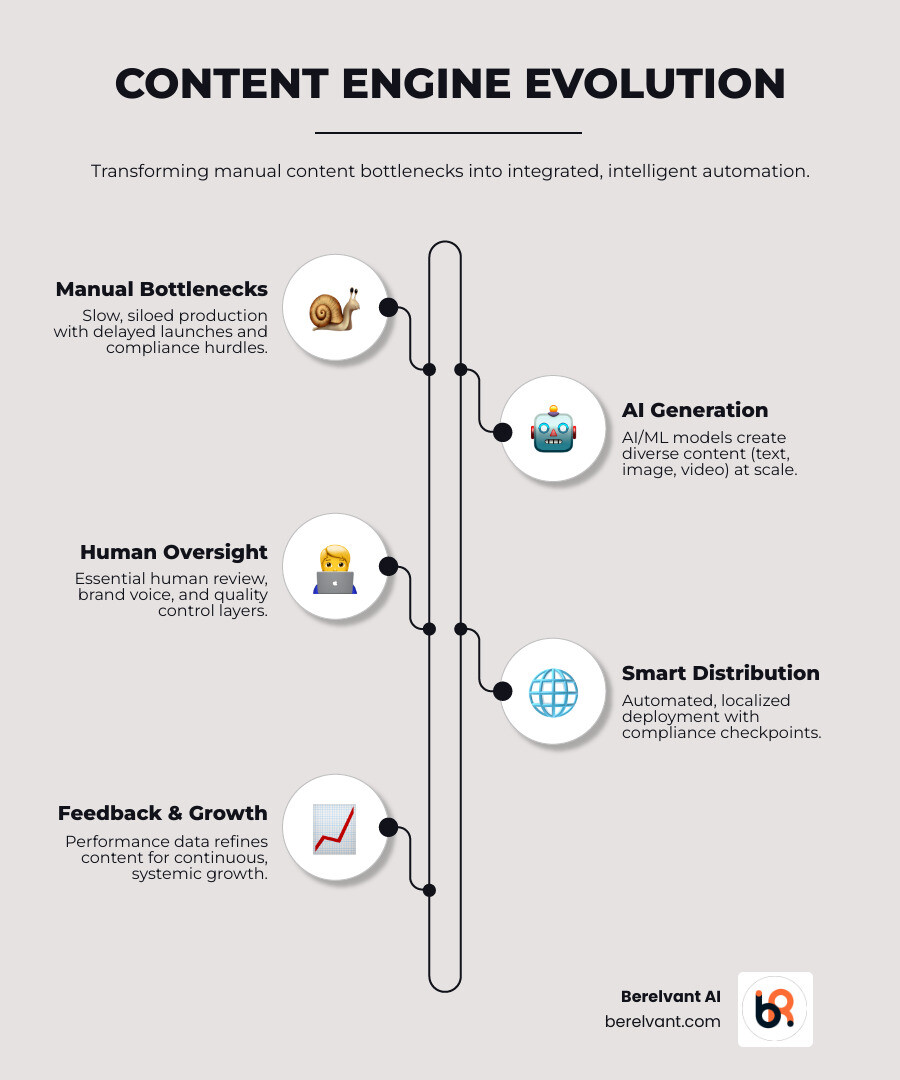
Market leaders have replaced manual workflows with integrated systems that generate, localize, and distribute assets in hours, not weeks. They use AI as operational architecture to build content engines that scale, maintain brand integrity, and drive acquisition without proportional headcount growth.
The research is clear: Content automation reduces manual work by up to 80%, enables real-time personalization, and allows teams to maintain consistency across dozens of markets. AI-driven systems analyze user behavior, predict performance, and optimize messaging before launch. They don’t just create faster—they create smarter.
But speed without control creates risk. The difference between an automated workflow that accelerates growth and one that creates chaos is system design—how you architect review stages, integrate data, enforce guardrails, and measure what matters.
I’m Renzo Proano, founder of Berelvant AI. I architect performance marketing systems and AI automation infrastructure for brands managing acquisition across regulated and non-regulated markets. My work replaces slow, manual content workflows with automated systems that maintain brand integrity, comply with regulatory requirements, and scale Automated content creation across languages and markets without compromising quality.
This article walks through the architecture, frameworks, and governance required to build an enterprise-grade automated content workflow. You’ll learn which AI models to use, how to design an integrated workflow, and how to implement the quality and compliance controls that make automation viable in regulated environments.
Handy Automated content creation terms:
The Core Technologies: Powering Your Content Engine

At the heart of any robust Automated content creation system is a sophisticated interplay of Artificial Intelligence (AI) technologies. For enterprise leaders, understanding these foundational components is critical to architecting effective and future-proof acquisition systems.
The backbone of modern Automated content creation relies on Large Language Models (LLMs), Natural Language Processing (NLP), and Natural Language Generation (NLG). LLMs are the engine, learning from vast text data to generate coherent content. NLP allows computers to understand human language, while NLG enables them to produce it. Together, they form the basis for creating natural and intelligible content.
Generative AI refers to algorithms that create content—written, visual, or audio—without direct human involvement, a powerful solution for the digital economy. The capabilities of Generative AI have been significantly strengthened by large model algorithms, enabling advanced features and cutting-edge content generation.
The transformer architecture, a deep learning model, underpins many of these advancements. Beyond text, multimodal AI models are emerging, capable of processing and generating content across various formats, including text, audio, image, and video. This is crucial for multi-platform strategies.
For an enterprise, seamless API integration is a necessity. It allows these AI models to connect with existing workflows, data sources, and distribution channels, turning disparate tools into a unified content engine. This integration facilitates data-driven decisions, where performance insights feed back into the AI models for continuous optimization. The goal is an integrated system that reduces friction between idea and execution, accelerating delivery and impact.
Understanding the AI Models
When we talk about Generative AI, we often refer to specific models that have become industry benchmarks for Automated content creation. These are complex systems trained on massive datasets to understand and generate human-like content.
What exactly is AI-Generated Content? It’s content produced by AI systems trained on vast amounts of existing data. This training allows the AI to recognize patterns and styles, which it then uses to create new, contextually relevant output.
Among the most prominent LLMs are:
- GPT-4: Developed by OpenAI, this advanced model has spearheaded the expansion of generative AI, capable of generating everything from essays and emails to entire blog posts.
- Gemini: Google’s multimodal AI, an upgrade from previous models. It processes and responds to inputs across text, audio, image, video, and code, offering tiers like Nano, Pro, and Ultra.
- Claude: Anthropic’s Claude AI is a powerful text generator known for producing long-form responses (up to 150,000 words), making it suitable for editing dense documents and holding detailed dialogues.
For enterprise applications, the choice between open-source and proprietary models, and the ability to fine-tune them, is paramount. Fine-tuning allows us to tailor the AI’s output to specific brand voices, industry terminologies, and compliance requirements. Some models, like Writer, are trained on B2B data, allowing further refinement with an organization’s own data. This customization ensures the generated content aligns with strategic objectives.
However, AI models are trained on existing data. While this enables them to generate vast amounts of content, they cannot produce completely original thought leadership. Their strength lies in combining and rephrasing existing information, which necessitates careful oversight regarding originality and potential copyright implications.
From Text to Multi-Format Assets
The power of Automated content creation extends far beyond text. Modern AI systems produce a diverse array of content formats, enabling a comprehensive multi-platform strategy for enterprises. This versatility is key to scaling acquisition efforts across various channels and engaging multicultural audiences.
Our capabilities in Automated content creation now encompass:
- Automated Text Generation: Producing articles, social media updates, email copy, and scripts, significantly reducing manual effort.
- AI Image Creation: Tools leveraging models like DALL-E and Midjourney generate striking graphics and images from text prompts, allowing rapid creative testing without traditional design resources.
- Video Synthesis: AI can generate video content by combining stock footage, images, and text-to-speech technology, invaluable for creating product demos or localized reports at scale.
- Data-Driven Reports: AI can synthesize complex data into coherent, narrative reports, streamlining analytics and insights dissemination.
- Code Generation: Some multimodal AI models can assist in generating code, further enhancing operational efficiency.
- Personalized Assets: Leveraging AI and data analysis, content automation can create personalized content for individual users, leading to higher engagement. AI can personalize email content by analyzing recipient data, ensuring messages resonate with diverse segments across the Americas.
Designing Your Automated Content Creation Workflow

Implementing enterprise Automated content creation requires strategically redesigning your content ecosystem. Recognizing that “content automation doesn’t replace good ideas, but it will streamline the creative process from ideation to publishing,” our objective is an integrated workflow that scales output, ensures brand consistency, and drives revenue. This demands a systematic approach to strategy, integration, distribution, and performance tracking.
We aim to create Creative Workflow Automation that frees our teams from repetitive tasks, allowing them to focus on high-value, strategic initiatives. The result is not merely faster content, but smarter, more impactful content that resonates across diverse markets.
Phase 1: Strategic Foundation and Infrastructure
Before adopting AI models, we must lay a solid strategic foundation to ensure our Automated content creation efforts are aligned with business objectives and designed for tangible results.
- Defining Business Objectives: Clear, measurable objectives (e.g., increased lead generation in Connecticut, higher conversion rates in specific Fairfield County markets) are the north star for our automation strategy.
- Developing Detailed Audience Personas: We develop detailed audience personas to capture the interests, needs, and behaviors of our target demographic, ensuring personalization is built into the core.
- Establishing Content Templates: To maintain brand voice and consistency at scale, we define content templates and guidelines for structure, tone, and style. These templates act as guardrails for AI-generated content.
- Keyword Research Integration: We integrate advanced keyword research tools to identify relevant topics and content gaps. This informs the AI models, enabling them to generate content optimized for search intent and SEO strategy alignment.
- Multilingual Planning: For multi-country execution across the Americas, we plan for automated translations and localization from the outset, ensuring cultural nuances are addressed and content resonates with diverse linguistic audiences.
Phase 2: Integrating Automated Content Creation into Operations
With our strategic foundation in place, the next step is to integrate Automated content creation seamlessly into our operational framework, turning disparate systems into a cohesive engine.
Here are key integration steps for an automated content system:
- API-First Approach: An API-first approach connects legacy and new AI tools into a unified, flexible, and scalable workflow, allowing us to “connect thousands of apps.”
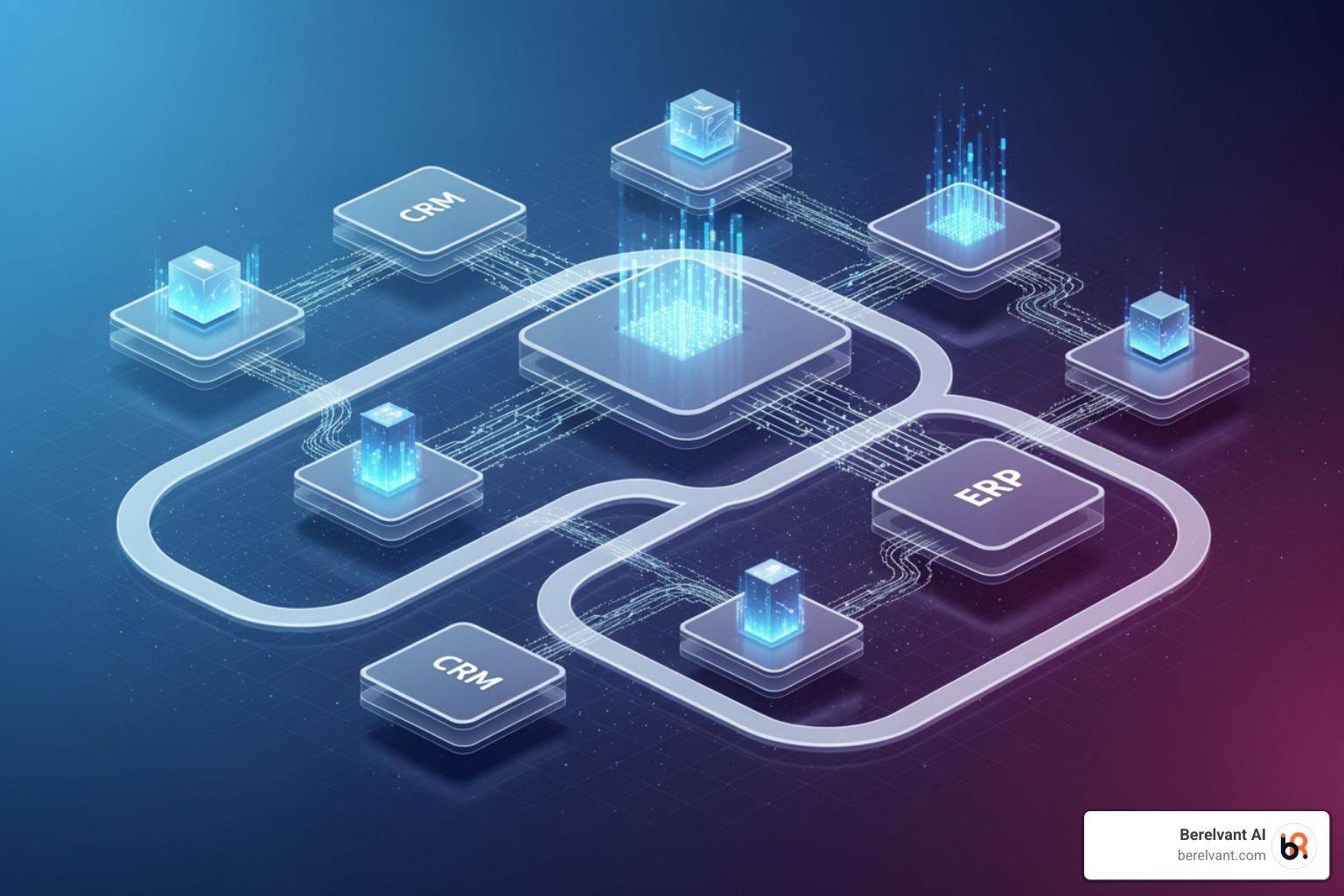
- Connecting Data Sources: We integrate our AI content generation engines with internal and external data sources (e.g., CRM, analytics) to provide the context needed for highly relevant and personalized content.
- AI-Powered Content Generation: The AI performs its heavy lifting, generating initial drafts of articles, social media posts, and ad copy quickly and efficiently using GPT-based language models.
- Human-in-the-Loop Review Stages: We design critical human-in-the-loop review stages to ensure quality, accuracy, and brand alignment. Human oversight is crucial, especially for regulated industries.
- SEO Optimization Modules: Our workflows incorporate SEO modules that analyze generated content for keywords, readability, and search engine best practices, ensuring our Automated content creation drives organic traffic. This is a critical aspect of Generative AI in Marketing.
Phase 3: Multi-Platform and Multilingual Distribution at Scale
The final phase involves pushing our content to the world, ensuring it reaches the right audience, on the right platform, in the right language. This is where the scalability of Automated content creation truly shines.
- Automated Content Repurposing: Our systems automatically repurpose content for multiple platforms. A long-form article can become social posts, an infographic, and a newsletter, all optimized for their respective channels.
- Platform-Specific Optimization: Workflows include platform-specific optimization, automatically adjusting character limits, image dimensions, and tone for channels like X/Twitter, Instagram, LinkedIn, and TikTok.
- Social Media Scheduling: Integrated tools handle automated social media scheduling, ensuring a consistent and timely presence across all relevant platforms without manual intervention.
- Email Marketing Automation: AI-driven platforms personalize recommendations and dynamically adjust subject lines, ensuring our messages resonate and drive conversions by analyzing recipient data.
- Cross-Market Deployment: For our multi-country operations, content is deployed across various markets simultaneously, ensuring brand messaging is consistent globally while being localized for regional relevance.
- Automated Translation and Localization: A cornerstone of our multi-market strategy is automated translation. AI tools translate text into dozens of languages, with human oversight to “tailor multilingual content based on cultural nuances and contextual subtleties.”
Governance: Managing Quality, Risk, and Compliance
While Automated content creation offers immense scale, speed without control is a recipe for disaster. For organizations in regulated or compliance-heavy environments, a robust governance framework is non-negotiable. It must address quality control, originality, and ethics to ensure AI-driven content is effective, trustworthy, and compliant. This is the sophisticated layer that distinguishes effective AI Digital Marketing from mere technological adoption.
Ensuring Quality, Authenticity, and Accuracy
The primary concern with any automated system is ensuring the output meets high enterprise standards. Our approach integrates multiple layers of control:
- Fact-Checking Protocols: We implement stringent fact-checking protocols. Since “AI programs can confidently state false information,” human fact-checking is crucial, particularly in regulated sectors where accuracy is paramount.
- Plagiarism Detection: AI models rephrase existing text, making them “prone to plagiarism.” Our systems use advanced plagiarism detection and human review to ensure content is fresh, valuable, and respects intellectual property.
- Brand Voice Consistency: We maintain a consistent brand voice by training AI models with on-brand content and providing continuous feedback. This prevents the “lack of personal touch” that can disconnect audiences.
- The Role of Human Creativity: We believe Automated content creation augments, not replaces, human creativity. “The role of human oversight and creativity” is non-negotiable. Humans provide the emotional depth, critical thinking, and unique perspectives that AI lacks.
- Editing and Refinement Loops: All AI-generated content undergoes rigorous editing. “Editing is crucial for accuracy and coherence in AI-generated materials.” These loops ensure the final content is accurate, authentic, and aligned with strategic goals.
Navigating Ethical Concerns and Regulated Environments
Operating in regulated industries (like those in Connecticut and Fairfield) requires a proactive stance on ethics and compliance. Our governance strategy addresses these head-on:
- Data Privacy Compliance (GDPR/CCPA): We ensure strict adherence to data privacy regulations like GDPR and CCPA, implementing robust data governance to protect sensitive information used in content generation.
- Mitigating AI Bias: AI can reflect biases from training data. We actively work to “mitigate AI bias” through careful model selection, diverse training data, and continuous auditing of outputs to uphold fairness.
- Disinformation Risks: The potential for AI to spread “fake news” is a significant concern. Our multi-layered review process and human fact-checking prevent the dissemination of misleading information, which is crucial for Generative AI Advertising.
- Maintaining Transparency: We advocate for transparency in our use of AI. Internal processes are clear about where AI is used and where human oversight is applied, fostering trust and accountability.
- Legal Implications of Copyright: The legal landscape around AI-generated content is evolving, with “lawsuits alleging that generative AI companies are infringing copyright law.” We steer these complexities by minimizing risks of infringement and prioritizing unique, value-adding content.
The Evolution of Roles and Future Trajectories
The advent of Automated content creation is not a harbinger of job displacement, but rather a catalyst for the evolution of roles within creative and marketing teams. For enterprise organizations, this translates into a strategic reallocation of human capital towards higher-value activities.
“Not likely [that AI will replace marketers]. But marketers who accept AI will replace those who don’t.” This sentiment encapsulates our philosophy: AI is a powerful augmentative force. It “isn’t here to steal jobs, but to boost them.” By automating repetitive tasks, AI “significantly boosts productivity,” freeing our human talent to focus on strategic thinking, creative ideation, and complex problem-solving.
The future of content creation professions will see a shift from content producers to content architects and strategists. Roles will evolve towards:
- AI System Architects: Professionals who design, implement, and manage the end-to-end Automated content creation workflows, ensuring seamless integration and optimal performance.
- Content Data Scientists: Experts who analyze the performance of AI-generated content, feeding insights back into the models for continuous improvement and personalization.
- Ethical AI Stewards: Individuals responsible for auditing AI outputs for bias, ensuring compliance, and upholding brand integrity.
- Strategic Creative Directors: Liberated from mundane tasks, creative leaders can now dedicate more time to breakthrough campaigns, emotional storytelling, and defining the overarching brand narrative. “AI tools offer more time and space for creative thinking by handling the labor-intensive parts of content creation.”
This evolution enables hyper-personalization at scale. With AI handling the heavy lifting of content generation and distribution, our teams can focus on crafting deeply resonant experiences for specific audience segments, even across multicultural audiences in complex markets. This shift towards agentic AI workflows means that AI doesn’t just execute tasks; it can initiate and manage entire processes based on predefined goals, further amplifying human capabilities. This is the essence of Generative AI Marketing.
“Content that’s truly unique, written by a human, will actually increase in value as it stands alone among a sea of restated ideas.” Our strategy is to use AI to generate the foundational, high-volume content, allowing human creatives to focus on the truly innovative, emotionally resonant pieces that define a brand and drive deep connection.
Frequently Asked Questions about Enterprise Content Automation
Can automated content match the quality required for regulated industries?
Yes, but with critical caveats. For regulated sectors (e.g., finance in Westport, CT), quality and accuracy are paramount. AI-generated content requires robust human oversight and stringent governance. We embed multiple checkpoints for human review, fact-checking, and compliance verification into our workflows. While AI can provide sources, human experts must validate all information. This human-in-the-loop approach ensures Automated content creation meets the highest standards, with AI acting as a speed and scale layer, not a replacement for accountability.
How does automation impact the roles of our existing creative and marketing teams?
Automated content creation redefines, rather than replaces, existing roles. Our experience shows that “AI significantly boosts productivity by automating repetitive tasks,” allowing teams to shift their focus to higher-value, strategic work. Instead of drafting routine posts, teams can concentrate on:
- Strategic Planning: Developing innovative campaign concepts.
- Deep Personalization: Refining AI content to resonate with nuanced audience segments.
- Brand Storytelling: Crafting unique narratives that only human creativity can deliver.
- Performance Analysis: Interpreting data to optimize content strategy and ROI.
“When used correctly, automation serves to augment human talent, not replace it.” Our teams in Connecticut and Fairfield find themselves empowered, with more time for creativity and strategic impact.
What is the typical ROI for implementing an end-to-end automated content system?
The Return on Investment (ROI) for an end-to-end Automated content creation system is substantial, driven by efficiency, scalability, and performance. We’ve seen that “content automation significantly reduces the time and effort required for manual content creation and management.” Key benefits include:
- Cost Reduction: Automation acts like “having an extra employee (or 10) for a fraction of the cost,” cutting production expenses.
- Increased Output & Speed-to-Market: Our systems can “reduce manual work by 80% through AI generation and automated publishing,” enabling rapid response to market trends.
- Improved Personalization & Engagement: By leveraging AI and data analysis, we create personalized content that leads to higher engagement and conversion rates.
- Scalability: Automated content creation allows businesses to “quickly scale their content production efforts… without a corresponding increase in resources or cost,” providing significant operational leverage.
While specific ROI figures vary, the strategic advantage gained from accelerated delivery and operational efficiency translates directly into measurable revenue growth and a stronger market position.
Conclusion: Activating Your Growth Engine
The landscape of content creation has irrevocably shifted. For enterprise leaders, Automated content creation is no longer a futuristic concept; it is a strategic imperative for sustained growth and competitive advantage in markets across the Americas. By embracing AI as an integral part of your operational architecture, you gain unprecedented operational leverage, enabling your organization to generate, localize, and distribute high-quality, compliant content at a scale and speed that manual processes simply cannot match.
Our expertise lies in building and managing these end-to-end acquisition systems. We specialize in navigating the complexities of regulated industries, compliance-heavy environments, multi-country execution, and multicultural audiences. AI, for us, is the speed and scale layer that accelerates delivery, removes bottlenecks, and multiplies the impact of every campaign, driving measurable revenue growth.
We invite you to activate your growth engine. Partner with us to architect a future where your content workflow is not a constraint, but a powerful accelerator for your enterprise. Let’s Develop your AI Marketing Strategies with an expert partner and transform your content operations into a finely tuned machine for market dominance.