Why Enterprise PPC Marketing Firms Define Scalable Acquisition Velocity
A ppc marketing firm builds the infrastructure that turns ad spend into predictable revenue across channels, geographies, and compliance environments. For organizations operating at scale, the right partner delivers:
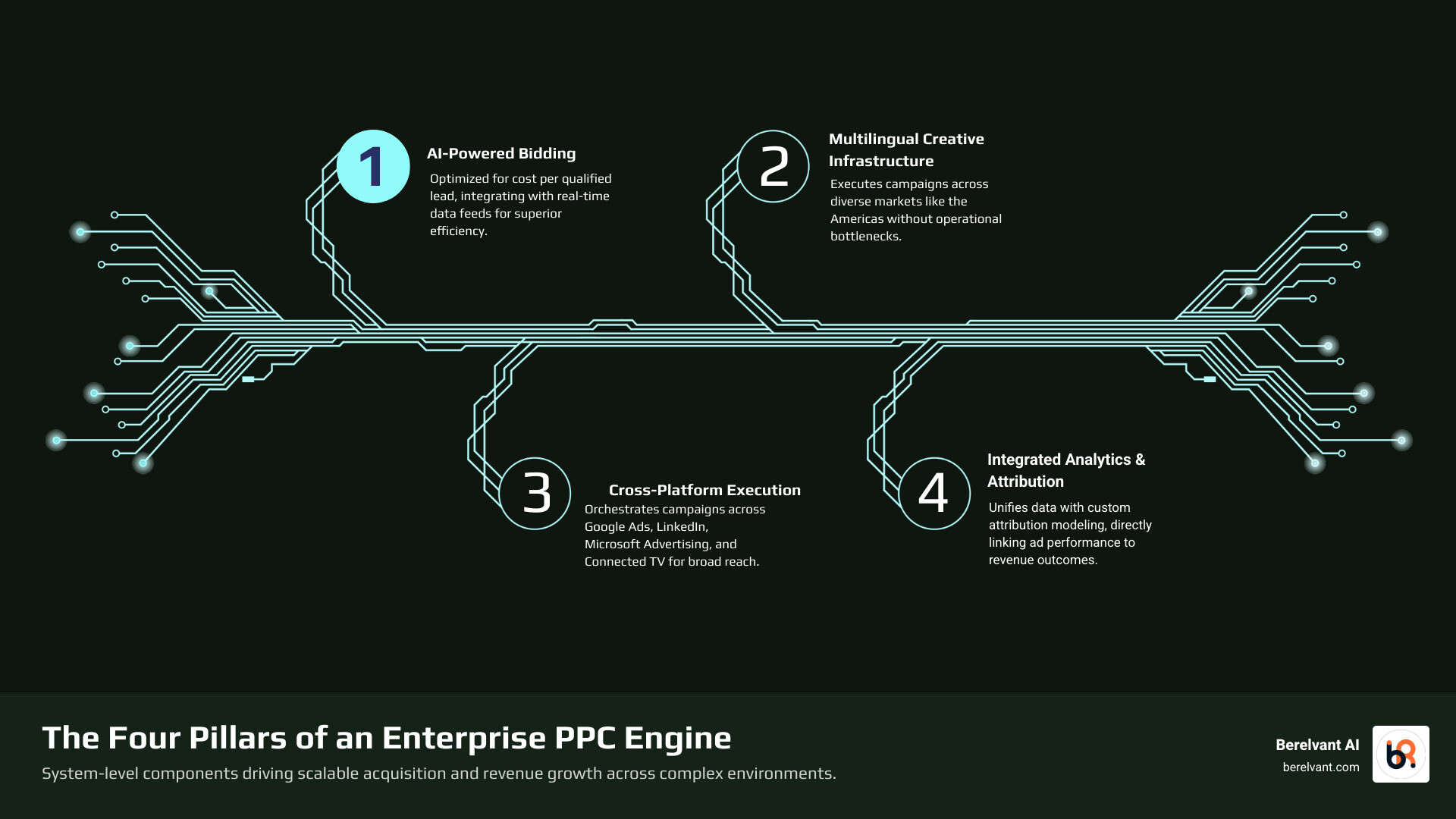
- AI-powered bid management optimized for cost per qualified lead, not just clicks
- Multilingual creative infrastructure that executes campaigns across the Americas without operational bottlenecks
- Cross-platform execution spanning Google Ads, LinkedIn, Microsoft Advertising, and Connected TV
- Integrated analytics and attribution that tie ad performance directly to revenue outcomes
- Compliance-ready campaign architecture for regulated industries like financial services, healthcare, and legal
The data supports strategic investment: businesses generate an average of $2 in revenue for every $1 spent on Google Ads, and PPC campaigns drive a 50% increase in brand awareness. But these outcomes require system-level thinking, technical depth, and operational speed that many internal teams can’t sustain.
Most mid-market and enterprise organizations face the same constraints: fragmented execution, slow creative velocity, inconsistent attribution, and compliance friction that delays launches. Traditional agencies optimize for clicks; enterprise-grade partners optimize for acquisition efficiency, revenue growth, and operational scalability.
Few firms truly operate at this level—executing multilingual campaigns, integrating first-party data pipelines, and managing compliance-heavy environments. Choosing the wrong partner compounds inefficiency: wasted budget, missed market opportunities, and slower competitive response.
I’m Renzo Proano, founder of Berelvant. I’ve managed $300M+ in ad spend for brands that demand precision, compliance, and speed at scale. This guide shows how to evaluate ppc marketing firms on the operational and strategic criteria that drive enterprise results.
Defining Enterprise-Grade PPC: Beyond Clicks to Systemic Growth
Most companies treat PPC as a channel. They run campaigns, track clicks, optimize for conversions, and call it a day. But if you’re operating at enterprise scale—across multiple markets, regulatory environments, and customer segments—that approach breaks down fast.
For organizations managing complex growth infrastructure, PPC is a revenue system, not a collection of campaigns. It’s the operational backbone that turns ad spend into predictable pipeline velocity, qualified leads, and measurable revenue outcomes. The difference between a transactional PPC effort and a systemic one is the difference between running ads and building scalable acquisition architecture.
This means you’re not just optimizing for a lower cost per click. You’re building a scalable architecture for multilingual execution, cross-platform coordination, and real-time adjustments. It’s a system that can absorb increased budget, enter new markets, and maintain conversion efficiency without requiring a complete rebuild every quarter.
A true enterprise PPC system operates across multiple platforms—not because diversification sounds strategic, but because your buyers don’t live on a single channel. Google Ads captures high-intent search traffic. LinkedIn delivers precision B2B targeting for decision-makers in regulated industries. Microsoft Advertising extends reach into enterprise environments. And Connected TV (CTV) builds brand awareness and retargeting pools at the top of the funnel. Each platform serves a distinct function within the broader acquisition system.
The operational advantage of this approach is clear: 75% of users say PPC ads make it easier to find what they are looking for. That’s not a vanity metric—it’s a signal that well-architected campaigns meet buyers at the exact moment they’re ready to engage. When you’re targeting high-intent users across multiple touchpoints, you’re not interrupting; you’re facilitating. And that’s where conversion efficiency compounds.
Speaking of conversion efficiency: the baseline average conversion rate on Search is 3.75%, but that number is nearly meaningless without context. Industry, audience intent, offer structure, landing page experience, and compliance requirements all influence what “good” looks like. Enterprise PPC systems don’t benchmark against averages—they’re built to exceed them through data-driven decision making at every layer. Keyword intent analysis. Audience segmentation. Dynamic creative optimization. Landing page systems that match message to intent. Attribution models that tie spend to revenue.
For companies operating across the Americas, there’s another layer of complexity: execution must be culturally fluent and linguistically precise. A campaign that works in Westport doesn’t automatically translate to São Paulo or Mexico City. Multilingual creative infrastructure isn’t optional—it’s table stakes for revenue growth in multi-country environments. And it’s one of the areas where most agencies fall short, either because they lack the operational capacity or because they treat localization as an afterthought.
The outcome of this system-level approach is consistent, scalable revenue growth: a repeatable, optimized engine that compounds efficiency and adapts to market conditions without losing momentum.
That’s what separates enterprise-grade PPC from everything else. And it’s exactly what organizations need when fragmented execution, slow creative velocity, and inconsistent attribution are costing them market share.
Core Capabilities of a High-Performance PPC Partner
When evaluating an enterprise ppc marketing firm, you’re not shopping for basic ad management. You need a partner who can architect scalable acquisition systems that function as revenue engines across multiple markets, platforms, and compliance environments.
The difference between tactical execution and strategic infrastructure comes down to six interconnected capabilities: campaign architecture that scales without breaking, audience segmentation that identifies high-intent buyers before your competitors do, multilingual creative systems that execute at speed across the Americas, AI-powered bid management that optimizes for revenue rather than vanity metrics, conversion rate optimization that treats landing pages as system components rather than afterthoughts, and analytics infrastructure that connects ad spend directly to pipeline contribution.
These aren’t separate services—they’re interdependent systems. When one element underperforms, the entire acquisition engine loses efficiency. For organizations operating in regulated industries or managing complex sales cycles, this integration becomes even more critical. You can explore how we apply AI Marketing Strategies to accelerate these systems and remove operational bottlenecks.
Strategic Campaign & Audience Management
Most agencies structure campaigns around keywords. We structure them around revenue outcomes.
Keyword intent analysis is the foundation. We map keywords to buyer journey stages and assign value based on conversion probability and customer lifetime value. This distinguishes informational queries from transactional queries that generate qualified pipeline.
Ad group structuring follows a logic of message-market fit. Each ad group addresses a specific user intent with creative and landing page experiences designed for that exact moment in the journey. This level of granularity is what allows enterprise campaigns to maintain relevance at scale, even when managing thousands of keyword-ad-landing page combinations across multiple geographies.
Negative keyword mastery is where most firms leave money on the table. We treat negative keyword lists as living documents, continuously refined based on search query reports and conversion data. For organizations spending six or seven figures monthly on PPC, eliminating irrelevant traffic isn’t just about efficiency—it’s about protecting budget for high-intent opportunities.
The strategic deployment of resources requires sophisticated budget allocation models that respond to performance in real time. We don’t distribute budgets evenly across campaigns. We shift spend dynamically toward the highest-performing segments, platforms, and geographies, using AI-powered automation to make these adjustments faster than manual management allows.
For companies operating across the Americas, geographic and demographic targeting must account for cultural nuance, language preferences, and local market conditions. A campaign targeting financial services executives in Westport, CT requires different messaging and creative than one targeting the same audience in São Paulo or Mexico City—even when the underlying value proposition remains consistent.
We extend reach through lookalike and custom intent audiences, leveraging first-party data to identify new prospects who share behavioral and demographic characteristics with your best existing customers. This is particularly valuable for B2B organizations with longer sales cycles, where building awareness among the right audience segments months before they enter active buying mode creates significant competitive advantage.
Performance Creative & Landing Page Optimization
Creative velocity determines how quickly you can respond to market signals, test new value propositions, and capitalize on emerging opportunities.
High-velocity A/B testing is our default operating mode. We’re continuously running experiments across ad copy, headlines, calls-to-action, visual elements, and landing page layouts. But this isn’t random testing—every experiment is hypothesis-driven, informed by conversion data and user behavior analysis.
Dynamic Creative Optimization (DCO) allows us to personalize ad experiences at scale, automatically assembling ad components based on user characteristics, search context, and real-time performance data. For enterprise campaigns managing dozens of audience segments across multiple platforms, DCO is what makes personalization operationally feasible.
With over 60% of clicks on Google Ads coming from mobile devices, we design every ad and landing page with a mobile-first approach. This isn’t just about responsive design—it’s about understanding how users interact with content on smaller screens and optimizing for thumb-friendly navigation, faster load times, and streamlined conversion paths.
Landing page UX/UI is where many campaigns fail. You can have perfect targeting and compelling ad copy, but if the landing page experience doesn’t immediately reinforce the user’s intent and guide them toward conversion, you’re burning budget. We design landing pages as system components, not marketing collateral—optimized for clarity, speed, and frictionless conversion.
Message matching ensures that the promise made in the ad is immediately fulfilled on the landing page. When a user clicks an ad about “enterprise compliance management for healthcare organizations,” they shouldn’t land on a generic homepage. They should land on a page that speaks directly to healthcare compliance challenges, uses the same language from the ad, and offers a clear next step aligned with their intent.
Advanced Analytics and Attribution Modeling
Measuring success by cost-per-click or even cost-per-acquisition misses the point entirely. Enterprise PPC performance should be measured by contribution to qualified pipeline and revenue.
Cross-channel attribution is essential for understanding how PPC interacts with other channels in the buyer journey. We implement UTM tagging, CRM integrations, and call tracking to follow prospects from initial ad click through multiple touchpoints to closed revenue. For B2B organizations with complex sales cycles, this visibility is what allows you to justify continued investment and optimize budget allocation across channels.
Customer Lifetime Value (CLV) tracking shifts the conversation from acquisition cost to long-term profitability. We can justify higher cost-per-acquisition when we know those customers will generate significantly more revenue over time. This is particularly relevant for subscription-based businesses, professional services, and any organization where customer retention drives profitability.
Return on Ad Spend (ROAS) analysis provides the ultimate profitability metric. We track ROAS at the campaign, ad group, and keyword level, continuously optimizing toward the highest-performing segments. But we also look beyond immediate ROAS to understand how PPC influences pipeline velocity and deal size across the entire sales cycle.
We provide custom dashboards that give you 24/7 access to the metrics that matter for your business—not generic reports filled with impressions and clicks, but dashboards showing qualified lead volume, cost per qualified opportunity, pipeline contribution, and revenue attribution. These dashboards connect directly to your CRM and analytics infrastructure, providing real-time visibility into profit contribution.
Measuring success beyond CPA is critical for enterprise organizations. While the average Cost-Per-Acquisition for PPC campaigns is $41.54 for Search, this number is meaningless without context. A $200 CPA might be exceptional if those leads convert to $50,000 deals. A $20 CPA might be wasteful if those leads never qualify. We optimize for cost-per-qualified-lead and contribution to sales pipeline, aligning PPC performance directly with revenue outcomes rather than channel-specific vanity metrics.
The Vetting Framework: How to Choose the Right PPC Marketing Firm
Selecting the right ppc marketing firm is a critical decision for mid-market and enterprise organizations, directly impacting acquisition velocity, operational efficiency, and revenue. The wrong partner creates compounding inefficiencies like fragmented execution and wasted budget, while the right partner becomes an extension of your growth infrastructure.
Your vetting process must focus on capabilities aligned with complex operational realities: deep industry specialization, a proven track record, technical expertise in AI and multilingual execution, a scalable team structure, and clear communication protocols. Transparency around data handling is also non-negotiable—understanding how your ppc marketing firm manages privacy and compliance starts with reviewing resources like Google’s data policies.

Evaluating a PPC Marketing Firm for Complex Environments
When your organization operates in regulated industries or across multiple countries, the complexity multiplies exponentially. Most agencies can’t handle this level of operational sophistication. You need a partner with regulated industry experience—particularly in sectors like Legal, Health & Medical, and Financial Services. These industries have strict compliance requirements that impact everything from ad copy to targeting parameters to data handling protocols.
The data tells the story: the legal industry achieves PPC conversion rates of 12.17%, while Health & Medical hits 5.74%. These numbers are only possible when compliance is managed effectively and campaigns are structured for high-intent, qualified traffic. A firm without deep regulatory expertise will either miss these opportunities or expose you to compliance risk.
For organizations targeting markets across the Americas, multi-country campaign execution is a make-or-break capability. This requires more than translation services. You need a ppc marketing firm that can manage multicultural audiences, execute multilingual creative at speed, and steer the operational complexity of campaigns spanning from Westport, CT, to São Paulo to Mexico City. Most generalist firms lack the infrastructure to execute at this level without creating bottlenecks.
Compliance management should be baked into the firm’s operational DNA, not treated as an afterthought. This means established processes for navigating legal and ethical landscapes, ensuring all campaigns adhere to local regulations and industry standards. If you’re exploring channels like Connected TV Advertising, compliance considerations become even more nuanced. The right partner anticipates these challenges and builds systems to address them before they delay campaign launches.
Understanding the Cost Structure of a PPC Marketing Firm
Pricing transparency is a litmus test for reliability. If a ppc marketing firm can’t clearly articulate their cost structure, that’s a red flag. Most firms use one of several common models, and understanding these upfront helps you budget accurately and avoid surprises.
The percentage of ad spend model is prevalent, with agencies typically charging between 10-30% of your total ad budget. This structure aligns incentives—when your campaigns perform better, the agency earns more. It works well for established programs with predictable spend levels.
Flat-rate retainers offer cost predictability. Monthly fees vary significantly based on campaign complexity and scope. Smaller campaigns might start around $1,500 per month, while enterprise-level programs with multi-country execution, compliance requirements, and advanced attribution modeling can exceed $10,000+ monthly. The advantage is budget certainty; the challenge is ensuring the scope of work scales appropriately with your needs.
Performance-based fees tie compensation directly to outcomes—specific CPA targets, ROAS thresholds, or qualified pipeline contribution. This model offers maximum accountability but requires sophisticated tracking infrastructure and clear definitions of what constitutes a qualified lead or conversion. It works best when both parties have confidence in the attribution model and data integrity.
Many sophisticated firms use hybrid models that combine elements of these approaches—a base retainer for strategic work and ongoing management, plus performance incentives tied to exceeding agreed-upon benchmarks. This balances predictability with outcome alignment.
The critical distinction is understanding that management fees are separate from ad spend. Your total investment includes what you pay the platform (Google, LinkedIn, Microsoft) plus what you pay the agency. A clear breakdown of both components ensures total cost transparency and helps you model ROI accurately. Hidden fees, vague pricing structures, or resistance to transparent reporting are all warning signs that should prompt deeper scrutiny.
The Integrated System: How PPC Drives Revenue with SEO and CTV
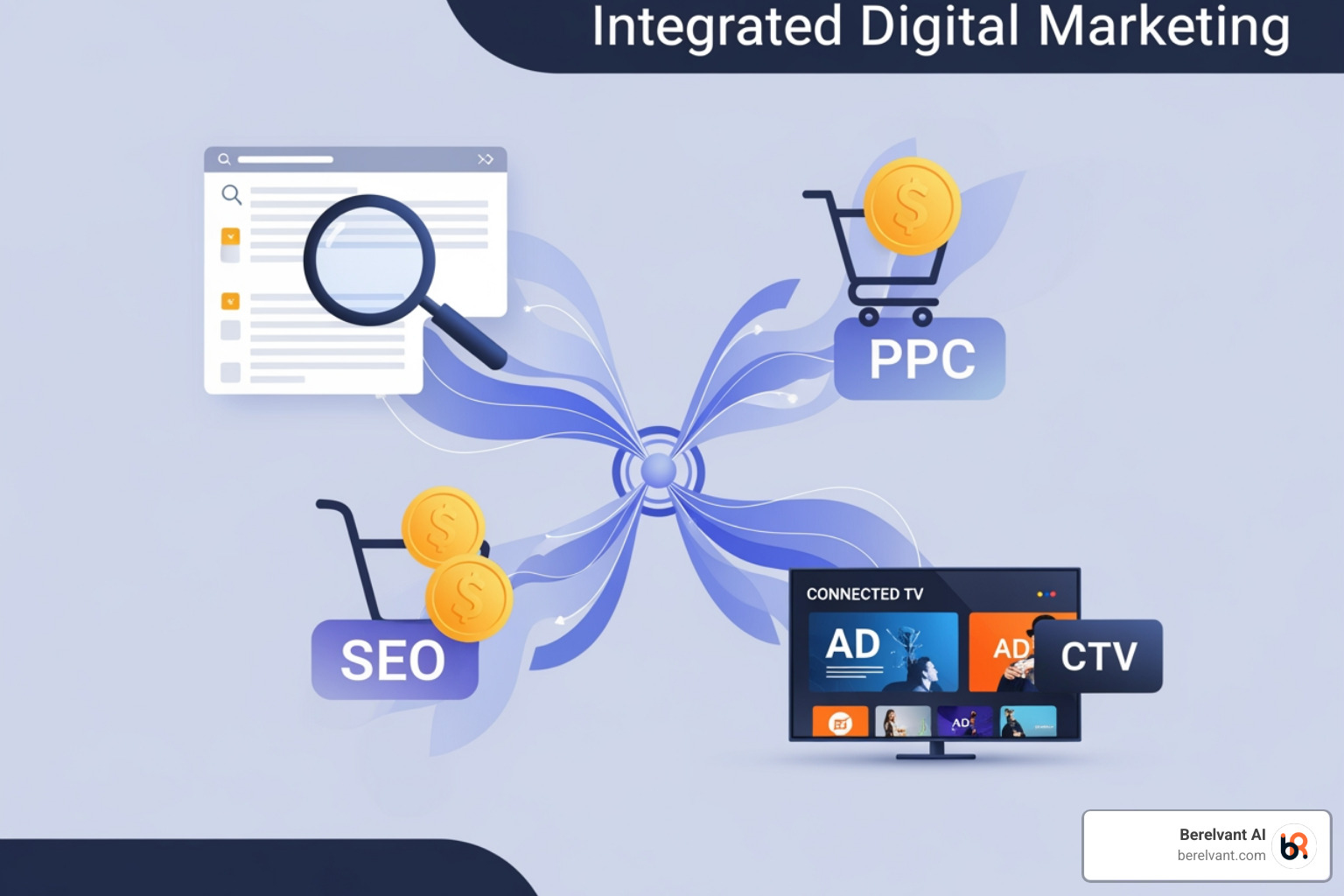
Siloed marketing channels are a luxury enterprise organizations can’t afford. When your acquisition strategy spans multiple countries, languages, and compliance environments, integration isn’t just beneficial—it’s operationally essential. The most effective ppc marketing firm doesn’t just manage paid campaigns in isolation; they architect systems where PPC, SEO, and Connected TV work as a unified revenue engine.
The synergy between PPC and SEO creates what we call SERP domination. Paid search delivers immediate visibility and captures high-intent demand while your organic presence builds. But the real value lies in the data exchange. High-performing PPC campaigns reveal exactly which keywords, messaging, and landing page structures convert qualified leads. We feed this intelligence directly into our SEO strategy, accelerating organic growth with proven conversion data rather than theoretical keyword research. This isn’t about running two separate programs—it’s about using paid insights to compress the timeline for organic authority.
When you control both paid and organic positions for your highest-value keywords, you fundamentally change the competitive dynamics in your market. Users see your brand twice on the same search result, building trust and capturing attention that competitors can’t match. For organizations operating across the Americas, this dual presence becomes even more critical in markets where brand recognition varies by region.
PPC data also informs CTV campaign strategy in ways that traditional media planning never could. The audience insights, demographic performance, and behavioral signals from your paid search and LinkedIn campaigns reveal precisely which segments convert at enterprise deal sizes. We use this intelligence to refine CTV targeting on streaming platforms, ensuring your brand reaches decision-makers in their living rooms with the same precision you expect from search campaigns. This creates a full-funnel retargeting system that moves prospects from initial awareness on Connected TV to high-intent search and conversion.
The customer journey rarely follows a linear path, especially in complex B2B environments or regulated industries. A CFO might see your CTV ad while streaming content, research your solution on LinkedIn the next day, and finally execute a branded search when they’re ready to evaluate vendors. Our integrated approach ensures consistent messaging and strategic retargeting across every touchpoint, nurturing prospects through each stage without operational friction or creative inconsistency.
For companies managing multilingual campaigns across markets from Connecticut to Latin America, this integration becomes even more powerful. The keyword data sharing between PPC and SEO ensures your organic content targets the same high-converting terms in Spanish and Portuguese that your paid campaigns have already validated. Your CTV creative reinforces the same value propositions that drive conversions in search, creating a cohesive brand experience regardless of where prospects encounter you.
This is the infrastructure advantage of working with an enterprise-grade partner. We don’t just run campaigns—we build acquisition systems where each channel amplifies the others, driving measurable revenue growth with operational efficiency that fragmented execution can never achieve. To explore how this integrated approach can transform your acquisition velocity, build your end-to-end acquisition system with a partner who understands system-level thinking.
Future-Proofing Your Strategy: Trends & Solutions for Common PPC Challenges
The digital advertising landscape shifts rapidly, and what worked eighteen months ago may already be obsolete. For enterprise organizations managing acquisition systems across the Americas, standing still means falling behind. The question isn’t whether to adapt—it’s whether your ppc marketing firm has the infrastructure and foresight to steer these changes without disrupting performance.
AI and automation have moved from experimental tools to operational requirements. We’ve integrated AI as the core speed and scale layer in our acquisition systems—not as a replacement for strategic thinking, but as the engine that accelerates delivery, eliminates bottlenecks, and multiplies campaign impact. From bid optimization that responds to market conditions in real-time to dynamic creative systems that personalize messaging across thousands of audience segments, automation enables the velocity that enterprise growth demands.
Performance Max campaigns represent Google’s push toward goal-based, fully automated advertising. While these campaigns offer significant reach and efficiency, they require careful integration into broader acquisition systems. We’ve found success by treating Performance Max as one component of a diversified strategy, ensuring it contributes to overall revenue goals rather than operating as a black box that obscures attribution and strategic control.
The rise of video and Connected TV advertising is reshaping how enterprise brands build awareness and fill their sales funnels. CTV offers cost-effective reach to engaged audiences, but only when integrated with performance data from search and social campaigns. We use insights from high-intent PPC activity to inform CTV targeting, creating a full-funnel experience that moves prospects from initial awareness on streaming platforms to high-intent search queries.
The cookieless future demands a fundamental shift in how we approach targeting and measurement. Privacy regulations and browser changes are eliminating traditional tracking mechanisms, but enterprise growth can’t wait for perfect solutions. We’re building privacy-centric strategies that rely on first-party data pipelines, advanced modeling, and contextual targeting to maintain campaign effectiveness without compromising user privacy or regulatory compliance.
These trends matter because they intersect with the persistent challenges that drain efficiency from PPC programs. Wasted ad spend remains the most common problem we encounter—some studies suggest that up to 70% of PPC budgets are inefficiently deployed. Our systems address this through rigorous negative keyword management, continuous audience refinement, and analytics that identify and eliminate underperforming segments before they compound losses.
Low conversion rates plague many PPC programs, with industry data showing that fewer than 25% of campaigns convert effectively. The issue typically isn’t traffic volume—it’s traffic quality and landing page execution. We solve this through advanced audience segmentation that targets users based on intent signals, paired with landing page systems optimized for conversion through continuous testing and message matching.
Scaling limitations become apparent when organizations attempt to expand into new markets or product lines. Many PPC programs are built for single-market execution and lack the infrastructure to scale across geographies, languages, and compliance environments. Our modular acquisition systems are designed for rapid expansion—whether that means launching campaigns across Latin America with multilingual creative or entering regulated industries that require specialized compliance protocols.
Inaccurate ROI measurement undermines strategic decision-making. When attribution models are fragmented or incomplete, marketing leaders can’t confidently allocate resources or justify budget increases. We’ve built comprehensive analytics architectures that tie ad spend directly to revenue outcomes, tracking the full customer journey across channels and providing VP and Director-level leaders with the visibility needed to optimize performance and defend investment decisions.
The organizations that thrive in this environment aren’t just reacting to changes—they’re building systems resilient enough to adapt as the landscape continues to evolve. That requires a ppc marketing firm that combines technical depth with operational speed, delivering enterprise-grade solutions without enterprise-level friction.
Conclusion
The right ppc marketing firm doesn’t just run campaigns—it becomes an extension of your growth infrastructure, operating with the technical precision and strategic vision that enterprise organizations require. For VPs and Directors navigating complex acquisition challenges across the Americas, this partnership determines whether you scale efficiently or struggle with fragmented execution and inconsistent results.
At Berelvant, we’ve built our entire operation around a single premise: enterprise growth demands integrated systems, not isolated tactics. Our expertise spans the full spectrum of what makes PPC work at scale—AI-powered automation systems that optimize in real-time, multilingual creative infrastructure that executes across markets without delays, and compliance-ready architecture that handles regulated industries with precision. We don’t treat these as separate services; they’re components of one unified acquisition engine designed to drive measurable revenue growth.
The challenges you face—multi-country execution, compliance friction, slow creative velocity, attribution complexity—aren’t problems you solve by hiring another vendor. They require a strategic growth partner who understands how to build systems that operate with speed, efficiency, and predictability across Fairfield County and every market you serve throughout the Americas.
We’ve managed over $300 million in ad spend because we approach every engagement with system-level thinking. Our clients don’t just get campaign management; they get operational infrastructure that scales with their ambitions. Whether you’re expanding into new markets, navigating regulatory constraints, or simply demanding better ROI from your acquisition spend, we’re designed to deliver.
Ready to move beyond fragmented tactics and build a true acquisition system? Let’s talk about how we can build your end-to-end acquisition system and transform your digital growth trajectory. The market won’t wait—and neither should you.