
Why Multilingual Creative Services Are Critical for Enterprise Growth
Multilingual creative services enterprise solutions are unified execution engines that combine creative localization, AI-driven automation, and in-market cultural expertise. They enable enterprises to launch high-velocity, compliant campaigns across multiple regions by integrating transcreation, visual adaptation, and regulatory oversight. This approach reduces time-to-market and drives measurable revenue growth in new markets.
Key Components of Enterprise Multilingual Creative Services:
- Creative Localization Engine – Transcreation, cultural adaptation, and multimodal content optimization.
- AI-Powered Workflow Automation – Centralized asset management, automated quality checks, and predictive analytics.
- Regulatory and Compliance Infrastructure – Built-in legal review, regional compliance tracking, and audit-ready documentation.
- Human-AI Synergy – Expert-in-the-loop validation for cultural nuance and strategic direction.
- Performance Measurement – Market-specific attribution, CPA tracking, and ROI reporting by region.
Global expansion demands more than translation. Locally targeted content generates six times more engagement, yet most enterprises struggle with fragmented workflows and inconsistent brand execution. This results in missed revenue and competitive disadvantage. The shift from reactive translation to a proactive creative infrastructure is a strategic requirement for organizations that need to scale faster than internal teams, maintain brand consistency, and prove the value of every creative dollar spent.
I’m Renzo Proano, founder of Berelvant. I’ve managed over $300 million in digital ad spend for enterprise brands, building multilingual creative services enterprise systems that integrate performance marketing, AI, and cross-market execution. This guide outlines the infrastructure and processes that enable global brands to scale creative operations without sacrificing quality, compliance, or speed.
Building a Scalable Multilingual Creative Engine
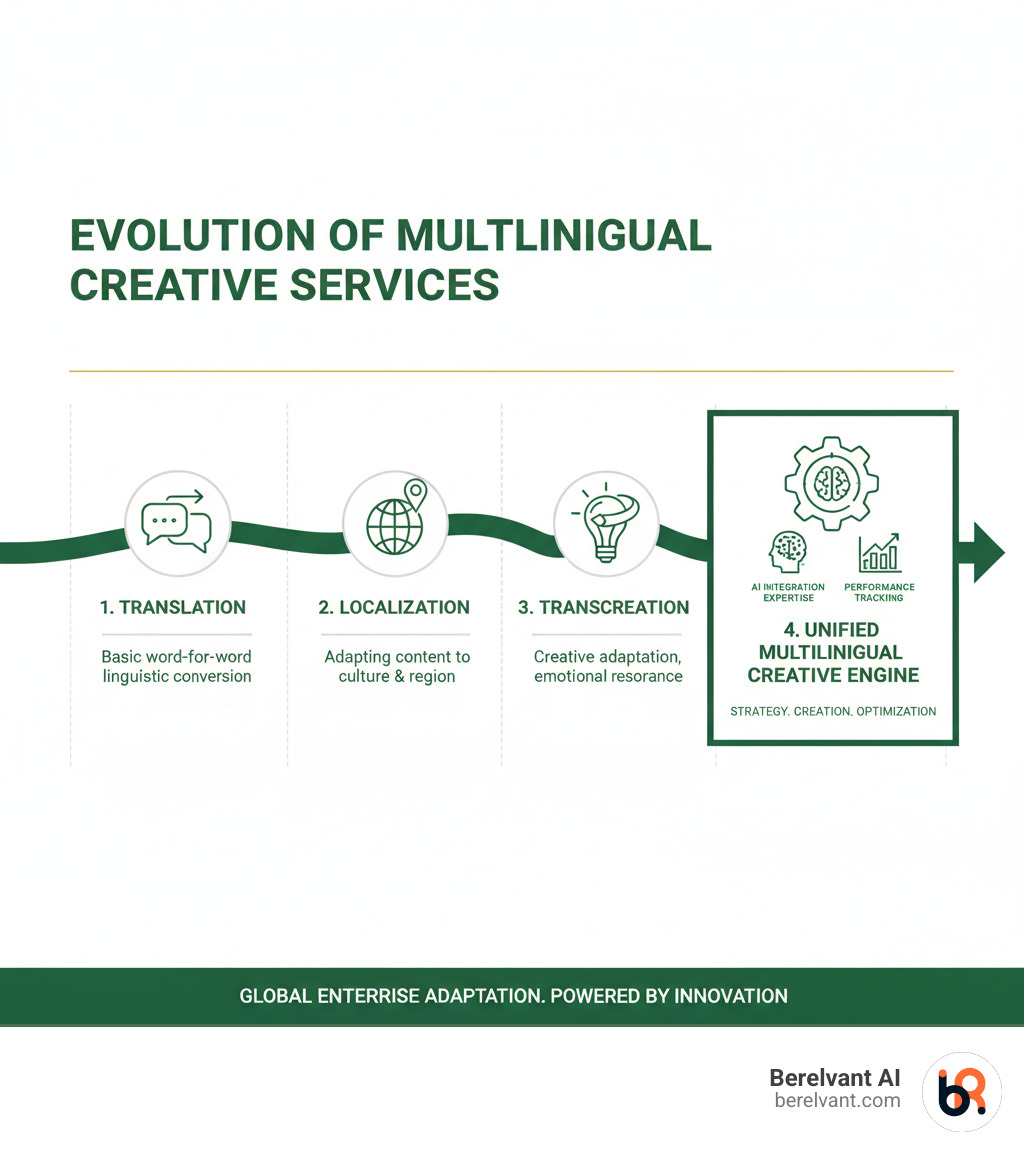
Enterprise global expansion challenges are not translation problems; they are creative infrastructure problems. Executing campaigns across Mexico City, São Paulo, and Miami simultaneously requires a multilingual creative services enterprise engine that adapts messaging to different cultural contexts at speed.
This is the difference between translation and transcreation. Translation preserves literal meaning, while transcreation rebuilds a message’s emotional and cultural impact for a new market. A slogan that works in Chicago might fail in Santiago because the underlying cultural references don’t connect.
A scalable engine requires three layers: cultural intelligence, technical infrastructure for asset centralization and workflow automation, and human expertise for strategic judgment. The technology stack—including translation management systems and digital asset management platforms—is the operational backbone that prevents teams from reinventing assets for every market. Workflow automation transforms this infrastructure into a competitive advantage by removing manual handoffs, allowing creative directors to focus on high-impact strategic decisions. Our AI Marketing Strategies page explores how we layer automation across the creative lifecycle.
Visual adaptation is as critical as linguistic precision, as imagery and design elements that perform well in one market can damage brand perception in another due to cultural misalignment.
Core Components of Effective Creative Localization
Enterprise-grade creative localization integrates six core capabilities. Cultural intelligence provides a deep understanding of how local values shape consumer behavior. In-market expertise from local marketers and copywriters brings that intelligence to life, catching nuances algorithms miss. Rigorous linguistic quality assurance (LQA) involves multiple native-speaker reviews to prevent errors. Brand voice stewardship maintains consistency through market-specific style guides. Multimodal content adaptation ensures every asset—from video to interactive content—delivers a quality experience. Finally, systematic process integration ties it all together with clear workflows and project management to handle complexity at scale.
Adapting Visual and Cultural Elements for Cross-Market Impact
Visual language varies as much as spoken language. Color theory is critical, as colors carry different cultural meanings; for example, white signifies purity in the West but mourning in some Asian cultures. Strategic imagery selection requires using people and settings that feel authentic to local audiences. Iconography must be vetted, as symbols like a thumbs-up can be offensive in some regions. User interface localization adapts layouts, formats, and text direction for a seamless native experience. Understanding local customs and taboos is paramount, where in-market experts prevent expensive missteps in humor or gestures.
You can watch an example of a global marketing campaign to see how brands adapt messaging across channels. Data-driven personalization amplifies this impact. With consumers expecting tailored content, we use analytics to apply audience insights to visual and cultural adaptation, driving stronger engagement and conversion.
The Role of AI in a Multilingual Creative Services Enterprise

AI is the operational backbone of modern multilingual creative services enterprise systems, acting as a speed and scale multiplier. The goal is not to replace humans but to build infrastructure that removes bottlenecks and enables teams to execute at a scale impossible to achieve manually. For enterprises, the challenge is deploying AI strategically without compromising brand integrity, data security, or cultural relevance.
Data security and IP protection are non-negotiable. Our approach uses secure, isolated AI environments where client data never trains public models, which is critical for regulated industries. The real power comes from seamless workflow integration, connecting AI capabilities directly into your core systems (CMS, DAM, etc.). This creates a continuous feedback loop for real-time optimization. For more on this, explore our AI Campaign Management insights.
How AI Improves Multilingual Content Creation and Localization
AI’s impact is measurable: faster turnarounds, fewer errors, and lower costs. AI-powered transcreation suggestions accelerate ideation by providing culturally analyzed starting points. Automated quality checks run continuously, flagging inconsistencies for human review. Predictive content performance analytics forecast creative effectiveness before launch, preventing spend on underperforming assets. Dynamic creative optimization tests and optimizes ad variations in real-time for each audience. Custom AI model training on your proprietary data creates highly accurate, brand-specific outputs in secure environments.
AI-driven features deliver key operational advantages:
- Automated keyword analysis for local search behavior.
- Content scoring for readability and emotional resonance.
- Tone adaptation to match cultural expectations.
- Image and video tagging for managing large localized asset libraries.
The Human-AI Synergy: Ensuring Quality and Cultural Relevance
The most effective multilingual creative services enterprise systems are partnerships between AI efficiency and human judgment. Our core principle is expert-in-the-loop validation, where human experts approve every AI output for cultural appropriateness, contextual accuracy, and brand alignment.
Creative direction and strategy remain entirely human, as they require a nuanced understanding of business objectives and market dynamics. Humans also provide oversight of nuance and idiom, handling the subtle humor and cultural references that AI misses. Strategic brand alignment is managed by brand stewards who ensure every asset reflects the brand’s core identity.
The division of labor is clear: AI handles efficiency, humans ensure authenticity. AI processes assets and manages workflows, while humans provide strategic direction, cultural intelligence, and final validation. This partnership allows teams to focus on high-value creative and strategic tasks, resulting in faster execution and higher-quality output.
Overcoming Enterprise-Scale Localization Challenges
Enterprise global expansion presents a complex maze of operational, brand, and regulatory requirements. Without a sophisticated strategy, localizing content at scale creates significant friction. A multilingual creative services enterprise must steer these challenges systematically to succeed in diverse markets like the Americas.
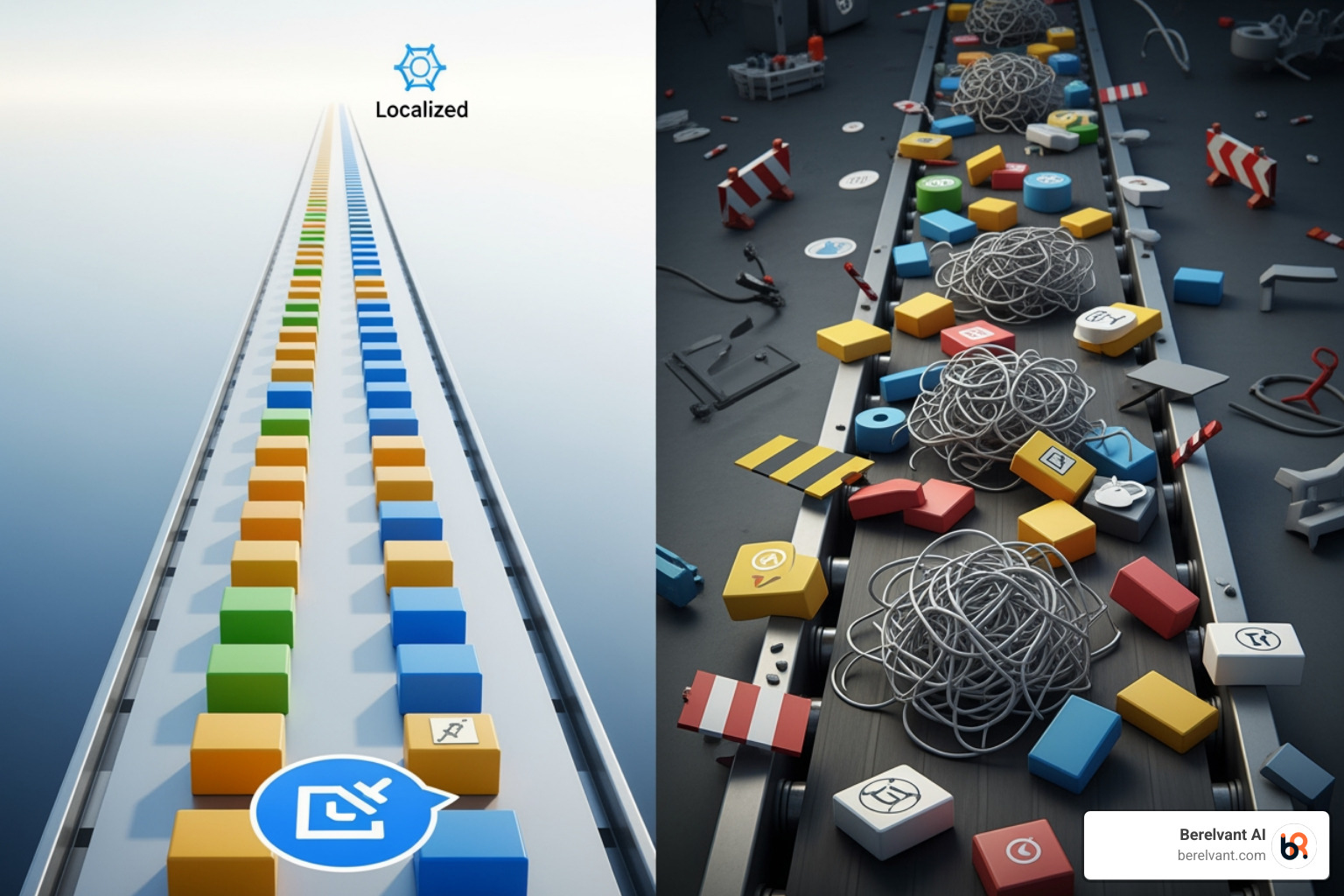
Common problems include operational bottlenecks from manual hand-offs and slow reviews; inconsistent brand messaging that dilutes brand equity; and a web of regulatory and compliance problems, especially in sectors like financial services. Additionally, managing distributed teams and meeting the constant demand for scalability and velocity requires a robust infrastructure where AI becomes a critical ally for speed and efficiency.
Best Practices for Maintaining Brand Consistency
Maintaining brand consistency is a non-negotiable cornerstone of global expansion. For a multilingual creative services enterprise, this requires proactive planning and systematic execution.
Success starts with centralized brand guidelines and dynamic style guides for each market, which adapt core principles for local creatives. Shared terminology databases (termbases) ensure key brand and product terms are used consistently. We use automated brand compliance checks to flag deviations, accelerating reviews. This is supported by strong cross-functional team alignment between global and regional departments and stakeholder enablement through training, empowering all teams to be effective brand stewards.
Primary Challenges for a Multilingual Creative Services Enterprise
Enterprises face amplified localization challenges due to their scale and complexity. A primary battle is managing high content velocity, localizing a massive volume of marketing, legal, and product content at speed without sacrificing quality. This leads to the challenge of ensuring quality at scale, which demands sophisticated workflows and technology.
Another hurdle is integrating with diverse enterprise tech stacks. Connecting localization platforms with existing CMS, CRM, and marketing automation systems is crucial for efficient data flow. Furthermore, budget tracking and allocation for multilingual initiatives require transparent reporting to attribute ROI accurately. Finally, navigating multi-country legal compliance across the Americas is a critical concern, requiring specialized legal review integrated directly into the localization workflow. This builds trust and ensures responsible operation in every market. Learn more on our About Us page.
Measuring ROI and Driving Revenue Growth
For any multilingual creative services enterprise, the goal is to drive tangible business outcomes. Measuring the Return on Investment (ROI) of multilingual creative is crucial for demonstrating value, optimizing strategy, and securing investment. Our approach connects every creative investment directly to measurable revenue growth.
The impact is clear: Content that is locally targeted has six times more engagement than messaging directed to a broader, global audience. This translates directly into higher conversion rates. Furthermore, studies show that 86% of localized advertising campaigns outperformed the English campaigns in both click-throughs and conversions. These statistics underscore the direct link between effective creative localization and superior market performance.
How to Measure the ROI of Your Multilingual Creative Investments
Measuring ROI requires a comprehensive set of Key Performance Indicators (KPIs) that reflect business impact:
- Market-Specific Conversion Rates: Track how localized assets convert visitors into customers in each target market.
- Customer Lifetime Value (CLV) by Region: Analyze the long-term value of customers acquired through localized campaigns.
- Brand Sentiment Analysis: Monitor brand perception in each market through social listening and surveys.
- Cost Per Acquisition (CPA) in New Markets: Compare the CPA of localized campaigns against generic campaigns to prove efficiency.
- Reduction in Localization Costs Over Time: Track cost decreases from AI, translation memory, and optimized workflows.
- Website Traffic and Engagement Metrics: Analyze metrics like bounce rates and time on page for localized content.
- Market Share Growth: Measure the increase in market share in regions with comprehensive multilingual services.
How Creative Localization Boosts Revenue and Accelerates AI Change
Creative localization is a strategic investment that fuels revenue and accelerates an enterprise’s AI adoption.
- Opening New Market Segments: Speaking to customers in their native language and cultural context opens previously untapped markets across the Americas.
- Increasing Global Market Share: High-quality localized content improves brand visibility and appeal, enabling enterprises to capture a larger share of international markets.
- Improving Customer Experience and Loyalty: Personalized, culturally relevant content creates a superior customer experience, increasing loyalty and reducing churn.
- Building Proprietary Data Assets for AI Model Training: Every localized campaign generates valuable data that becomes a proprietary asset for training and refining custom AI models.
- Creating Competitive Advantage Through Operational Efficiency: The integration of AI and human expertise leads to faster content production cycles and optimized resource allocation, allowing clients to outmaneuver competitors.
Frequently Asked Questions about Multilingual Creative Services
What is the difference between creative translation and transcreation?
Understanding this distinction is critical for a multilingual creative services enterprise to drive impact.
-
Creative Translation focuses on accuracy and style. It translates a message precisely, maintaining its original tone, and is ideal for technical or legal documents where literal meaning is paramount.
-
Transcreation is a creative process that re-imagines a message for a target culture. The goal is to evoke the same emotion and intent as the original, not just convert words. This is vital for marketing slogans and ad copy, ensuring the message feels native to the local audience and resonates deeply.
How do you ensure quality and consistency across dozens of languages?
We use a multi-layered, systematic approach that integrates technology with human expertise. Our foundation is a centralized technology platform (TMS and DAM) that acts as a single source of truth. We use Translation Memory (TM) and Terminology Bases (Termbases) to ensure linguistic consistency and correct use of brand terms, which also drives cost efficiency.
Dynamic style guides for each market and a rigorous multi-step Linguistic Quality Assurance (LQA) process ensure brand voice and cultural appropriateness. This process includes translation, editing, proofreading, and a final In-Country Review (ICR) by a native speaker in the target market. AI-powered quality checks provide an initial layer of review, allowing our human experts to focus on high-value cultural adaptation.
Can AI replace human creatives and linguists in a multilingual enterprise?
No. In a multilingual creative services enterprise, AI is a powerful augmentation tool, not a replacement. It acts as a speed and efficiency multiplier, handling high-volume, repetitive tasks like generating initial drafts and running automated quality checks. This accelerates production and allows creative output to scale.
However, human expertise remains indispensable for strategic and creative work. Humans provide the creative strategy, understand cultural nuance like humor and idioms, and ensure contextual understanding and ethical considerations. Every AI-generated output requires human oversight in an “expert-in-the-loop” model to ensure accuracy, cultural relevance, and brand alignment. AI provides the scale, but humans provide the strategy and soul.
Conclusion
Building a multilingual creative services enterprise system is about fundamentally rethinking how your organization connects with diverse markets. The companies that win are those that treat localization as core growth infrastructure, not a cost center.
Enterprises that integrate performance media, multilingual creative, and automation into a unified engine don’t just enter new markets—they dominate them. They move faster and build deeper customer relationships because their content doesn’t just translate; it resonates.
The future of global marketing is about speaking to each market in a way that feels native and authentic. This means adapting language, visuals, tone, and creative strategy, understanding that a campaign must be built for its specific audience to succeed.
At Berelvant, we build acquisition systems that solve these exact challenges for enterprises in regulated, compliance-heavy, and multi-country environments. Our approach uses AI as a speed and scale layer while keeping human expertise at the center of strategy and cultural nuance. We don’t just manage campaigns; we build systems that drive measurable revenue growth across borders.
If you’re ready to move beyond fragmented workflows and build a creative engine that scales with your ambitions, let’s talk. Develop your enterprise AI marketing strategies with us and turn global complexity into a competitive advantage.