
Why Most SEO Strategies Can’t Scale Across Markets
Customized SEO strategy is a performance marketing system that aligns search engine optimization with specific business objectives, market conditions, regulatory requirements, and operational constraints—rather than applying generic tactics that ignore the complexity of mid-market and enterprise environments.
Key Components of a Customized SEO Strategy:
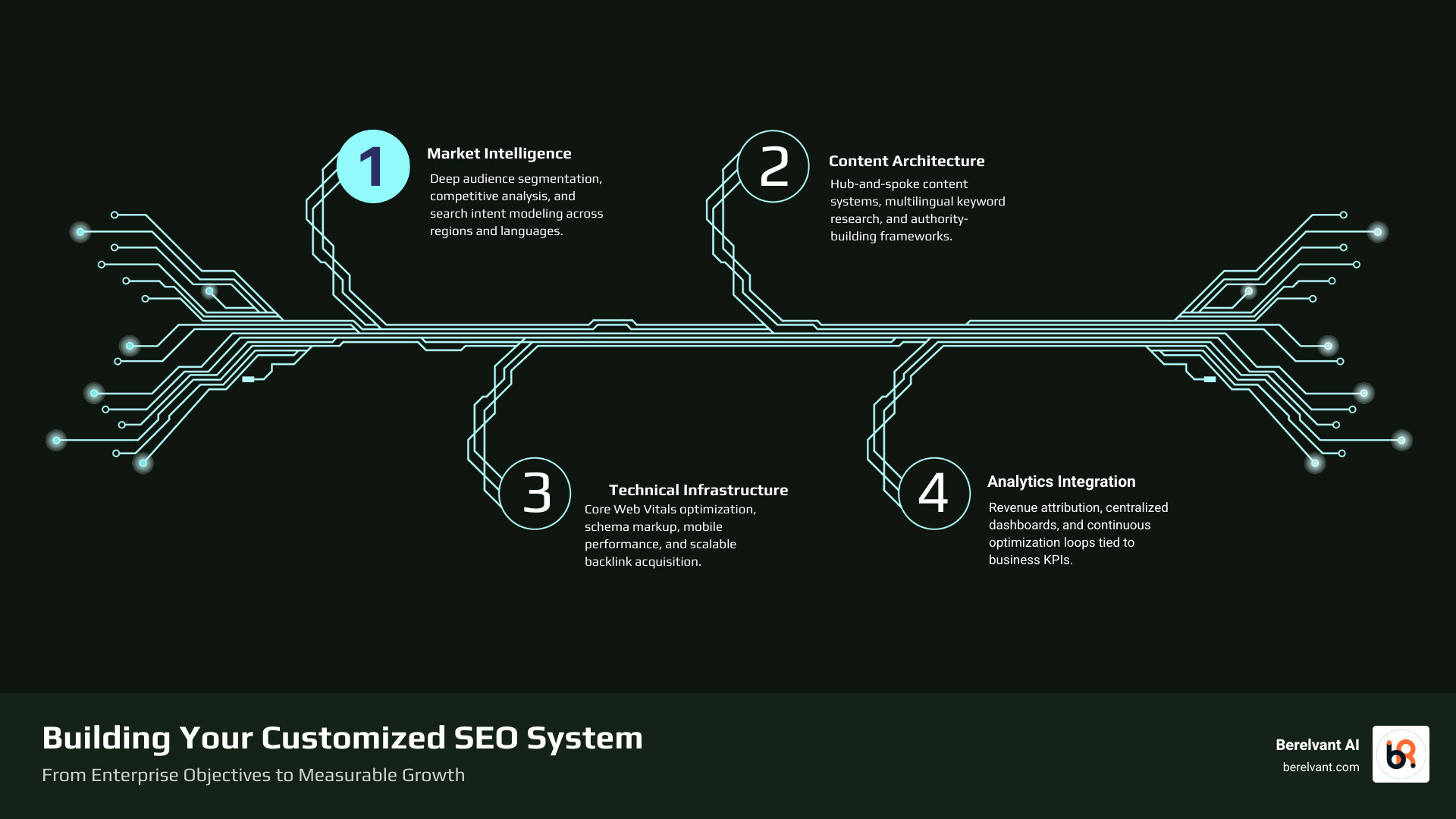
- Market Intelligence – Deep audience segmentation, competitive analysis, and search intent modeling across regions and languages
- Content Architecture – Hub-and-spoke content systems, multilingual keyword research, and authority-building frameworks
- Technical Infrastructure – Core Web Vitals optimization, schema markup, mobile performance, and backlink acquisition at scale
- Analytics Integration – Revenue attribution, centralized dashboards, and continuous optimization loops tied to business KPIs
Why Generic SEO Fails: 92% of all web pages never get traffic from Google, primarily because they lack backlinks and fail to address real search intent. In complex markets—regulated industries, multi-country operations, multicultural audiences—this problem compounds. One-size-fits-all strategies ignore compliance requirements, regional nuances, and the operational friction that slows execution.
The Outcome of a Customized Approach: A scalable SEO system that drives qualified traffic, reduces customer acquisition costs, and integrates with your broader performance marketing engine. This is not a checklist—it’s a unified growth infrastructure.
I’m Renzo Proano, founder of Berelvant AI, where I’ve managed over $300 million in digital ad spend and built Customized SEO strategy systems for brands across financial services, SaaS, GovTech, and e-commerce. My work focuses on creating AI-driven acquisition engines that integrate SEO, paid media, content automation, and analytics into one cohesive system that scales across markets and operates inside real compliance and operational constraints.
Similar topics to Customized SEO strategy:
Why Generic SEO Fails in Complex Markets
In the intricate landscape of enterprise operations, the notion that a single SEO playbook can serve all businesses is, quite frankly, a fallacy. If SEO were a one-size-fits-all game, our role as strategic growth partners would be obsolete. Websites, much like the enterprises they represent, possess unique histories, motivations, resources, and market contexts. Applying generic SEO practices to a complex organization operating in regulated industries or across multicultural audiences is akin to prescribing the same medicine for every ailment—it simply won’t yield the desired results.
The digital field is unforgiving: 75% of users never scroll past the first page of search results. For enterprise-level organizations, this isn’t just a statistic; it’s a stark reality. Failing to appear prominently means ceding market share and sacrificing potential revenue. Yet, many organizations fall into the trap of rehashing vague statistics and applying generalized benchmarks that are irrelevant to their specific challenges. As our research indicates, different types of queries have different SERPS, meaning the search engine results page layout and features can vary wildly depending on the user’s intent and query type. A generic approach often overlooks these critical nuances.
Consider the inherent complexity:
- Multicultural Audiences: A global enterprise cannot afford to treat diverse linguistic and cultural groups with a single content strategy. What resonates in Westport, CT, may not be effective in Fairfield, CT, let alone across different regions of the Americas. Generic SEO often fails to account for these vital cultural and linguistic distinctions, leading to missed opportunities and ineffective communication.
- Regulated Industries: For businesses operating in compliance-heavy environments, such as financial services or healthcare, SEO isn’t just about ranking; it’s about ranking responsibly. Generic strategies rarely incorporate the stringent legal and ethical guidelines that govern these sectors, potentially exposing organizations to significant risks. Our expertise in navigating these complex challenges for clients in regulated industries (such as those in Connecticut) is precisely why a Customized SEO strategy becomes indispensable.
- Multi-Country Operations: Expanding across the Americas, for example, demands more than simple content translation. It requires localized SEO that respects regional search behaviors, local competitors, and market-specific regulations. A generic approach would inevitably lead to inefficiencies and a fragmented brand presence.
The cost of these missed opportunities and competitive disadvantages is substantial. Enterprises face unique operational friction, often struggling with siloed departments and a lack of executive buy-in for SEO initiatives. A generic strategy, detached from core business objectives, only perpetuates this disconnect. It’s why we champion a unique approach to AI Marketing Strategies that transcends tactical checklists, embedding SEO within a holistic, AI-driven acquisition system designed for enterprise scale.
The 4-Step Framework for Building a Scalable SEO System
To truly harness the power of organic search for enterprise growth, we must move beyond a campaign mindset and accept a systems-thinking approach. Our goal is to build a repeatable and scalable engine for organic growth—a unified acquisition infrastructure that consistently delivers measurable results. This is precisely what a Customized SEO strategy achieves.
This framework isn’t just a process; it’s a strategic blueprint designed to integrate SEO deeply into your operational DNA, changing it from a mere marketing tactic into a core driver of long-term business value.
Step 1: Establish Market Intelligence & Define Performance Goals
For an enterprise, understanding your target audience goes far beyond basic demographic personas. We’re talking about deep psychographic analysis, mapping the entire customer journey across multiple, often complex, touchpoints. This involves identifying who your customers are, what they are searching for online, and, critically, their pain points and preferences. Utilizing advanced audience research tools and techniques allows us to segment your audience at a granular level, revealing the contextual needs that generic approaches overlook.
Our approach to understanding of your target audience extends to analyzing search behaviors, preferences, and pain points to inform every aspect of our strategy. For clients in Connecticut, this means understanding the local nuances of search intent, whether they’re searching for financial services in Westport, CT, or specialized tech solutions in Fairfield, CT.
Defining performance goals isn’t about vanity metrics like keyword rankings alone; it’s about setting measurable KPIs directly tied to revenue attribution and market share growth. We focus on business outcomes, such as increasing qualified leads, driving revenue, or improving customer acquisition costs (CAC). We track directional trends and leading indicators like brand search volume and direct traffic increases, rather than chasing perfect attribution in a world where AI tools don’t always pass referral data. This includes:
- Lead Generation Goals: For B2B enterprises, this might mean achieving a specific number of qualified demo requests from bottom-funnel keywords.
- Revenue Goals: For e-commerce, it could be a targeted percentage increase in organic revenue from product pages.
- Market Share Growth: For competitive industries, it involves expanding organic visibility within specific product categories.
Crucially, in regulated industries, we factor in compliance and legal considerations from the outset. This ensures that every piece of content, every keyword targeted, and every technical implementation adheres to industry standards. This level of strategic planning and operational integration is where our Marketing Operations Consulting truly makes a difference, aligning SEO with your broader operational excellence.
Step 2: Architect Your Keyword & Content Ecosystem
With a clear understanding of your market and objectives, the next step is to architect a robust keyword and content ecosystem. This is the backbone of your Customized SEO strategy. Keyword research isn’t a one-time task; it’s an ongoing, multilingual endeavor that informs content development and website optimization. We focus on identifying high-volume, low-competition keywords, including critical long-tail keywords that often have higher conversion rates. For multicultural audiences, this means performing dedicated keyword research in each target language, ensuring we capture nuanced search intent.
Our approach to content architecture involves:
- Search Intent Modeling: We decode what users truly want at each stage of their buying cycle, from initial awareness to final conversion. This involves analyzing the first page of Google results for dominant content formats, depth, and SERP features, revealing what users prefer and what search engines reward.
- Authority Pillars with a Hub-and-Spoke Model: We build foundational “hub” pages that target high-volume, commercial intent keywords. These are supported by “spoke” pages (often blog content, technical papers, or case studies) that dig deeper into related topics, all interlinking to create a powerful network of authority. This model is particularly effective for enterprises with complex product lines or extensive services.
- Competitive Gap Analysis at Scale: We rigorously analyze competitor top-performing pages and keyword portfolios to identify underserved niches and content opportunities. This helps us create content that offers “information gain”—original research, unique frameworks, custom visuals, or advanced tactics that competitors miss.
- Content Diversification: To broaden reach and appeal to various audience preferences, we produce content in multiple formats. This includes in-depth guides, videos, webinars, infographics, and interactive tools. Content diversification not only increases engagement but also significantly improves backlink earning potential, strengthening your brand authority.

This rigorous approach ensures that every piece of content developed for our clients in Connecticut, whether for a local service or a global SaaS product, is strategically aligned and optimized for maximum impact.
Step 3: Engineer the Technical & Creative Infrastructure
The technical foundation of your website is paramount for enterprise SEO. It ensures that search engines can efficiently crawl, index, and render your content, while providing a flawless user experience. Our focus is on engineering a robust and scalable technical and creative infrastructure that meets the stringent demands of modern search.
Key elements of this infrastructure include:
- Core Web Vitals Optimization: Google’s emphasis on user experience is reflected in its Core Web Vitals metrics. We optimize for loading performance (Largest Contentful Paint – LCP), interactivity (First Input Delay – FID), and visual stability (Cumulative Layout Shift – CLS) to ensure your site delivers an exceptional experience, especially across mobile devices.
- Mobile Performance at Scale: With over 60% of searches conducted on mobile devices, and 53% of mobile users abandoning sites that take longer than three seconds to load, mobile-first indexing and performance are non-negotiable. We leverage tools like Google’s Lighthouse testing tool to identify and rectify performance bottlenecks, ensuring your site is blazing fast and responsive on any device.
- Advanced Schema Markup: For enterprises, advanced schema markup is critical. This structured data helps search engines understand the context of your content, leading to richer search results (rich snippets) for products, services, events, or FAQs. This is particularly vital for organizations with complex offerings, ensuring their unique entities are clearly communicated to search engines.
- Scalable Backlink Profile: Backlinks remain a key signal of authority. 92% of all web pages will never get traffic from Google, primarily because they lack backlinks. Our strategy focuses on acquiring high-quality backlinks from reputable, industry-relevant websites. This isn’t about volume; it’s about strategic acquisition that builds genuine domain authority and trust signals.
- Multilingual Creative Services Integration: For multi-country operations, integrating Multilingual Creative Services for Enterprise is essential. This ensures that not only is content localized, but the entire creative execution—from ad copy to landing page design—is culturally resonant and optimized for each target market, avoiding generic translations that fall flat.
This comprehensive engineering approach ensures that your web presence in Connecticut and beyond is technically sound, creatively impactful, and optimized for global reach.
Step 4: Implement a Unified Analytics & Optimization Loop
A Customized SEO strategy is not a set-it-and-forget-it endeavor. It requires a continuous, data-driven optimization loop. For enterprises, this means integrating analytics seamlessly into your operational framework, allowing for real-time insights and strategic adjustments.
Our approach to analytics involves:
- Centralized Dashboards & API Integration: We move beyond siloed data sources. By integrating tools like Google Search Console with your broader analytics platforms and CRMs via API, we create centralized dashboards. These dashboards provide a holistic view of performance, allowing us to track organic traffic, keyword rankings, conversion rates, and, most importantly, revenue attribution.
- Tracking Performance Against Revenue Goals: The ultimate measure of SEO success for an enterprise is its impact on the bottom line. We establish clear KPIs tied directly to business outcomes, such as qualified leads generated, sales conversions, and ROI. Our reporting focuses on translating SEO data into actionable business impact for leadership, ensuring that the value of organic search is clearly understood and continually demonstrated.
- Implementing A/B Testing Frameworks: To drive continuous improvement, we integrate robust A/B testing frameworks. This allows us to systematically test different content approaches, technical optimizations, and user experience elements, iterating based on empirical data to maximize performance.
- Translating SEO Data into Business Impact: Our expertise lies not just in collecting data, but in interpreting it within the context of your overall business objectives. A dip in organic traffic, for instance, might signal algorithm changes or technical issues. We identify these, propose solutions, and forecast their impact on your revenue goals, ensuring that every adjustment is strategic and purposeful.
This continuous optimization loop, fueled by precise data and strategic analysis, is critical for refining your Customized SEO strategy and ensuring it remains aligned with evolving market dynamics and business priorities. To understand how this integrated approach can benefit your enterprise, we invite you to Get a Free Digital Marketing Analysis.
The Role of AI in Your Customized SEO Strategy
In today’s rapidly evolving digital landscape, AI is not just a buzzword; it’s the speed and scale layer that accelerates delivery, removes bottlenecks, and multiplies the impact of every campaign within a Customized SEO strategy. For enterprise-level organizations, AI is an indispensable tool for navigating complexity and achieving competitive advantage.
Here’s how we leverage AI within our customized SEO framework:
- AI for Predictive Analytics: AI excels at identifying patterns and predicting emerging search trends. This allows us to proactively adjust strategies, uncover less obvious keywords, and understand the nuanced context of search terms even before they become mainstream. This foresight is invaluable for maintaining a competitive edge in dynamic markets.
- Automating Content Gap Analysis and Opportunity Sizing: Manually identifying content gaps across vast enterprise websites and competitive landscapes is a colossal task. AI automates this by quickly analyzing your existing content, comparing it to competitors, and highlighting underserved niches or topics with high potential. This enables us to rapidly identify and prioritize content opportunities that align with your business objectives.
- Using Generative AI Marketing for Content Briefing and Localization at Scale: AI-powered tools can generate comprehensive content outlines, suggest optimal structures, and even draft initial content pieces. Crucially, for multilingual and multicultural audiences, AI assists in localizing content at scale, ensuring cultural relevance while maintaining brand voice. However, we always maintain human oversight, as AI cannot fully grasp nuances, context, and emotion. Our creative teams in Connecticut ensure that AI-generated content is refined, authentic, and infused with human expertise.
- AI-Powered Technical Monitoring and Anomaly Detection: AI tools can continuously assess a website’s technical health at scale, identifying issues like site speed degradation, mobile responsiveness problems, or structured data errors that might be missed by human auditors. This allows for proactive intervention, preventing potential ranking drops and ensuring a seamless user experience.
AI reshapes SEO by automating complex tasks and enabling faster adaptation to algorithm changes, which is critical in an era where AI Overviews and the rise of Large Language Models (LLMs) are fundamentally changing how people search. Our AI Digital Marketing Agency Ultimate Guide digs deeper into how we integrate these powerful capabilities.
Common Pitfalls in Enterprise SEO Implementation
Even with the best intentions, enterprise SEO implementations can stumble. Understanding these common pitfalls is crucial for avoiding costly mistakes and ensuring your Customized SEO strategy delivers its full potential.
- Siloed Departments and a Lack of Executive Buy-in: In large organizations, marketing, IT, product, and sales teams often operate in isolation. Without a unified vision and executive championship, SEO initiatives can lack the cross-functional support needed for successful implementation. SEO requires buy-in from various departments to secure resources for technical fixes, content creation, and strategic alignment.
- Chasing Algorithm Changes Instead of Focusing on User Experience: The biggest mistake SEOs make, particularly at the enterprise level, is optimizing for metrics that don’t directly translate to business value. Constantly reacting to every Google algorithm update without a foundational focus on delivering exceptional user experience (UX) is a recipe for short-term gains and long-term instability. Google’s algorithms increasingly prioritize user satisfaction, site speed, mobile-friendliness, and high-quality, relevant content that addresses user needs.
- Underestimating the Resources for High-Quality Content and Technical Execution: Creating authoritative, in-depth content that truly stands out in competitive enterprise markets demands significant investment. Similarly, implementing complex technical SEO fixes and maintaining a robust infrastructure requires dedicated resources and expertise. Underestimating these needs leads to subpar execution, hindering scalability and impact.
- Neglecting Local and Multilingual Nuances: For enterprises with a physical presence in places like Westport, CT, or Fairfield, CT, or those expanding across diverse linguistic markets, neglecting local and multilingual SEO is a critical oversight. Approximately 46% of all searches are local, highlighting the importance of optimizing for location-specific queries and maintaining accurate Google Business Profiles. For multicultural audiences, simple translation is insufficient; cultural adaptation and localized content are paramount.
- Choosing Vanity Metrics Over Revenue-Focused KPIs: Focusing on metrics like total keyword rankings or domain authority scores, rather than on qualified traffic, conversions, and ROI, can mislead stakeholders and misallocate resources. A Customized SEO strategy must directly tie SEO efforts to business outcomes, demonstrating tangible value to the organization.
Avoiding these pitfalls requires a holistic, systems-thinking approach, strategic alignment across all levels of the organization, and a commitment to continuous optimization.
Conclusion: Building Your Long-Term Growth Engine
We’ve explored how a Customized SEO strategy transcends generic tactics, changing SEO into a powerful, integrated growth engine for enterprise-level organizations. It is no longer optional; it’s a necessity for thriving in today’s complex digital environment, particularly in regulated industries, multi-country operations, and multicultural markets.
By building a unified acquisition system that encompasses deep market intelligence, strategic content architecture, robust technical infrastructure, and a continuous analytics and optimization loop, you open up a sustainable competitive advantage. This isn’t about chasing rankings; it’s about achieving long-term business growth, increasing market share, and driving measurable revenue.
At Berelvant AI, we specialize in building and managing these end-to-end acquisition systems. Our expertise in integrating performance media, multilingual creative, automation, and analytics into one unified engine means we solve complex challenges for our clients in Connecticut and across the Americas. AI serves as our speed and scale layer, accelerating delivery, removing bottlenecks, and multiplying the impact of every campaign.
If your enterprise is ready to move beyond generic SEO and build a truly customized, AI-driven growth engine that aligns with your unique business objectives, we’re here to partner with you. Let us help you Build your unified acquisition system with us.