Why Higher Conversion Rates Are the Most Efficient Growth Lever for Enterprise Organizations
Higher conversion rates are the most efficient path to revenue growth without increasing acquisition spend. For enterprise leaders, conversion rate optimization (CRO) is a systematic discipline that compounds over time, not a one-time project.
Quick Answer: How to Achieve Higher Conversion Rates
To achieve higher conversion rates, enterprise teams must optimize value propositions, simplify conversion paths, build trust with social proof, test systematically, improve site speed, personalize user journeys, recover lost revenue, ensure mobile optimization, and continuously measure and iterate.
The data is clear: top performers in e-commerce and B2B achieve conversion rates 2-5x higher than the average. This isn’t luck; it’s superior system design. A mere 1% lift in conversion rate can translate to millions in incremental revenue. For an enterprise driving 100,000 monthly visits at a $200 AOV, moving from a 2% to 3% conversion rate adds $200,000 in monthly revenue—with zero additional acquisition spend.
Achieving this at scale requires end-to-end system architecture, including analytics, creative testing infrastructure, and multilingual execution. Many enterprise teams are hindered by fragmented tools, slow creative velocity, and inconsistent attribution, preventing them from iterating fast enough to lead the market.
This guide provides a strategic framework for VP and Director-level leaders, focusing on the systems and practices that drive scalable conversion growth in complex organizations.
I’m Renzo Proano, founder of Berelvant AI. Having managed over $300 million in digital ad spend for brands like Microsoft, StoneX, and FOREX.com, I’ve built the performance marketing systems that help enterprises achieve higher conversion rates. This article synthesizes data-backed strategies from that experience.
Must-know Higher conversion rates terms:
Deconstructing Conversion Rate: The Core Metrics for Enterprise Growth
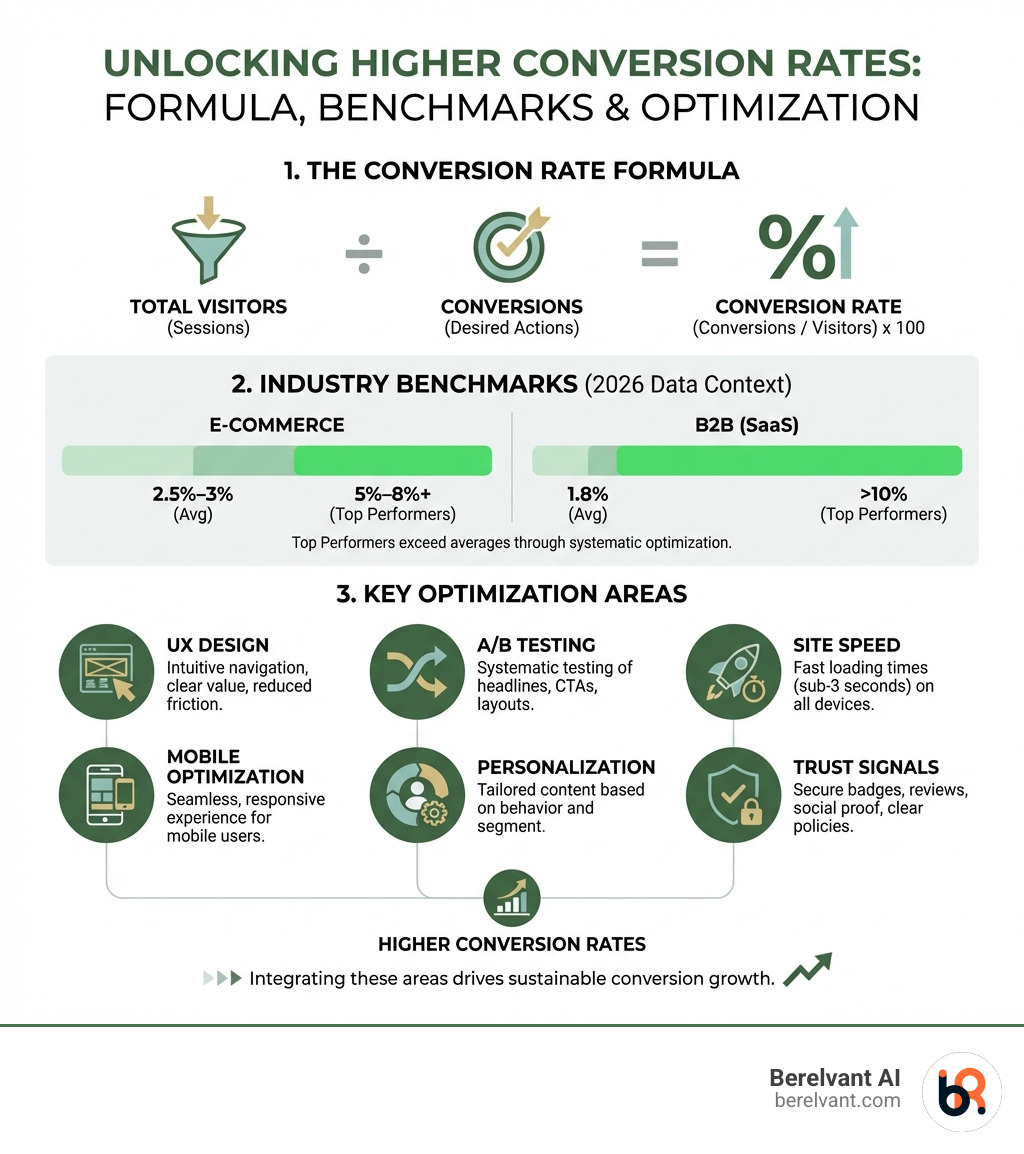
For enterprise organizations, higher conversion rates represent the efficiency of the entire acquisition system. We view conversion rate as a critical KPI that directly impacts ROI and signals the health of our sales funnel architecture. The calculation is (Total Conversions ÷ Total Visitors) × 100, but defining a “conversion” in an enterprise can range from a macro event like a signed contract to a micro-conversion like a whitepaper download.
Understanding the Conversion Funnel as a System
Our enterprise sales funnel is a dynamic system designed to nurture leads through distinct stages, each requiring specific strategies to achieve higher conversion rates.
- ToFu (Awareness): Attract a broad audience with value-driven content. Micro conversions include newsletter signups or content downloads.
- MoFu (Consideration): Prospects are actively researching. We provide case studies and detailed information. Micro conversions include webinar registrations or free trials.
- BoFu (Decision): This is where primary macro conversions occur. We focus on removing friction and providing compelling reasons to choose our solution.
Mapping the customer journey across multi-market operations is crucial. We use advanced analytics, scroll depth, and heat maps to identify drop-off points and friction. By benchmarking our funnel’s performance against industry standards, we can pinpoint inefficiencies and build scalable acquisition systems that perform across diverse audiences and regulatory environments.
What is a Good Conversion Rate for Your Industry?
What constitutes a “good” conversion rate varies by industry, audience, and traffic source. Understanding these benchmarks is essential for setting realistic goals.
- E-commerce: Averages 2.5-3%, with top performers reaching 5-8% or higher.
- SaaS: The average visitor-to-lead rate is 1.8%. For free account signups, the benchmark is 2–5%, with top brands exceeding 10%.
- Finance: Averages around 3.1%, reflecting higher user intent.
- Travel: Averages 2.4%. Landing pages in this sector average 4.8%.
- Healthcare / Wellness: Healthcare landing pages have a median rate of 5.1%, while wellness subcategories can reach 8.2% or higher.
While external benchmarks are useful, we emphasize internal benchmarking. Our focus is on establishing a baseline for our own digital assets and continuously improving it. This data-driven approach, combined with our Berelvant AI data on landing page conversion rates by industry, allows us to identify opportunities for significant performance uplifts.
Architecting a High-Trust User Experience Across Markets
In the enterprise space, a high-trust User Experience (UX) and User Interface (UI) are paramount, especially across diverse markets. We architect design systems that ensure operational consistency, address customer objections, and build trust at scale, which leads to higher conversion rates. A well-designed site is crucial for conversions. You can find More info about High Converting Websites on our blog.
How UX and UI Drive Conversions
The impact of UX/UI on conversions is immediate; we have 50 milliseconds to make a good first impression. An amateur-looking site kills trust.
- Navigation & Hierarchy: Clear navigation and visual hierarchy are key for large-scale sites. We guide users to what matters most, avoiding the “Paradox of Choice” by building better filters and clear paths.
- Brand & Device Consistency: Maintaining brand consistency across regions reinforces reliability. With over 60% of traffic from mobile, a seamless, responsive design across all devices is a baseline requirement, especially for multi-market operations.
Clarity trumps persuasion. As Paul Graham said, “imagine you’re explaining your product to your close friend.” We rephrase marketing jargon into clear, conversational language to drive higher conversion rates.
Building Trust and Overcoming Objections
For enterprise clients, trust is a prerequisite for conversion. We proactively address objections and build credibility through various signals.
- Security & Guarantees: We prominently display security badges, privacy policies, and payment assurances. Strong guarantees, like Hyundai’s 10-year warranty, reduce perceived risk and build confidence.
- Transparency & Compliance: In regulated industries, transparent pricing is key. We explicitly communicate our commitment to data privacy and regulatory compliance, a core strength for Berelvant AI across the Americas.
Key Trust Signals for Enterprise Platforms:
- Professional, up-to-date design
- Clear contact information
- Security badges and privacy policies
- Testimonials, case studies, and reviews
- Industry awards and certifications
- Guarantees and clear refund policies
- Transparent pricing and terms
Simplifying the Path to Purchase
A complicated process kills conversions; 27% of users abandon long forms. We relentlessly simplify the buying process.
- Reduce Friction: Forcing account creation is a major barrier. We offer guest checkout, inspired by the “300 million dollar button” case study. We also minimize form fields, using multi-step forms with progress indicators for longer processes.
- Accelerate Payments: One-click payment options like Shop Pay, Amazon Pay, and Google Pay dramatically increase lower-funnel conversion rates. Mobile shoppers using Shop Pay, for example, have a 1.91x higher checkout-to-order rate.
- Provide Information: We avoid decision fatigue by organizing information clearly, preventing the loss of up to 50% of potential sales due to inadequate information. We’ve seen the positive Impact of checkout optimization on enterprise revenue through these methods.
Strategic Levers for Achieving Higher Conversion Rates
Beyond UX, strategic levers are essential for driving higher conversion rates in enterprise environments. These include crafting a powerful value proposition, leveraging social proof, and deploying incentives. We explore More info about Unique Ways to Increase Sales using these strategies.
Crafting a Compelling Value Proposition
A compelling value proposition is the most important conversion factor. It must clearly answer “What’s in it for me?” and “Why buy from us?”
- USP for Enterprise: We articulate what makes our solutions uniquely superior, focusing on tangible business outcomes and competitive advantages.
- Benefit-Driven Messaging: Our messaging emphasizes benefits over features, addressing the pain points of enterprise decision-makers.
- Above-the-Fold Clarity: The core value proposition must be immediately visible. Five times as many people read the headline as the body copy, so headlines must be impactful.
- A/B Testing & Clarity: We continuously test headlines on high-traffic pages. We also eliminate technical jargon, adopting Paul Graham’s advice to rephrase anything we wouldn’t say to a friend.
The Power of Social Proof and Testimonials
Social proof is a potent psychological trigger, especially in the risk-averse enterprise sector. It shows that peers have found success with our solutions.
- Reviews & Case Studies: Customer reviews can increase conversions by 270%. For enterprise buyers, detailed case studies with measurable results (ROI, efficiency gains) are invaluable proof points.
- Endorsements & Badges: We prominently feature industry awards, certifications, and mentions in reputable publications. In regulated sectors, compliance certifications serve as powerful trust signals. Our Berelvant AI research on reviews and conversion impact underscores their importance.
Using Incentives and Urgency to Drive Action
Once trust is established, strategic incentives and genuine urgency can prompt immediate action, driving higher conversion rates.
- Time-Sensitive Offers: Limited-time enterprise offers, tied to business cycles, encourage prompt decisions.
- Authentic Scarcity: For high-value products with limited availability (e.g., implementation slots), authentic scarcity is a powerful motivator. Artificial scarcity can backfire.
- Value-Adds & Discounts: For e-commerce, free shipping is critical. For enterprise, this translates to value-added services or complimentary consultations. Custom discount codes for first-time clients can also significantly boost conversion.
- Exit-Intent Strategies: When a visitor is about to leave, an exit-intent pop-up offering a resource or consultation can re-engage them. Our Data on incentives as conversion drivers validates these tactics.
The Technical & Analytical Engine for Scalable Optimization
Achieving higher conversion rates at the enterprise level requires a robust technical and analytical engine. This involves continuous A/B testing, optimizing for speed and mobile, designing effective Calls to Action (CTAs), and leveraging personalization. This systematic approach is accelerated by AI, which you can learn more about in our More info about Generative AI Marketing article.
A/B Testing: Your Engine for Continuous Improvement
A/B testing is a core discipline for continuous improvement. At enterprise scale, it allows us to systematically validate hypotheses and refine digital assets for maximum impact.
- Process: We start with clear hypotheses from data (analytics, heatmaps), run tests to statistical significance using enterprise-grade tools like Optimizely, and sometimes use multivariate testing for complex funnels.
- High-Impact Elements to Test First in Enterprise Environments:
- Value Proposition & Headlines
- Calls to Action (CTAs)
- Forms: Number of fields, layout, and submission experience.
- Visuals: Hero images, product videos, and trust badges.
- Page Layout & Information Hierarchy
- Pricing & Offer Structure
Optimizing for Speed and Mobile to Achieve Higher Conversion Rates
Speed and mobile responsiveness are non-negotiable foundations for higher conversion rates. A one-second delay in page load can cause a 7% drop in conversions, and for every second of load time, conversions drop by 12%. We use tools like GTMetrix and Google PageSpeed Insights to monitor and optimize load times, focusing on Core Web Vitals.
With over 60% of e-commerce traffic from mobile, a mobile-first design is critical. Our sites must be fast and easy to steer on smaller screens. We ensure responsive layouts and compress all images to boost site speed. We regularly use Google’s mobile-friendly compatibility test to validate our mobile experience.
Designing Effective CTAs and Personalizing Journeys
CTAs are the gateway to conversion, while personalization makes the journey relevant. Our CTAs are clear, action-oriented (e.g., “Request a Demo”), and visually prominent through color contrast and strategic placement. Personalized CTAs are 202% more likely to convert. We leverage AI to deliver dynamic content based on user data, tailoring journeys for different segments and driving higher conversion rates.
Recovering Revenue with Automation
Even with optimized funnels, some prospects slip away. We use robust automation to recover this lost revenue.
- Abandoned Cart and Quote Follow-up Automation: Over two-thirds of shoppers abandon carts. We deploy automated email sequences to remind them, address objections, or offer incentives. This applies to B2B quote requests as well.
- Retargeting Campaigns for Enterprise Buyers: We use retargeting ads to re-engage visitors who didn’t convert. Post-purchase, we use automation for cross-sell and upsell opportunities, maximizing customer lifetime value. Our More info about Remarketing Campaign Setup outlines how we execute these campaigns effectively.
Frequently Asked Questions about Conversion Rate Optimization
Should my enterprise focus on increasing traffic or achieving higher conversion rates first?
Focus on achieving higher conversion rates first. Pouring more traffic into a “leaky bucket” (a low-converting website) is inefficient and inflates Customer Acquisition Cost (CAC). First, fix the leaks. Once your conversion systems are efficient, scaling traffic will yield significantly better ROI and accelerate growth.
What are the most common mistakes to avoid when optimizing for conversions in regulated or complex industries?
In regulated industries, common mistakes are costly. Key pitfalls to avoid include:
- Fragmented Tools and Data: This leads to an incomplete view of the customer journey and prevents accurate attribution.
- Slow Creative Velocity: Inability to rapidly test and iterate on multilingual creative means missing market opportunities.
- Inconsistent Attribution: Without a clear model, you can’t measure ROI or optimize budgets effectively.
- Ignoring Regional Nuances: A “one-size-fits-all” approach fails across diverse markets. UX and messaging must account for local preferences and regulations.
- Lack of Continuous Testing: CRO is an ongoing process, not a one-time project. The market is always evolving.
- Focusing Solely on Macro Conversions: Neglecting micro conversions obscures critical friction points early in the funnel.
How long does it take to see a significant revenue lift from a conversion rate optimization program at scale?
The timeline varies, but here are realistic expectations:
- Quick Wins (2-4 weeks): Simple, high-impact changes (e.g., simplifying forms, tweaking CTA copy) can yield measurable lifts quickly.
- Moderate Improvements (2-3 months): Larger initiatives, like redesigning checkout flows or running structured A/B tests, require a few months to show statistically significant impact.
- Significant Revenue Lift (6+ months, ongoing): A comprehensive, enterprise-wide CRO program is an ongoing process. The continuous cycle of research, testing, and implementation compounds improvements over time, leading to substantial and sustained growth.
Conclusion: Systematize Your Growth
For enterprise leaders, achieving higher conversion rates is a direct path to accelerated revenue and improved profitability. This isn’t about isolated tweaks; it’s about building a resilient, data-driven system that optimizes the value of every visitor.
Our key takeaways for enterprise leaders are:
- Conversion is System Design: View your entire digital presence as an interconnected system and optimize each component.
- Data is Your Compass: Use analytics, heatmaps, and A/B testing to let data, not assumptions, drive decisions.
- Trust and Clarity are Paramount: Proactively build trust and ensure clear communication to reduce friction.
- Speed and Mobile are Foundations: A fast, mobile-optimized experience is a prerequisite for achieving higher conversion rates.
- Personalization and Automation: Use AI to deliver custom experiences and implement automation to recover lost revenue.
At Berelvant AI, we are your strategic growth partner, building and managing the end-to-end acquisition systems that drive measurable results. We specialize in solving complex challenges in regulated industries and multi-country execution across the Americas, from Westport, CT, to Fairfield, CT, and beyond. AI is our speed and scale layer, ensuring you consistently achieve higher conversion rates and sustainable growth.
Let’s transform your conversion strategy into a predictable, high-performance growth engine. You can Develop your enterprise growth plan with AI Marketing Strategies through our proven framework.