Why Enterprise Marketing Leaders Are Turning to AI Marketing Tools
AI marketing tools are software platforms powered by artificial intelligence that analyze data, automate workflows, and generate content at scale. They enable marketing teams to execute faster, personalize across channels, and make data-driven decisions without expanding headcount. For enterprise leaders managing multi-region campaigns under compliance constraints, these tools replace fragmented manual processes with unified, automated systems that drive measurable revenue growth.
Key AI Marketing Tool Categories:
| Category | Primary Function | Enterprise Value |
|---|---|---|
| Content Automation | Generate and optimize marketing assets at scale | Accelerate time-to-market, maintain brand consistency |
| Predictive Analytics | Forecast trends and customer behavior | Reduce acquisition costs, improve targeting precision |
| Customer Data Platforms | Unify cross-channel customer data | Enable personalization across markets and languages |
| Performance Optimization | Automate ad bidding and budget allocation | Maximize ROAS, eliminate manual campaign management |
| Social Intelligence | Monitor sentiment and competitive landscape | Inform strategy with real-time market insights |
The marketing technology landscape has shifted from point solutions to integrated systems. AI adoption is accelerating among marketing professionals, with many reporting they use AI in their daily workflows and “couldn’t live without AI.” Businesses are weaving AI into their operations to streamline processes, improve targeting, and achieve efficiency levels previously unattainable. AI can now identify emerging trends before they peak, optimize ad performance autonomously, and automate entire campaigns—creating a marketing ecosystem that’s faster, more adaptive, and significantly more effective.
Yet most enterprise marketing teams are underutilizing these capabilities. The gap isn’t in the technology itself but in how it’s deployed. Organizations struggle with slow execution, inconsistent creative velocity, poor attribution across channels, and fragmented teams operating in silos. The result is wasted ad spend, missed opportunities in high-growth markets, and campaigns that lack the speed and precision required to compete.
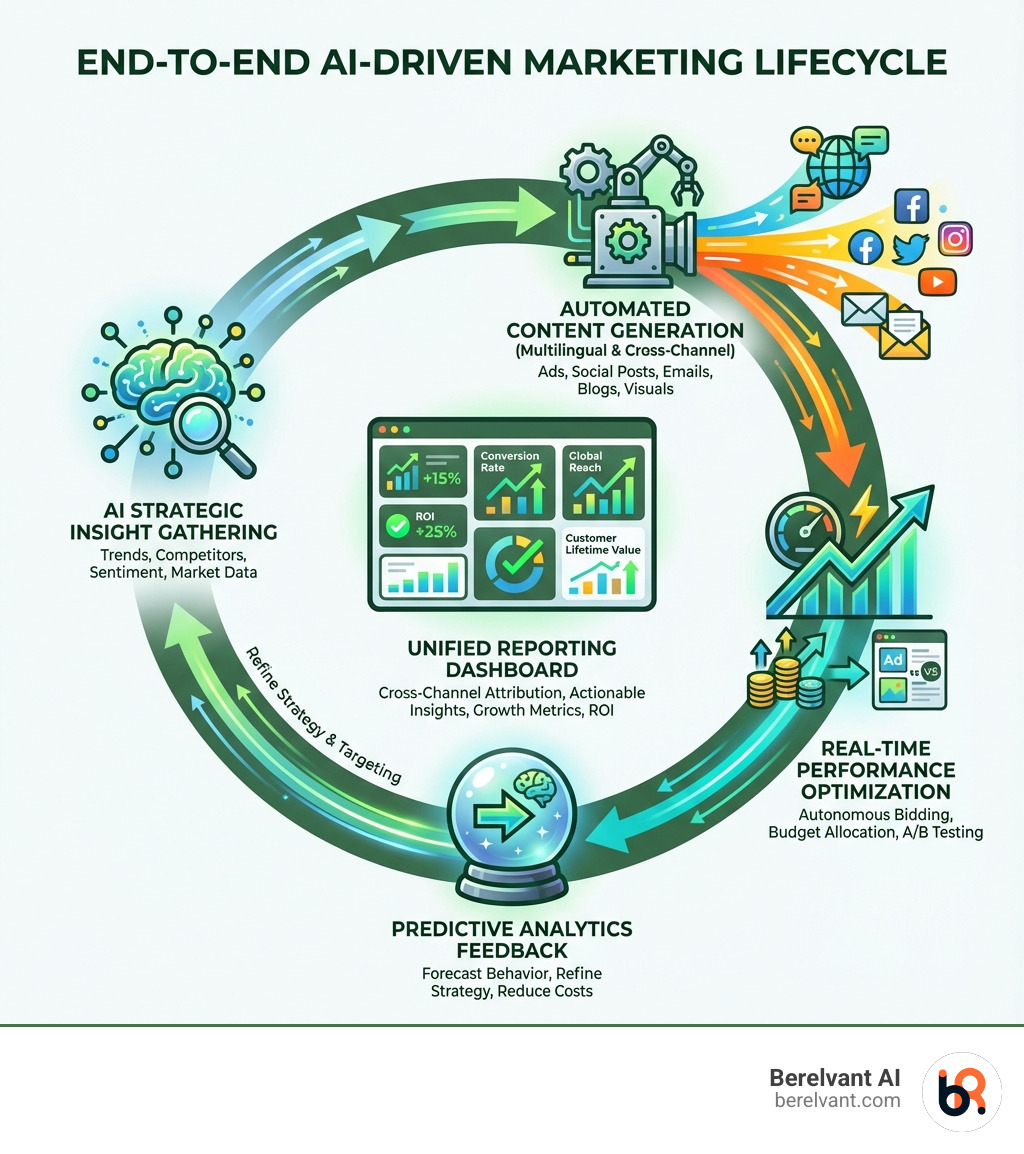
This is where system-level thinking becomes essential. AI marketing tools are most effective when integrated into a unified growth engine—one that connects performance media, creative production, analytics, and multilingual execution into a single automated workflow. For VP and Director-level leaders managing complex operations across the Americas, this means moving beyond experimenting with individual tools and building infrastructure that scales execution without scaling complexity.
I’m Renzo Proano, founder of Berelvant, where I’ve managed over $300 million in digital ad spend and built AI-driven performance marketing systems for brands across financial services, SaaS, GovTech, and e-commerce. Throughout my work with enterprise clients, I’ve designed and deployed ai marketing tools that automate content pipelines, unify attribution, and accelerate multilingual campaign execution across regulated and non-regulated markets.
The Strategic Imperative of AI in Enterprise Marketing Operations
For enterprise-level organizations, the adoption of AI marketing tools isn’t merely about incremental improvements; it’s a strategic imperative for sustained growth and competitive advantage. We leverage AI to drive operational efficiency, accelerate revenue growth, and achieve personalization at a scale previously unimaginable. This is particularly critical for businesses operating across diverse markets in the Americas, where multilingual execution and multicultural audiences demand nuanced, data-driven approaches.
AI transforms marketing operations by streamlining processes and enhancing targeting, leading to unprecedented levels of efficiency. It empowers our teams to make faster, more informed decisions, cutting through the noise to deliver hyper-targeted campaigns that resonate with the right audience at the right time. For instance, in Connecticut, local businesses can use AI to manage their local visibility on Google Maps, ensuring they rank in the top three results, which is crucial for capturing local market share. This isn’t just about saving valuable time; it’s about open uping greater value from existing marketing technologies and ensuring every dollar spent contributes measurably to the bottom line.
From Reactive to Predictive Marketing
The traditional marketing paradigm has often been reactive, responding to market shifts and consumer behavior after they occur. With AI, we shift from reaction to prediction. Predictive analytics, a cornerstone of advanced AI marketing tools, allows us to forecast future events by extrapolating historical data using machine learning and statistical models. This enables us to analyze consumer behavior and market trends, informing campaigns and strategies to stay ahead of the competition.
For enterprise leaders, this translates into AI-powered lead scoring, which helps prioritize potential customers based on their likelihood to convert. By analyzing audience engagement, demographics, and behavior, AI improves lead scoring accuracy, allowing our sales teams to focus on the most promising opportunities. Demand forecasting integrates historical sales data, market trends, and consumer buying patterns to anticipate demand, optimize supply chain operations, and prevent overstocking.
Furthermore, AI provides real-time insights into customer behavior throughout the entire sales process, from initial engagement to final purchase. This instant feedback loop allows us to adjust campaigns, messaging, and recommendations on the fly, capitalizing on opportunities as they arise. This capability is especially vital for businesses in dynamic, compliance-heavy environments where rapid adjustments can mean the difference between success and regulatory adherence.
Achieving Hyper-Personalization Across Markets
Today’s consumers expect interactions that are deeply customized to their individual needs. AI makes this possible at an unprecedented scale, moving beyond basic demographic segmentation to individual-level personalization. Our AI marketing tools excel at analyzing not just easily searchable information like names and purchase histories, but also unstructured data—such as images, videos, and social media posts—to gain profound insights into consumer preferences, brand perception, and shopping trends.
This deep understanding allows us to tailor campaigns by analyzing customer behavior and preferences, delivering highly personalized experiences, from product recommendations to targeted advertisements. For multicultural audiences across the Americas, this means dynamic content optimization and multilingual execution, ensuring that messaging is not only linguistically accurate but also culturally resonant. Imagine healthcare companies using generative AI to develop personalized treatment plans or e-commerce platforms like Amazon leveraging AI to analyze browsing history and demographic information to deliver custom product suggestions. These are not just about efficiency gains; they are about crafting experiences that make customers feel seen and valued, fostering stronger customer relationships and improved brand loyalty.
Core Capabilities of Enterprise-Grade AI Platforms
The heart of effective AI-driven marketing lies in robust, enterprise-grade platforms that unify disparate functions into a cohesive system. These platforms are designed not just to automate tasks but to orchestrate entire marketing workflows, from content creation to performance analysis.
Our approach integrates content automation systems, sophisticated analytics and reporting engines, and centralized campaign optimization capabilities. A critical consideration for us is an LLM-agnostic architecture, which provides the flexibility to leverage the best large language models (LLMs) available (like GPT-4, Claude, Gemini, or Grok) without being locked into a single provider. This architecture, often supported by a Model Context Protocol (MCP), enables seamless integration and superior quality outputs, allowing us to build powerful AI Calling Agent Automation solutions that redefine efficiency.
Automating the Entire Content Lifecycle
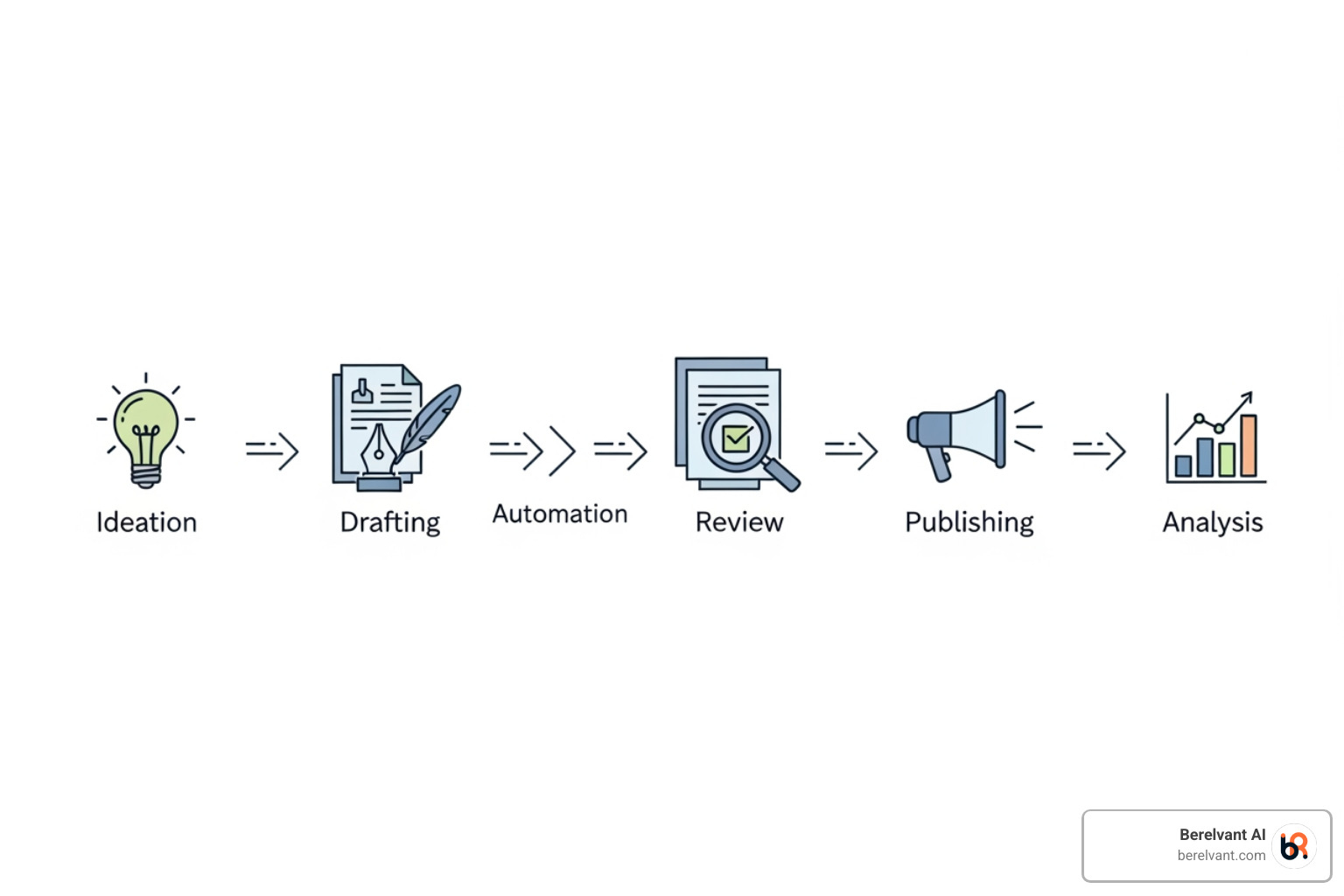
Marketing runs on content. For enterprise teams, the sheer volume and diversity of content required across channels, languages, and cultural contexts can be overwhelming. AI marketing tools are purpose-built for AI content automation, changing how our teams plan, create, and scale content. Platforms like Jasper, for instance, unify brand voice, connect workflows, and automate the entire content lifecycle through intelligent Content Pipelines. We’ve seen clients automate 60% of their SEO content with AI, tripling content production and saving thousands of hours annually.
Generative AI plays a pivotal role here, allowing marketers to input specific instructions and, in seconds, receive AI-generated scripts, articles, product descriptions, images, and even videos custom to brand voice and audience requirements. This accelerates time-to-market for campaigns. To maintain brand voice consistency at scale, platforms incorporate “IQ layers” (like Jasper IQ) that embed brand guidelines, tone, and messaging into every asset, ensuring authenticity and alignment regardless of who creates the content. While AI accelerates creation, a balanced approach is crucial: human oversight and creativity remain indispensable for fine-tuning, ensuring transparency, upholding ethical standards, and engaging with audiences authentically. This ensures that while AI handles the volume, the human touch preserves the unique essence of the brand, especially important for regulated industries where nuance and compliance are paramount.
Open uping Actionable Insights from Complex Data
Data is the lifeblood of modern marketing, but its sheer volume can be paralyzing. Enterprise-grade AI marketing tools are designed to open up actionable insights from complex, cross-channel data, turning raw information into strategic intelligence.

These platforms provide real-time analytics, giving us an instant pulse on campaign performance and customer behavior. Multi-touch attribution (MTA) models, powered by AI, carefully assign credit across the customer journey, helping us understand precisely which channels and touchpoints are truly driving conversions. Tools like Windsor.ai, for example, leverage AI-driven MTA to optimize ad spend by providing granular insights into budget allocation and ad performance across integrated platforms like Google Ads and Facebook.
Beyond performance metrics, AI provides advanced consumer insights by processing and analyzing vast amounts of data, including unstructured data from social media, reviews, and customer service interactions. Platforms like Brandwatch excel in social listening, sentiment analysis, and real-time trend tracking, giving us a clear picture of brand perception and emerging conversations. Similarly, GWI Spark gives marketing teams real-time, data-backed insights to move faster and with greater precision, especially valuable for understanding consumer behavior across global markets. Predictive modeling for market trends allows us to anticipate shifts and adjust strategies proactively, ensuring our campaigns remain relevant and impactful.
A-Z Guide: AI Tool Categories for End-to-End Campaign Execution
Navigating the expansive landscape of AI marketing tools requires a strategic understanding of their diverse capabilities and how they fit into an enterprise marketing stack. For Berelvant, integrating these tools with existing CRMs and data warehouses, ensuring robust API support for custom workflows, and evaluating platforms for scalability and performance are paramount. We’re looking for solutions that improve our end-to-end acquisition systems, especially for multi-country execution across the Americas.
Consumer & Market Intelligence Platforms
Understanding our target audience and the competitive landscape is foundational. AI-powered consumer and market intelligence platforms provide unparalleled depth and speed in gathering these insights:
- AI-powered social listening: Tools like Brandwatch use AI to monitor online conversations, track sentiment, and identify emerging trends in real time. This allows us to adjust messaging, manage brand reputation, and respond strategically to public perception.
- Real-time trend tracking: BuzzSumo, for example, leverages AI to highlight top-performing content and trending topics, enabling us to refine content strategies by identifying what resonates most with audiences.
- Automated competitor intelligence reports: AI can analyze competitor activities, ad strategies, and content performance at scale, providing crucial insights for competitive positioning.
- Advanced audience segmentation: By mining unstructured data, these platforms can uncover nuanced audience segments and preferences, moving beyond broad demographics to highly specific targeting.
How to select the right AI marketing tools for your enterprise stack
Choosing the right AI marketing tool isn’t about adopting the latest tech; it’s about finding the perfect match for your specific business needs and strategic goals. For enterprise leaders, this selection process is rigorous and outcome-driven:
- Defining Strategic Goals: What are your core marketing objectives? Do you need to accelerate content creation, optimize ad spend, improve personalization, or gain deeper customer insights? Your goals will dictate the type of AI tool required. For instance, if you’re in Connecticut and your goal is to automate marketing for your business, specific tools will fit better than others.
- Assessing Complexity vs. Team Skill Sets: Some AI platforms are highly sophisticated, requiring a solid understanding of AI inputs and modeling. Others offer intuitive interfaces with no-code automation. We assess our team’s current capabilities and resources to choose tools that augment, rather than overwhelm, our talent.
- Budgeting for Enterprise-Level Solutions: AI marketing tools come in a wide range of price points. Enterprise-grade solutions often involve significant investment, but they deliver the scalability, security, and integration capabilities required for complex operations.
- Prioritizing Integration Capabilities: A standalone AI tool offers limited value. We prioritize platforms that offer robust API support and integrate seamlessly with our existing CRMs, analytics tools, and marketing automation software to create a unified ecosystem.
- Ensuring Security and Compliance: For regulated industries and compliance-heavy environments, data privacy and security are non-negotiable. We demand AI providers with strong security measures, adherence to regulations like GDPR, and regular updates to maintain evolving standards. This is particularly important for any AI solution used by businesses in Connecticut or across the Americas.
A breakdown of essential AI marketing tools by function
To provide a clearer picture, let’s categorize essential AI marketing tools by their primary function within an enterprise marketing workflow:
-
Content Generation & Optimization Systems:
- Jasper: An AI writing assistant known for generating high-quality copy across various formats (email campaigns, product descriptions, blog posts) in a range of tones and styles. It helps accelerate content creation and maintain SEO page scores.
- Surfer SEO: A content optimization tool that analyzes over 500 on-page ranking factors, providing insights on keywords, readability, and content structure to improve search engine visibility.
- Brandwell (formerly Content at Scale): An AI writing tool that generates long-form content, often passing AI detectors with a high human-written score, suitable for SEO blog posts.
- Lexica Art: An AI image generator capable of creating realistic images for marketing content like blog thumbnails and social media posts, moving beyond standard stock imagery.
- Crayo: A platform for streamlining short-form video creation, helping to ideate, produce, and generate videos for platforms like TikTok, Instagram Reels, and YouTube Shorts.
- LALAL.AI: An audio processing tool that removes background noise from recordings (e.g., podcasts, YouTube videos) without compromising voice quality.
-
Performance Marketing & Advertising Automation:
- The Trade Desk: A leading demand-side platform (DSP) that uses AI to buy and optimize digital advertising across multiple channels, offering AI-driven audience segmentation and predictive insights for maximum ad performance.
- Amazon DSP: A programmatic advertising solution leveraging AI-driven audience targeting, automated campaign optimization, and dynamic creative optimization (DCO) to personalize ad experiences across Amazon’s properties and third-party sites.
- Adzooma: An AI-powered platform designed to manage and optimize ad campaigns across Google, Facebook, and Microsoft Ads from a single dashboard, simplifying operations and improving performance.
- GumGum: Redefines digital advertising with contextual intelligence technology, using AI to analyze sentiment and emotional context on webpages to place ads in brand-safe, relevant environments without relying on cookies.
-
Analytics, Attribution & Reporting Engines:
- Tableau: A visual analytics platform with built-in AI features that transform complex data into actionable insights, making it easier to spot trends and make informed decisions through interactive dashboards.
- Triple Whale: An AI-powered analytics and attribution platform specifically for e-commerce brands, consolidating data from various ad networks and marketing channels into one view to track revenue, customer behavior, and marketing spend.
- Windsor.ai: An advanced AI-powered marketing attribution and data integration platform that uses multi-touch attribution (MTA) to optimize ad spend and refine targeting strategies across channels.
-
Customer Data Platforms (CDPs) & Marketing Automation:
- HubSpot: A powerful CRM that integrates customer data, content marketing, automation, and analytics, with AI features to streamline lead management, outreach, and campaign optimization.
- ActiveCampaign: An AI-driven email marketing platform that automates data-driven decision-making, enabling highly personalized, behavior-based email campaigns at scale.
- Klaviyo: An email marketing platform custom for e-commerce, using AI to transform customer data into targeted, timely campaigns that boost retention and conversions.
- Blueshift: An AI-powered customer data platform (CDP) that unifies customer interactions to enable personalized, multi-channel marketing campaigns across email, SMS, and mobile apps with predictive analytics.
Implementing AI: Governance, Security, and Team Enablement
The successful integration of AI marketing tools into enterprise operations goes beyond selecting the right software; it requires a robust framework for governance, security, and team enablement. This is especially true for our clients in regulated industries and compliance-heavy environments, where data privacy and ethical considerations are paramount.
We understand that enterprise-grade AI marketing platforms must offer foundational security and trust. This includes LLM-optimized architectures that prioritize data protection and privacy, alongside built-in governance and compliance features. Our goal is to ensure that while AI accelerates delivery and multiplies impact, it does so within a secure, transparent, and ethical framework. This proactive approach helps mitigate risks and builds trust with consumers, which is essential for long-term brand equity. For deeper insights into secure AI deployment, explore our Demo AI solutions.
Establishing a Framework for Responsible AI Use
Ethical considerations are at the forefront of our AI strategy. The rapid advancement of AI brings challenges related to data privacy and algorithmic bias, which demand careful navigation.
- Transparency in data collection and usage: Sophisticated AI systems rely on vast amounts of consumer data. We advocate for clear policies that disclose how data is collected, used, and processed, ensuring compliance with regulations like the European Union’s General Data Protection Regulation (GDPR) and similar privacy laws in the Americas. This transparency fosters trust and allows consumers to make informed decisions.
- The role of human oversight and intervention: While AI can automate many tasks, human oversight is non-negotiable. Marketers must review AI-generated content for accuracy and brand alignment, correct mistakes, and ensure outputs meet strategic objectives. AI is a powerful assistant, but it cannot replace human judgment, empathy, or creativity.
- Establishing accountability frameworks: Organizations must develop clear accountability frameworks to ensure that AI-driven marketing campaigns align with ethical standards and brand values. This includes defining who is responsible for AI outputs and their potential impacts.
- Auditing systems for representational bias: AI models trained on biased data can perpetuate or even amplify discrimination. We emphasize the importance of regularly auditing AI systems and ensuring that representative datasets are used during training to prevent algorithmic bias, an ongoing concern that requires constant vigilance.
- Adhering to GDPR and other data protection regulations: Compliance with data protection laws is critical. For businesses operating in Connecticut and across the Americas, understanding and adhering to various regional and national data privacy regulations is essential to avoid legal repercussions and maintain consumer trust.
Building Enterprise AI Expertise and Readiness
The marketing industry is in transition, and building AI expertise is crucial for staying relevant. While AI adoption is accelerating, there remains a significant gap between individual enthusiasm for AI and organizational readiness.
We believe that a marketer’s job won’t be taken by AI, but by a person who knows how to use AI. Therefore, investing in education and training is paramount. Organizations must develop a strategic roadmap for AI implementation, fostering a culture of experimentation and innovation. This includes:
- Understanding the basics: Getting familiar with the core concepts of AI and machine learning.
- Gaining hands-on experience: Experimenting with available tools to understand their capabilities and limitations. Many marketers in Fairfield, CT, are already exploring various AI tools to improve their daily workflows.
- Collaborating with data teams: Learning how to leverage AI tools for content strategy, search engine optimization, and predictive analytics.
- Building a portfolio: Demonstrating AI expertise through practical projects and use cases.
- Reskilling the workforce: Providing opportunities for marketers to master predictive analytics, generative AI, and marketing automation, ensuring increased career longevity.
This proactive approach to building AI expertise ensures that our teams are not just users of technology, but strategic architects of AI-driven growth, ready to tackle the complex challenges of enterprise marketing.
Conclusion
The future of marketing is undeniably integrated and intelligent. AI marketing tools are no longer a luxury but a strategic necessity, serving as the speed and scale layer that accelerates delivery, removes bottlenecks, and multiplies the impact of every campaign. We’ve seen how AI transforms reactive marketing into predictive powerhouse, enables hyper-personalization across diverse markets, and automates the entire content lifecycle from ideation to publication.
For enterprise leaders managing complex operations, the true power of AI lies in its ability to build an end-to-end acquisition system—one that unifies performance media, multilingual creative, automation, and analytics into a single, cohesive engine. This system-level thinking is what drives measurable revenue growth and allows businesses to steer regulated industries, compliance-heavy environments, and multicultural audiences with precision and efficacy.
At Berelvant, we pride ourselves on being an enterprise growth partner, building and managing these unified engines for revenue acceleration across the Americas. We equip our clients with the strategies and tools to not just adapt to the AI-driven marketing landscape, but to lead within it. To explore how we can integrate these advanced AI marketing tools into your strategic framework and build a custom end-to-end acquisition system, we invite you to learn more about our AI Marketing Strategies. The future is here, and it’s intelligent.