
Why Enterprise Workflow Automation Matters Now
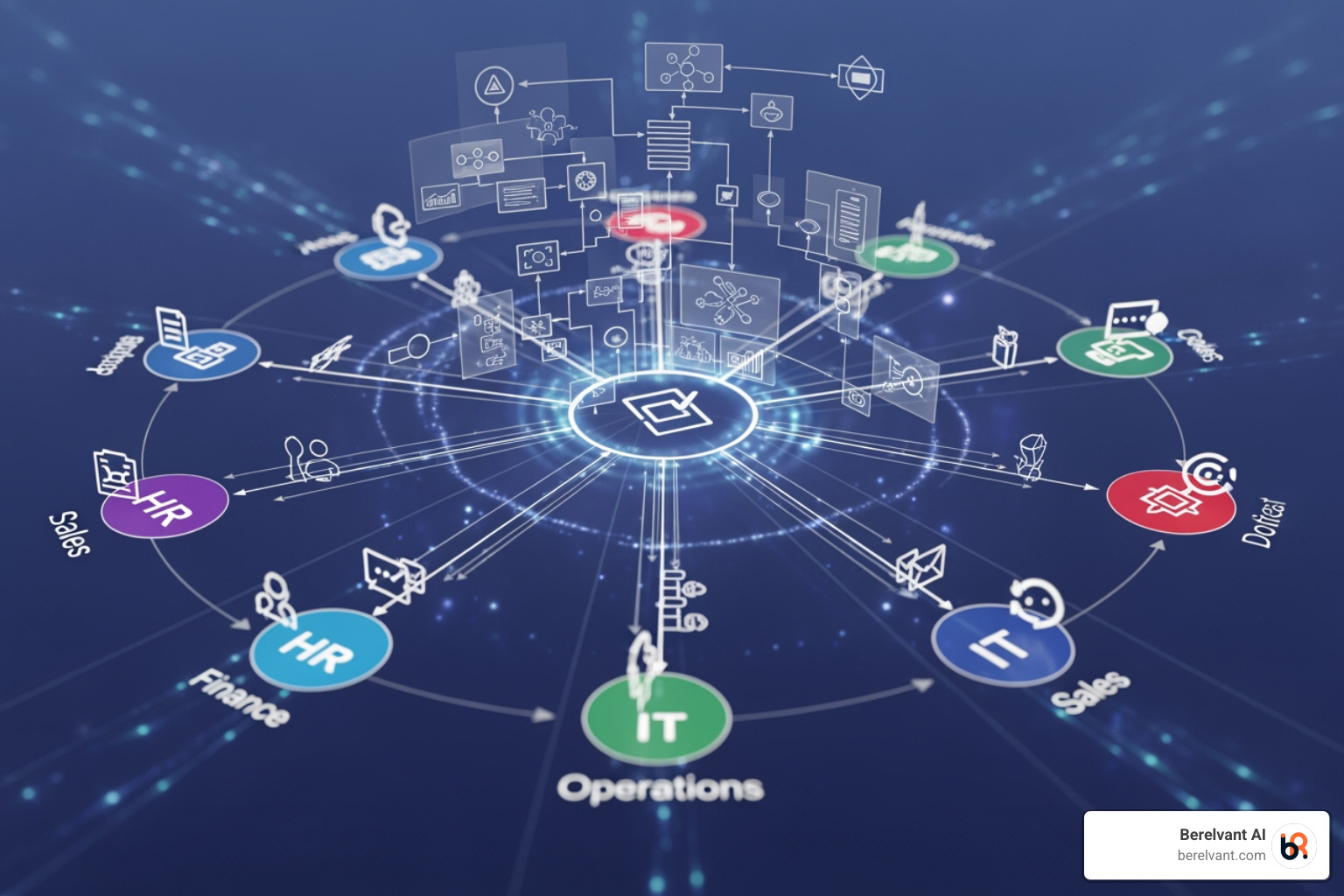
Enterprise workflow automation is the system-level orchestration of complex, cross-functional business processes across multiple departments, systems, and geographies. It moves beyond simple task automation to create an intelligent operating system that connects ERP, CRM, HRIS, and other enterprise platforms into a unified execution layer.
Key Components of Enterprise Workflow Automation:
- System Orchestration – Connects disparate enterprise platforms (ERP, CRM, HRIS, financial systems) for real-time data exchange
- Cross-Functional Process Design – Automates end-to-end workflows spanning sales, legal, finance, operations, and IT
- Intelligent Decision Logic – Uses AI and rules-based engines to route work, make decisions, and adapt to changing conditions
- Compliance and Governance – Maintains audit trails, enforces role-based access, and ensures regulatory adherence (GDPR, HIPAA, SOX)
- Analytics and Monitoring – Provides real-time visibility into process performance, bottlenecks, and ROI metrics
Knowledge workers spend up to 60% of their day on routine tasks that could be automated. For enterprise organizations managing multiple regions, complex approval chains, and regulatory requirements, this inefficiency compounds into millions in lost productivity. Manual handoffs between departments create delays. Inconsistent processes create compliance risk. Siloed systems create data gaps that slow decision-making.
The strategic value of enterprise workflow automation is not just efficiency. It’s operational predictability at scale. When you automate customer onboarding across sales, legal, finance, and operations, you don’t just save time—you create a repeatable system that scales without adding headcount. When you orchestrate compliance reporting across jurisdictions, you reduce risk and accelerate audits. When you connect marketing automation to CRM to billing systems, you create a closed-loop attribution model that shows true revenue impact.
This is not about replacing spreadsheets with software. It’s about building a growth engine that executes faster than your competition, adapts to market changes without rebuilding infrastructure, and gives leadership real-time visibility into what’s working.
I’m Renzo Proano, and I’ve spent my career building performance marketing systems and AI-driven automation for enterprise brands across financial services, SaaS, and GovTech. I design enterprise workflow automation systems that connect marketing, sales, and operations into one measurable engine—reducing acquisition costs, accelerating time-to-revenue, and giving teams the infrastructure to scale without operational chaos.
Beyond Task Automation: Defining the Enterprise-Scale Operating System
When we talk about enterprise workflow automation, we’re not just swapping out manual steps for a digital button. We’re talking about a fundamental shift in how an organization operates—a strategic capability for orchestrating complex, end-to-end processes across disparate systems, departments, and geographies. It’s about building a cohesive operating system that drives business outcomes, not just individual tasks.
The Strategic Difference: Workflow Orchestration vs. Task Automation
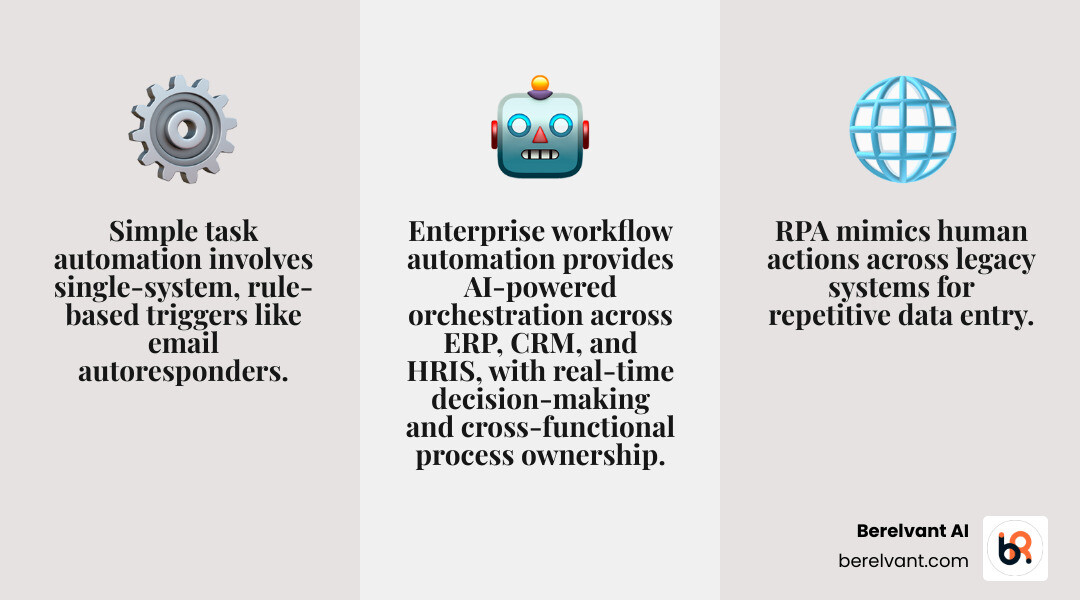
It’s easy to confuse simple task automation or Robotic Process Automation (RPA) with the expansive capabilities of enterprise workflow automation. Let’s clarify:
- Simple Task Automation: This is about automating a single, repetitive action within one system. Think of an email auto-responder or a basic data entry script. It’s helpful, but it lacks broader organizational impact.
- Robotic Process Automation (RPA): RPA tools are designed to mimic human actions when interacting with digital systems. Imagine a software robot that logs into an application, copies data from one field, and pastes it into another. RPA is excellent for automating highly repetitive, rules-based tasks, especially in legacy systems. However, RPA bots often operate in isolation, lacking a deep understanding of the broader business process or the ability to adapt to dynamic conditions. They’re like digital hands, but not a digital brain.
- Enterprise Workflow Automation (EWA): This is where the game changes. EWA integrates systems like ERP, HRIS, CRM, and ITSM to support cross-functional processes. It’s about streamlining, optimizing, and accelerating complex business processes by reducing manual effort, eliminating bottlenecks, and enhancing consistency and transparency across the entire enterprise. We’re talking about end-to-end process ownership, moving beyond isolated tasks to connect the dots across an entire business function. EWA leverages Business Process Management (BPM) principles to design, model, execute, and monitor these complex flows, often incorporating dynamic decision-making rather than just static, rules-based logic. It’s the difference between automating a single step and orchestrating an entire journey.
Core Benefits for the Modern Enterprise
Implementing enterprise workflow automation is a strategic investment that yields substantial returns, particularly for organizations operating in complex, compliance-heavy environments like those we serve in Connecticut. The benefits are far-reaching:
- Improved Cross-Functional Efficiency: By connecting previously siloed departments and systems, EWA eliminates manual handoffs and accelerates processes. This means faster customer onboarding, quicker financial approvals, and more agile project management.
- Scalability for Growth: As your business expands, manual processes become bottlenecks. EWA creates repeatable, scalable systems that can handle increased volumes of tasks, users, and data without compromising performance or requiring a disproportionate increase in headcount.
- Reduced Operational Costs: By automating repetitive tasks, we significantly reduce the need for manual intervention, cutting labor costs and reallocating human capital to higher-value, strategic work.
- Simplified Regulatory Compliance: In regulated industries, maintaining audit trails and adhering to strict guidelines is paramount. Automated workflows provide visible audit trails, capturing critical timestamps (e.g., when a file was accessed, shared, or modified), ensuring consistency, and simplifying compliance reporting for regulations like GDPR and HIPAA. This is a game-changer for our clients in Fairfield, CT.
- Improved Decision-Making: EWA platforms generate rich data on process performance, bottlenecks, and efficiency. This data provides smarter insights, enabling leaders to make informed, data-driven decisions that optimize operations and strategy.
- Accelerated Time-to-Market: From product development to campaign launches, faster internal processes translate directly to quicker delivery of value to customers.
- Improved Customer and Employee Experience: Customers benefit from faster service, consistent interactions, and real-time updates. Employees are freed from tedious, routine tasks, leading to higher job satisfaction and allowing them to focus on more engaging, strategic work. As research from McKinsey found, knowledge workers can spend as much as 60% of their day on routine tasks that could be automated. Imagine the boost in morale and productivity when that burden is lifted!
Architecting the Automation Stack: Core Components and Selection Criteria
Building an effective enterprise workflow automation system isn’t about picking a single tool; it’s about architecting a robust, scalable, and secure technology stack. For VP and Director-level leaders, understanding these core components and selection criteria is crucial for building a resilient system that supports long-term growth.
Key Components of an enterprise workflow automation platform
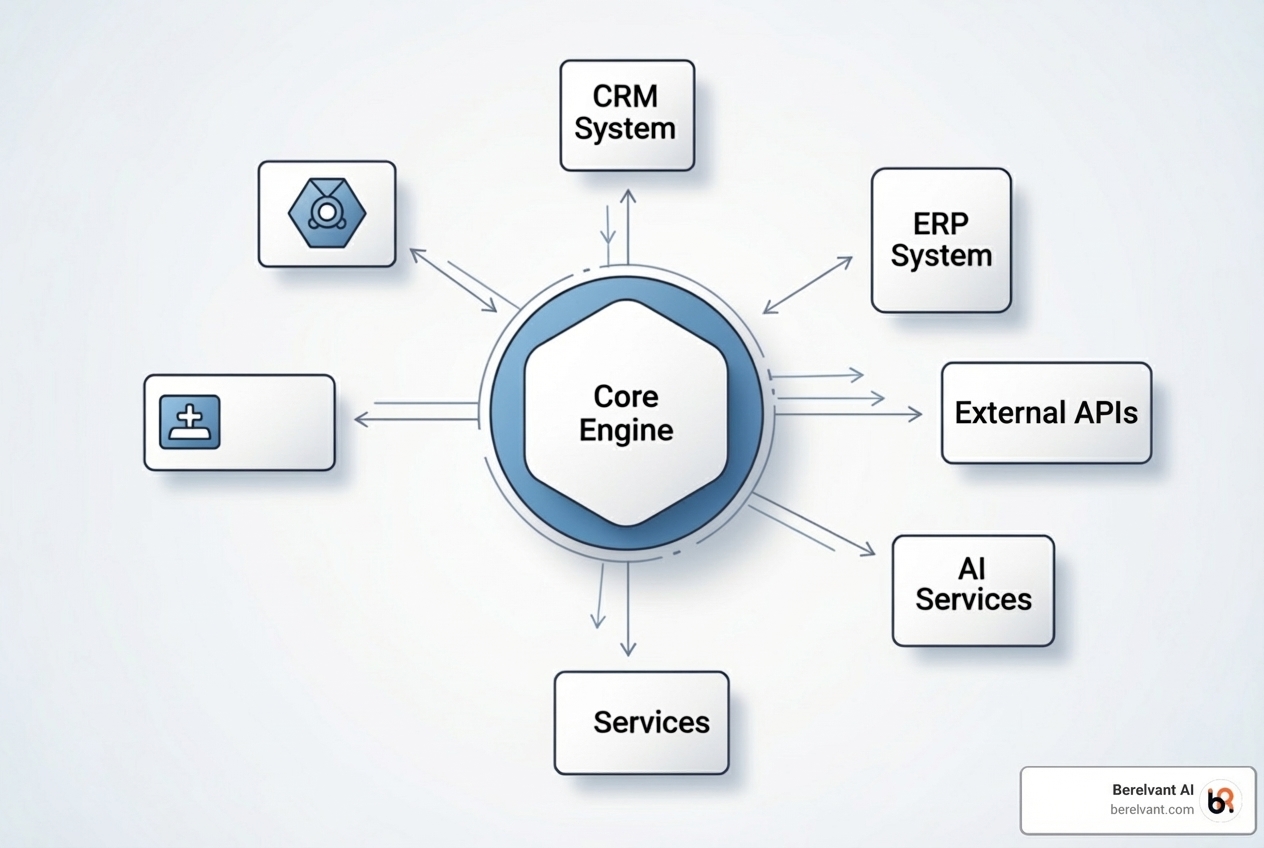
A powerful EWA platform acts as the central nervous system for your operations. Here are the essential components we look for:
- Workflow Designer: This is your blueprint tool. It should offer intuitive, visual modeling capabilities, often leveraging standards like Business Process Model and Notation (BPMN) or Decision Model and Notation (DMN). This allows technical and non-technical stakeholders to collaborate effectively on process design.
- Integration Capabilities: The heart of enterprise automation lies in connecting disparate systems. Look for an API-first architecture, robust APIs, and a comprehensive library of pre-built connectors to popular enterprise applications (e.g., ERP, CRM, HRIS, marketing platforms).
- Monitoring and Analytics Dashboards: You can’t improve what you don’t measure. The platform must provide real-time visibility into process performance, identify bottlenecks, track key performance indicators (KPIs), and offer audit trails for every automated step.
- Low-code/No-code Interfaces: To empower business users and accelerate development, effective EWA platforms often feature low-code or no-code tools. These allow non-developers to design and implement workflows, reducing reliance on IT and increasing agility.
- Administration and Governance Controls: For enterprise-scale deployment, granular control over user roles, permissions, workflow versions, and system access is non-negotiable.
Critical Considerations for Your Technology Stack
When evaluating solutions, we emphasize architectural considerations to ensure the platform integrates seamlessly with your existing creative infrastructure and supports cross-market operations.
- Integration Architecture: An API-first design is paramount. This ensures that the platform can communicate effectively with your existing systems and any future additions. Look for robust APIs that allow for deep, bidirectional integration.
- Pre-built Connectors: While custom integrations are sometimes necessary, a rich library of pre-built connectors to common enterprise applications can significantly accelerate deployment and reduce development costs.
- Custom Integration Development: For unique or legacy systems, the platform should offer flexible options for custom integrations, allowing us to build upon existing capabilities and incorporate specific services and tools.
- Real-time Data Synchronization: To avoid data silos and ensure consistent decision-making, the platform must facilitate real-time data exchange across all connected systems. This is critical for accurate reporting and responsive operations.
- Avoiding Data Silos: A fragmented data landscape leads to inefficiencies and errors. Your EWA solution should act as a unifying layer, ensuring data flows freely and securely across your entire tech stack.
For more insights into how intelligent systems can boost your marketing efforts, explore our approach to AI Marketing Strategies.
Security, Compliance, and Governance
In compliance-heavy industries, particularly those we serve in Westport, CT, security and governance are non-negotiable. Your chosen EWA platform must meet stringent requirements:
- Data Encryption: Ensure all data, both in transit and at rest, is secured with strong encryption protocols (e.g., AES-256 for data at rest, TLS for data in transit).
- Role-Based Access Control (RBAC): Granular control over who can access, modify, or approve workflows is essential. RBAC ensures that users only have access to the information and functions necessary for their role.
- Single Sign-On (SSO): Streamline user authentication and improve security by integrating with enterprise SSO solutions.
- Audit Trails: Comprehensive, immutable audit trails are critical for compliance. Every action, decision, and data change within an automated workflow must be logged and easily retrievable.
- Compliance with Regulations: The platform must meet relevant industry standards and regulatory requirements such as GDPR and HIPAA. For our clients, this is often a make-or-break criterion.
- Change Management Protocols: Robust version control and change management processes are needed to track modifications to workflows and ensure that changes are properly tested and approved before deployment.
The Build vs. Buy vs. Hybrid Decision
A common strategic question for enterprise leaders is whether to build a custom solution, buy an off-the-shelf platform, or adopt a hybrid approach. Each path has distinct implications for cost, speed, flexibility, and maintenance.
| Feature | Custom-Built Solutions | Off-the-Shelf Platforms |
|---|---|---|
| Initial Cost | High (development, infrastructure, expertise) | Lower (subscription fees, implementation services) |
| Deployment Speed | Slow (long development cycles) | Fast (quick setup, ready-to-use features) |
| Flexibility | Unlimited (custom to exact needs) | Limited (vendor-defined features, configurable options) |
| Maintenance | High (internal team or dedicated vendor) | Lower (vendor handles updates, bug fixes, security) |
| Scalability | High (if designed well, but requires ongoing development) | High (vendor-managed infrastructure) |
| Innovation | Driven by internal R&D | Driven by vendor R&D and community |
| Risk | High (development failure, technical debt) | Lower (proven solutions, vendor support) |
Custom-built solutions offer unparalleled control and can be perfectly custom to highly specific, complex workflows. However, they demand significant upfront investment, specialized development resources, and ongoing maintenance overhead. This is often a path for organizations with extremely unique operational requirements and deep technical teams.
Off-the-shelf platforms, including Integration Platform as a Service (iPaaS) solutions, offer quicker deployment and benefit from vendor-managed maintenance and updates. They are designed for broader applicability but may offer limited customization, potentially requiring businesses to adapt their processes to the software.
A hybrid approach often strikes the right balance, leveraging powerful off-the-shelf platforms for core automation while building custom integrations or extensions for unique business logic. This allows for faster time-to-value while retaining the flexibility to address specific enterprise needs. We often recommend this approach to our clients, ensuring they get the best of both worlds without unnecessary complexity.
The Intelligence Layer: How Agentic AI Transforms Enterprise Workflows
The evolution of enterprise workflow automation is inextricably linked to advancements in Artificial Intelligence. We’re moving beyond simple automation to an intelligence layer that transforms how workflows operate, making them smarter, more adaptive, and increasingly autonomous. This is particularly true with the emergence of agentic AI, which represents a paradigm shift from static, rules-based processes to dynamic, intelligent systems.
Moving from Automation to Autonomy with AI
Traditional automation relies on explicit rules: “If X happens, then do Y.” AI introduces a new dimension, allowing workflows to:
- Understand Context: AI, particularly through Natural Language Processing (NLP), can interpret unstructured data—emails, documents, customer inquiries—to understand the intent and context of a request. This means an automated system can discern why a customer is contacting support, not just that they did.
- Leverage Machine Learning for Predictive Routing: Instead of rigid rules, machine learning algorithms can analyze historical data to predict the best path for a workflow. For example, it can predict which agent is best suited for a customer query or which approval step is most likely to cause a bottleneck, then proactively reroute or flag it.
- Process Unstructured Data: Unlike traditional automation limited to structured data fields, AI can extract meaning from images, videos, voice recordings, and free-text documents. This open ups automation opportunities in areas previously deemed too complex for machines, such as automatically categorizing incoming documents or summarizing meeting notes.
This shift empowers our clients in Connecticut to execute more sophisticated multilingual creative and cross-market operations. To see how these intelligent systems are applied in practice, explore our insights on AI Campaign Management.
The Rise of Agentic AI in enterprise workflow automation
The most exciting development is agentic AI. This isn’t just AI making predictions; it’s AI taking initiative. An agentic AI system doesn’t just follow instructions; it has a goal, understands its environment, plans a series of actions, executes them, and adapts if conditions change. It can reason through complex processes and take autonomous action.
- Defining Agentic AI: Agentic AI systems are designed to achieve specific goals autonomously. They perceive their environment, process information, make decisions, and execute actions without constant human oversight. Think of it as moving from a digital assistant to a digital colleague.
- Autonomous Goal Achievement: An agentic AI doesn’t just complete a task; it strives to achieve an objective. If an initial action fails, it can devise and attempt alternative solutions.
- Reasoning and Planning Capabilities: These systems can break down complex problems into smaller steps, anticipate outcomes, and plan a sequence of actions, often interacting with multiple systems simultaneously.
- Interacting with Multiple Systems: Agentic AI can seamlessly steer and interact with various enterprise applications, pulling data, initiating actions, and updating records across your tech stack.
- Human-in-the-Loop Collaboration: While autonomous, agentic AI often incorporates “human-in-the-loop” checkpoints, allowing human oversight for critical decisions or complex exceptions, ensuring control and compliance.
Use Case: Autonomous Campaign Optimization
For a marketing team managing campaigns across the Americas, an agentic AI could monitor campaign performance in real-time, identify underperforming segments, autonomously adjust bidding strategies or creative elements, and even generate new ad copy based on performance data—all while adhering to brand guidelines and budget constraints. This is AI as a speed and scale layer, accelerating delivery and multiplying the impact of every campaign.
Responsible AI and Model Governance
As we integrate more powerful AI into our enterprise workflow automation systems, responsible AI practices and robust model governance become paramount. This is especially true for our clients in regulated industries.
- Explainability and Transparency: We need to understand why an AI made a particular decision. Explainable AI (XAI) ensures that the logic behind AI-driven actions is transparent and auditable, which is crucial for compliance and building trust.
- Data Validation and Quality: The quality of AI output is directly tied to the quality of its input. Rigorous data validation and continuous monitoring of data sources are essential to prevent biased or erroneous decisions.
- Bias Detection and Mitigation: AI models can inadvertently perpetuate or amplify biases present in training data. Proactive measures for bias detection and mitigation are necessary to ensure fair and equitable outcomes.
- Model Performance Monitoring: AI models are not “set and forget.” Continuous monitoring of model performance helps identify drift, degradation, or unexpected behavior, allowing for timely retraining and updates.
- Security for AI Models: Protecting AI models from adversarial attacks, data poisoning, and unauthorized access is critical. This involves securing the training data, the models themselves, and the inference endpoints.
From Blueprint to Reality: Implementation, Governance, and ROI
The strategic value of enterprise workflow automation is clear, but changing this blueprint into reality requires a structured approach. For enterprise leaders, this means moving beyond theoretical benefits to a practical framework for deployment, robust governance, and clear measurement of tangible business impact.
A Phased Implementation Framework
We advocate for a phased implementation strategy that minimizes disruption while maximizing learning and buy-in.
- Process Findy and Mapping: The first step is to thoroughly understand your existing business processes. This involves reviewing current workflows, identifying repetitive, time-consuming, and error-prone tasks, and mapping them visually. Engaging stakeholders from across the organization is crucial here.
- Setting SMART Objectives: Define clear, Specific, Measurable, Achievable, Relevant, and Time-bound (SMART) goals for your automation initiatives. Are you aiming to reduce costs, improve accuracy, accelerate sales cycles, or improve customer satisfaction? Clear objectives guide tool selection and ROI measurement.
- Pilot Project Selection: Start small. Select a high-impact, low-complexity process for an initial pilot project. This allows your team to test the chosen tools, identify challenges, refine the process, and demonstrate early success without risking large-scale disruption.
- Phased Enterprise Rollout: Based on the success and learnings from the pilot, roll out automation to other departments or processes in a phased manner. This allows for continuous adaptation and ensures broader organizational readiness.
- Establishing a Center of Excellence (CoE): For sustained success, consider establishing a CoE for automation. This dedicated team provides expertise, sets standards, manages governance, and fosters a culture of automation across the enterprise.
- Training and Change Management: Technology adoption is as much about people as it is about platforms. Provide comprehensive training to employees on new tools and processes. Crucially, manage the change process effectively, communicating the benefits, addressing concerns, and ensuring continuous support.
Best Practices for a Successful enterprise workflow automation Initiative
Successful enterprise workflow automation initiatives don’t happen by accident. They are the result of deliberate planning and adherence to best practices:
- Start with High-Impact, Low-Complexity Processes: This builds momentum and demonstrates value quickly, making it easier to gain executive support for larger initiatives.
- Involve Business Stakeholders Early and Often: Those who perform the work often have the best insights into how to improve it. Their buy-in and feedback are invaluable from design to deployment.
- Document Everything: Clear and comprehensive documentation of workflows, rules, and integrations is essential for maintenance, troubleshooting, and future scalability.
- Design for Scalability and Failure: Ensure your automation architecture can grow with your business and has built-in mechanisms to handle exceptions or system failures gracefully.
- Foster a Culture of Continuous Improvement: Automation is not a one-time project. Regularly monitor performance, gather feedback, and iterate on your workflows to adapt to changing business needs and technological advancements.
By following these best practices, we help our clients build end-to-end acquisition systems that are not only efficient but also resilient and adaptable.
Measuring True Enterprise ROI
Measuring the Return on Investment (ROI) of enterprise workflow automation goes far beyond simply calculating hours saved. While time savings are a significant benefit, the true enterprise ROI encompasses a broader range of strategic advantages:
- Calculating Reduced Cost of Compliance: For regulated industries, automation significantly reduces the risk of non-compliance, which can result in substantial fines. Quantifying this avoided cost is a key part of ROI.
- Measuring Increased Revenue Velocity: Faster sales cycles, quicker customer onboarding, and accelerated product launches all contribute to getting revenue in the door faster. This improved cash flow and time-to-revenue can be directly measured.
- Faster Sales Cycles: By automating lead qualification, quote generation, and contract approvals, businesses can significantly shorten their sales cycle, leading to more closed deals and increased revenue.
- Reduced Error Rates and Rework Costs: Automated processes are inherently more consistent and less prone to human error. This leads to fewer mistakes, reduced rework, and improved data quality, all of which translate into tangible cost savings.
- Improved Customer Lifetime Value (CLV): Improved customer experience through faster service and consistent interactions can lead to higher customer satisfaction, increased loyalty, and ultimately, a higher CLV.
By focusing on these comprehensive metrics, we provide our clients with a clear, measurable understanding of the impact of their enterprise workflow automation initiatives, demonstrating true revenue growth and operational predictability. Many organizations achieve significant automation ROI metrics within the first year of adoption, with dramatic increases as automation scales across departments.
Conclusion: Building Your Future-Proof Growth Engine
Enterprise workflow automation is not just an IT project; it’s a fundamental redesign of your company’s operating system. It’s about building a strategic capability that transforms how your business operates, making it more efficient, compliant, and adaptable to the ever-changing market landscape. By integrating intelligent automation, robust governance, and a strategic implementation plan, you can build a resilient, efficient, and scalable engine for growth.
We understand that navigating the complexities of multi-country execution, multilingual creative, and compliance-heavy environments requires a partner with deep expertise. The right partner can accelerate this change, turning complex operational challenges into a distinct competitive advantage. At Berelvant, we help enterprises architect and manage these end-to-end systems to drive measurable revenue growth across the Americas. We leverage AI as the speed and scale layer that accelerates delivery, removes bottlenecks, and multiplies the impact of every campaign for our clients in Connecticut.
Ready to build your blueprint for efficiency and transform your operational challenges into a powerful growth engine? Explore our approach to AI Marketing Strategies.